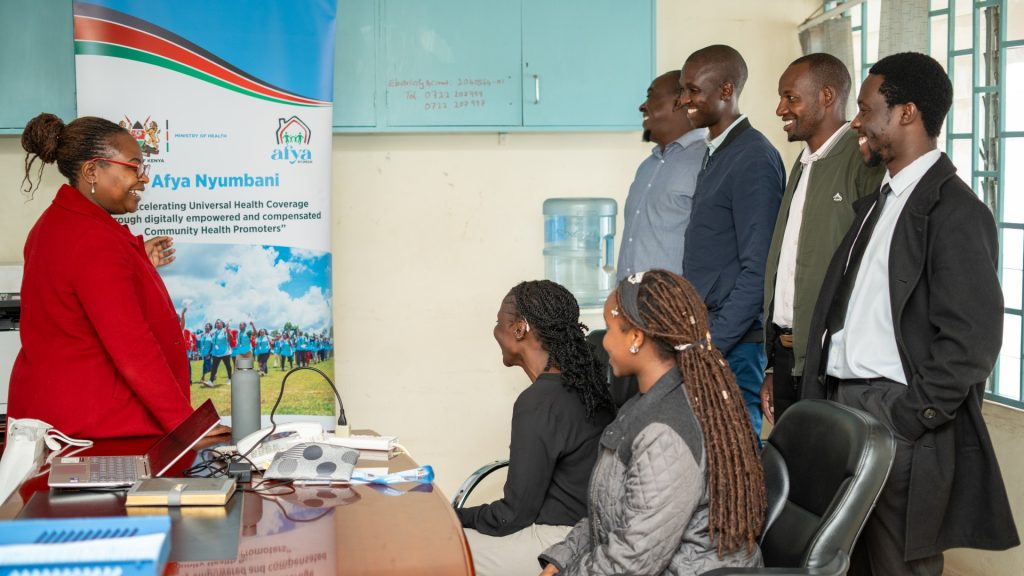
Dr. Maureen Kimani was part of the 2018 cohort of the International Program in Public Health Leadership (IPPHL). At that time she was working as a program manager overseeing care and treatment services for HIV programs in Kenya. In March 2020, she transitioned into her current role as Head of the Division of Community Health Services, Ministry of Health, Kenya – a timely transition to support the escalation of community health services and home-based care during the COVID-19 pandemic. Dr. Maureen cites the learning from IPPHL as instrumental in transforming community health service delivery in Kenya through the launch and national scale up of an integrated electronic health information system for community health. She approached this task by “pulling up her notes” from her time in the IPPHL and mobilizing her team, turning a challenging period into a defining moment in her career.
Her training from IPPHL in stakeholder analysis and theory of change frameworks stood out as key tools that she applied to get the initiative started. Leveraging a community health network of about 50 partners and following the appropriate steps for introducing the initiative, she obtained partner alignment. This platform facilitated coordination across multiple organizations and stirred the engagement of policymakers, enabling budget commitments exceeding 10 billion Kenyan shillings ($77M USD) to support the initiative. At the community level, effective communication was particularly useful even as she and her team seized the window of opportunity already provided by the vulnerability of the community amidst the pandemic.
Building on these, Dr. Maureen led the digitization of community health services to both simplify and enhance the efficacy of these services. This intervention eliminated the use of as many as 20 different apps by community health workers (CHWs) in addition to paper note entries, with the development of an electronic Community Health Information System (eCHIS). The eCHIS serves as an integrated digital app which interfaces with government health information systems to provide centralized reporting with real-time updates. In a pilot study of the app in Kisumu County, the app was readily embraced by CHWs who provided peer-to-peer support, developing ownership and buy-in across the community. Use of the digital app has since been scaled to all 47 counties in the country with over 100,000 CHWs trained to use the app. To date, about 8 million households have been registered with visits conducted in about 7.3 million of them. Over 7 million children have been screened for common childhood diseases like malaria, pneumonia, malnutrition and over 18 million adults have been screened for conditions like hypertension with data and reporting captured in the centralized electronic records system.
The experience was not without challenges. Dr. Maureen and team pressed through promoting digital literacy, community awareness and responding to stakeholder pushbacks, applying negotiation and problem-solving skills gained through the IPPHL.
Dr. Maureen emphasizes the impact of her training at IPPHL at every stage of this journey. Her ability to lead effectively, navigating through a season of global crisis to build a community health reporting platform which has been the standard for community health practices across Kenya.