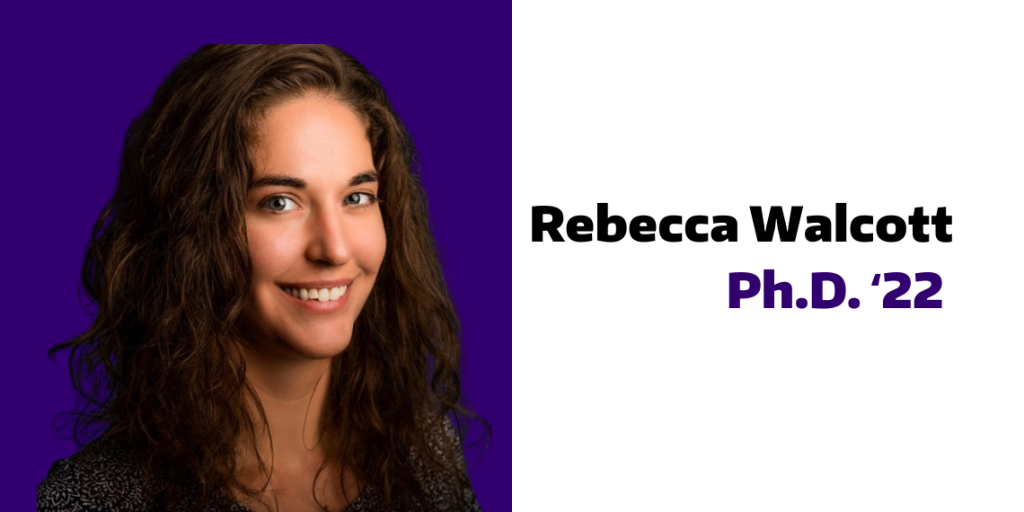
Becka Walcott finished her Ph.D. at the Evans School in December 2022, with dissertation work focused on mobile money and financial inclusion tools in sub-Saharan Africa. The Evans School spoke early in the new year with Becka about her dissertation project.
Your project examined innovative mobile money tools. What is mobile money and why are these critical finance tools for households in sub-Saharan Africa?
Mobile money refers to financial transactions that take place over SMS networks on mobile phones. SMS is just regular texting – so users don’t need a smartphone or Wi-Fi connection. Plus, mobile money is usually administered through a telecoms company with agents in village bodegas, which means people don’t need to access formal banks to use it. Thus, mobile money is broadly accessible to populations without internet infrastructure or brick and mortar banks.
You find that earned interest can encourage households to use their mobile wallets to store money. You also find increases in mobile savings do not reduce conventional bank account use. Tell us more about the original insights of this study.
Mobile money regulations vary across countries, and Tanzania was the first country to require mobile money providers to distribute interest to mobile wallet accounts. The banks were worried that the ability to earn mobile wallet interest would cause people to pull their money out of formal savings accounts – or act as a disincentive from opening such accounts. My study was the first to examine the effects of providing mobile interest – and I was able to demonstrate that interest can encourage mobile savings without harming the banking sector. Hopefully this evidence can mitigate the concerns of the banking sector and also encourage other countries to offer more mobile financial tools.
Another study in your dissertation examined preferences for digital repayment among microfinance borrowers in Uganda. Here you use a mixed methods research design to understand why individuals would opt for digital repayment. Why was it valuable to have both quantitative and qualitative evidence in this instance?
The quantitative data could tell us a borrower’s repayment preference at the time the question was asked, plus some important contextual data – but we needed the qualitative data to learn about how each borrower was framing the repayment options. Some were updating their preferences with new information, some were not receiving that new information, and some were influenced by other borrowers. The qualitative data revealed these important nuances that contributed to repayment preference.
You also examine how countries adopt policies governing identity verification across mobile money tools. What did you learn about when countries enact identity verification regulation?
I learned that policy diffusion from regional neighbors likely plays a large role in adoption timing for these policies. I was surprised that I didn’t find more support for hypotheses around domestic factors and policy adoption, and I think there is room for a deeper examination of the way the domestic political economy can influence the diffusion of mobile money regulations.
What’s up next?
I just started my new job as an economist at the American Institutes for Research, primarily working on international development projects. I’m super excited for this new chapter!