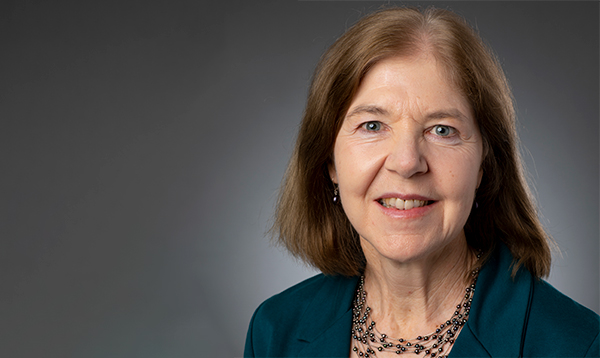
Professor Alison Cullen’s love for nature started early—her first-grade teacher was an avid bird watcher and sparked Cullen’s passion for the environment. She may not have envisioned it at that time, but Cullen, a first generation American, would go on to be a first generation college student, followed by graduate school and a field-leading academic career in environmental policy.
A Formative Early Career
Drawn to quantitative subjects, Cullen began her higher education journey studying civil engineering at MIT, fascinated by large-scale public works projects involving transit, energy, and land use. After graduating, she began her career at the Environmental Protection Agency (EPA) as a civil engineer. “It was bracing as a young person to learn how government works by being inside the government,” she recalls. That experience sparked her interest in how to create change within public systems.
Cullen went on to work in civil engineering consulting during a time when many of the environmental statutes from the 1960s and 70s were gaining traction. It was during this period that she realized she wanted to do more than just contribute to projects—she wanted to lead them, manage people, and forge solutions. This realization led her back to graduate school.
She earned her Master of Science from Harvard University in Environmental Health Science, and her passion for the field led her to complete a doctoral degree. She eventually joined the faculty at Harvard’s School of Public Health. But the Pacific Northwest’s beauty—and her then-beau, now husband, Chris Bretherton—drew her westward to the University of Washington.
Joining the Evans School
It was a stroke of good fortune that brought Cullen to the Evans School. While seeking a faculty position at UW her colleagues in the School of Public Health connected Cullen with Margo Gordon, the Dean of the Evans School (then the Graduate School of Public Affairs), and she was invited to interview for an assistant professor opening. Cullen remembers, “I gave a job talk that was full of quantitative information about environmental health. They asked, ‘Who would use this information and how?’ I shared my vision for how these tools could shape public policy.” Dean Gordon offered her a position, launching a 30-year career at the Evans School marked by transformative research and mentorship. She’s published more than 75 scholarly works related to the analysis of decision making about risks to human health and the environment including her recent scholarship on managing wildfire risk.
A consistent highlight of Cullen’s tenure has been working alongside incredible students, staff, and faculty colleagues at the Evans School. “No one can accomplish anything alone,” she reflects. “We didn’t always agree on the path forward, but through all the twists and turns we always found ways to work together.” She’s especially proud of her work on pressing issues like agricultural development with EPAR, environmental health and policy with colleagues across campus and around the world, and most recently wildfire risk and mitigation.
Cullen served as Interim Dean of the Evans School from 2019-2021, holding the school steady through the shift to remote learning during the pandemic and the renovation of Parrington Hall. Cullen shares, “working on the remodel was a massive highlight—it was a huge undertaking, but it’s incredibly rewarding every time I walk into this building.” She remembers fondly working with close supporters of the school like Dan and Nancy Evans and the Remaks during that time.