Long before Zach Hall, MPA ’24, stepped onto the floor of the Washington State House of Representatives, he learned a key lesson of elected office at the local level: asking good questions matters.
Evans Expertise: Public Leadership, Management, and Decision-Making
Finding Purpose Across Borders: Xinying Zeng, MPA ’16
Long before Zach Hall, MPA ’24, stepped onto the floor of the Washington State House of Representatives, he learned a key lesson of elected office at the local level: asking good questions matters.
Look for the Helpers: Kate Sykes, MPA ’17
Long before Zach Hall, MPA ’24, stepped onto the floor of the Washington State House of Representatives, he learned a key lesson of elected office at the local level: asking good questions matters.
From City Hall to the State House: Zach Hall, MPA ’24
Long before Zach Hall, MPA ’24, stepped onto the floor of the Washington State House of Representatives, he learned a key lesson of elected office at the local level: asking good questions matters.
Building a Public Service Swiss Army Knife: Roy Plaeger-Brocker, MPA ’86
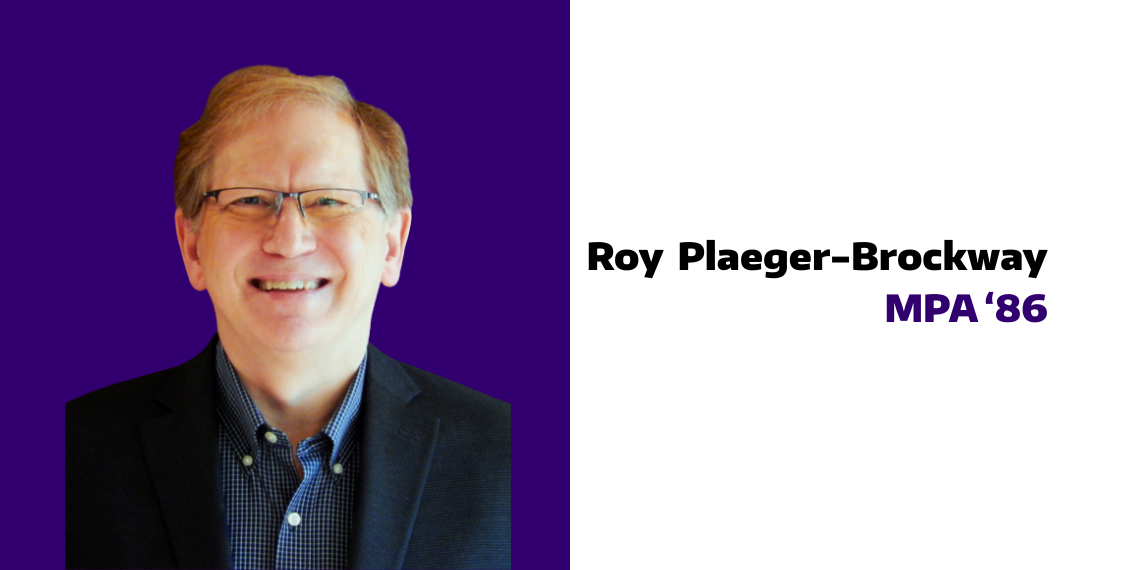
How Roy Plaeger-Brockway built a career improving health care systems through his Evans School education
When Roy Plaeger-Brockway, MPA ‘86, arrived at the Evans School, he had no idea that his degree would become the foundation for a career shaping health policy and improving the lives of Washington residents. But he knew “I wanted to make government work better.” At Evans, he found both the mindset and the tools that would guide him through decades of public service.
Roy often describes his MPA as building a professional Swiss Army Knife. Each course became a go-to tool in his toolkit, including policy analysis, quantitative analysis, statistics, project planning, public health services, and organizational behavior. That toolkit was put to the test during his Governor’s Executive Internship. Paired with a senior health economist addressing rising health care costs, Roy analyzed problems, wrote decision papers, and helped launch early process improvements. The work also connected directly to ideas he was developing in his extended policy analysis paper with Professor Peter May. What began as academic exploration became the blueprint for pilot projects and ultimately a new model for delivering occupational health services.
These skills helped Roy develop the Centers for Occupational Health and Education (COHEs), which improved care for patients, rewarded doctors with quality-based payments, and streamlined health care delivery. Today, this innovation includes most major health systems in Washington and has begun to take root in other states too. Roy credits Evans for the evidence-based decision-making approach that made these health care advancements possible. The ability to conduct rigorous analysis, frame ideas for decision makers, and build proposals on research enabled him to lead improvements that were practical and lasting.
As Roy moved into senior executive roles and later into state and federal consulting, his Evans-built toolkit expanded much like a Swiss Army Knife. He led analyst teams, oversaw a major health care division, and played a central role in Washington state’s multi-year Lean Transformation. The work brought him into collaboration with leaders from Toyota, Boeing, and Virginia Mason. He found that the systems thinking, analytical discipline, and purpose-driven approach he learned at Evans were not only relevant but essential. These same habits later shaped his work teaching continuous improvement and leadership practices to federal health leaders at the Centers for Medicare and Medicaid Services.
Throughout his career, Roy has seen Evans values reflected in every level of his work. He carried forward the belief that public service is a noble calling. He used evidence to build trust among partners and health systems, and grounded improvement efforts in a commitment to making care more affordable, efficient, and accessible for the people who need it most.
For students considering an MPA, Roy has a clear message. “Evans gives you a toolkit that grows with you,” he said. “Whether you’re improving health care, the environment, or social services, the Evans School prepares you to step into complexity with self-confidence, a sense of purpose, and the tools to improve results for citizens. If you want a career where you can make a tangible difference, the Evans School gives you everything you need to start — plus the mindset to keep adding tools as you grow.”
Roy’s story is a testament to what happens when curiosity meets rigorous training and a commitment to public service. His impact stretches across Washington state and into national health care leadership, and his Evans education remains central to everything he has built. His career is a reminder that what happens at Evans ripples far beyond the classroom.
Keeping the Promise: Abel Lee Pacheco, MPA ’12
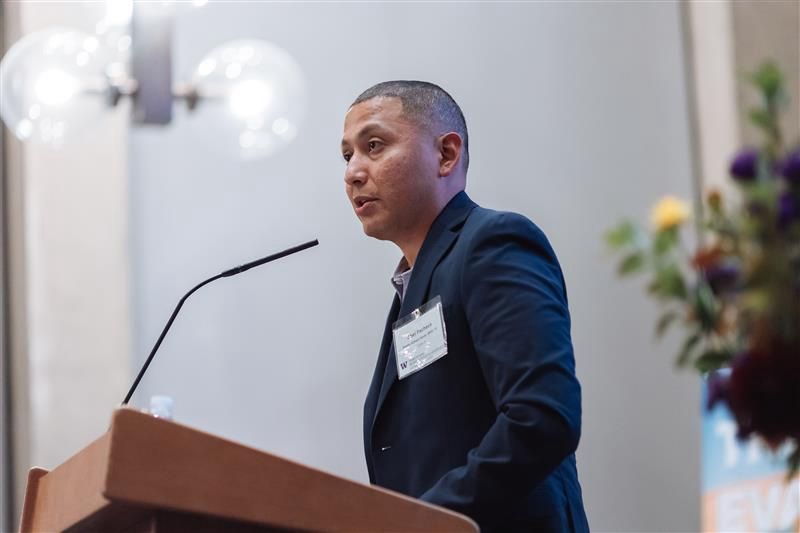
Abel Lee Pacheco’s Journey of Service and Community
Fifteen years ago, Abel Lee Pacheco MPA ‘12 packed his car, said goodbye to his family in Los Angeles, and drove north toward a city he had never been to before. Seattle was cold, unfamiliar, and far from home, but Abel carried with him something stronger than fear: a promise to his parents that he would make them proud and a determination to serve the public good.
Those early days were filled with both excitement and uncertainty. Abel arrived from Venice Beach, trading year-round sunshine for the rain and long winters of the Pacific Northwest. As the son of a Black man from Compton and an immigrant mother from Mexico City, he came to a place where he had no family or established community.
Fifteen years ago, Abel Lee Pacheco MPA ‘12 packed his car, said goodbye to his family in Los Angeles, and drove north toward a city he had never been to before. Seattle was cold, unfamiliar, and far from home, but Abel carried with him something stronger than fear: a promise to his parents that he would make them proud and a determination to serve the public good.
Those early days were filled with both excitement and uncertainty. Abel arrived from Venice Beach, trading year-round sunshine for the rain and long winters of the Pacific Northwest. As the son of a Black man from Compton and an immigrant mother from Mexico City, he came to a place where he had no family or established community.
What he did have was the faith and perseverance instilled in him by his parents. Qualities that carried him forward and ultimately led him to the Evans School of Public Policy & Governance, where he began to find his community and purpose.
At Evans, Abel found mentors who believed in him, classmates who inspired him, and a community grounded in shared values and a belief in the power of public service. He discovered that leadership is not about individual success but about collective progress. It is about showing up for one another and for the communities we serve.
That belief has guided Abel throughout his career. From serving as a Seattle City Councilmember to his work as Director of Government and Community Relations at Sound Transit, and as an Intelligence Analyst in the Washington Army National Guard, Abel’s path reflects the courage, equity, and service at the heart of the Evans School mission.
In February of last year Abel received devastating news that his father had been killed by a drunk driver on his way to work. In that moment of profound loss, he found strength in his father’s lessons. “You can’t keep a good man down,” his dad used to say. Even in grief, Abel continued his father’s legacy of compassion and perseverance.
“Home isn’t about location,” Abel reflects. “Home is about people.”
For Abel, the Evans School helped him find that home. It became the place where his purpose took shape, where his promise to his parents was fulfilled, and where he learned that public service is a lifelong calling.
“I stand here today because of the people who believed in me—my family, my community, and this school,” Abel shared at a recent Evans event. “Now it’s our turn to believe in the next generation.”
Abel’s story is a reminder that public service begins with a promise: to our families, our communities, and ourselves, to leave the world better than we found it. The Evans School continues to nurture that promise, preparing leaders who carry forward the same spirit of courage, equity, and service that shaped Abel’s journey. Staying engaged—through mentorship, connection, or support—ensures that more students like Abel can find their path, their purpose, and their home in service to others.
The Evans School would like to extend our special thanks to Abel Lee Pacheco for sharing his story with our community and for his dedicated service to the public good.
Luis Navarro

Luis Navarro
Postsecondary Education in Washington
Washington stands out nationally for its robust network of 34 community colleges and six public universities. The state has also earned recognition as a pioneer in longitudinal data systems that connect education directly to workforce outcomes. Building on these powerful foundations, we collaborate with state agencies, policy innovators, and diverse stakeholders to equitably transform Washington’s higher education landscape. Our dynamic initiatives have tackled transfer pathway redesign, expanded community college baccalaureate opportunities, improved data utilization in CTE programs, and forged strategic partnerships with individual institutions to boost student success.
Publications
- Bragg, Debra, D. (2025). Labels Matter: Reframing and Valuing Non-Traditional Adult Learners in Community College. Office of Community College Research and Leadership, University of Illinois at Urbana-Champaign.
- Meza, E., Bragg, D. (2025). Washington’s Community College Baccalaureate Degrees: Growth and Outcomes, 2024 Update. University of Washington
- Meza, E. A., & Bragg, D. D. (2022). Scaling up community college baccalaureates in Washington State: Labor market outcomes and equity implications for higher education. Education Policy Analysis Archives, 30, 140-140.
- Meza, E.A., Blume, G., Balhan, K., Hang, K., Rubin, Z., Zumeta, W., Bragg, D., (2021). The landscape of career and technical education faculty data use for decision-making and program improvement in National Science Foundation – Advanced Technical Education programs in Washington State. Career and Technical Education Research. 46(2), 42-58.
Dean’s Forum: Trust on the Ballot
On Thursday, November 7, the University of Washington’s College of Arts & Sciences and the Evans School of Public Policy & Governance hosted Trust on the Ballot: Voting in Washington. The forum brought together three Washington Secretaries of State to explore the history and evolution of voting systems in Washington, examining both the successes and challenges within the current polarized climate following the November 5, 2024, General Election.
The panel discussion featured insights from current Secretary of State Steve Hobbs, along with former Secretaries Kim Wyman and Sam Reed. Together, they discussed how Washington’s voting systems have adapted over the years and the factors shaping election integrity and voter trust today. Their collective experience provided an in-depth look at the complexities of securing elections in an era marked by increasing challenges to democratic processes.
Event Panelists
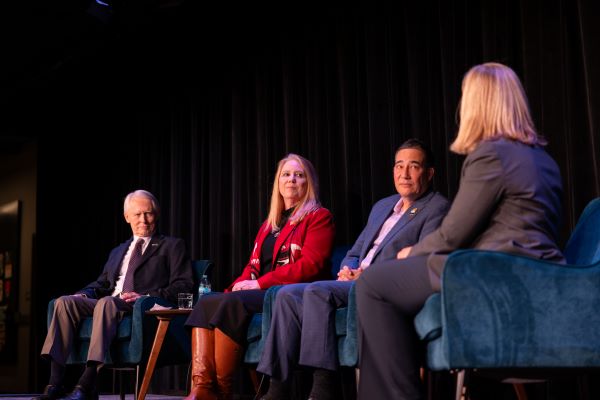
Sam Reed, Former Washington Secretary of State
Kim Wyman, Former Washington Secretary of State
Steve Hobbs, Washington Secretary of State
Jodi Sandfort, Dean & Professor, Evans School

Alumni Spotlight: Joel Anderson, MPA ’23
For Joel Anderson, an MPA ’23 graduate, diving into public service has been all about understanding how our systems work and using that knowledge to make our democracy stronger. As the Assistant Director of External Affairs at the Washington Student Achievement Council (WSAC), Joel is on a mission to make higher education accessible for everyone in Washington state. His journey started as a young political campaigner, but his time at Evans helped open his eyes to the importance of democracy—showing him that creating policies and being accountable for them is just as crucial as making those policies happen.
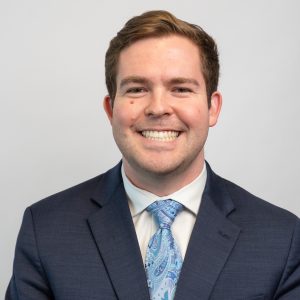
Looking back, Joel admits he felt more comfortable pitching ideas than implementing them. But at Evans, he realized how important it is to pair a solid grasp of policy with clear communication. “Proactively sharing ideas with the communities, you serve is just as important as keeping track of your past decisions,” he points out, highlighting that both aspects are key to a healthy democracy.
Joel’s drive to support higher education is deeply personal. As a caregiver for his dad, who battled a terminal illness, he witnessed firsthand how the financial strain of accessing and providing healthcare affected his family as well as his educational dreams. A merit scholarship opened the door for him to attend college, but he believes no one should have to rely on luck to get an education. Now at WSAC, he is working to create policies that ensure everyone has a fair shot at earning a degree or credential.
For Joel, education is a vital community resource that helps strengthen democracy. “Our democracy gets a boost when everyone has equal access to information and basic needs,” he says. By helping students earn their degrees, schools and universities play a huge role in promoting economic mobility and social stability, laying the groundwork for engaged citizens. “If we want to safeguard our democracy, we have to improve access to education and help create well-informed students,” he insists. “Education is a right, not a privilege.”
Joel believes that young people are central to this mission, and many of them are stepping up on critical issues like gun violence and healthcare access. For those who are new to civic engagement, he suggests getting involved with local organizations and keeping track of their advocacy efforts for future generations. “Knowledge is power and sharing that knowledge among young people can really make a difference in how we influence policy decisions,” he explains.
Looking ahead, Joel sees misinformation as one of the biggest threats to democracy, whether it is falsehoods about public health or conspiracy theories around elections. He believes creating spaces for open conversations about different perspectives—and challenging ideas that jeopardize our democracy—will only make our democratic foundations stronger.
With a passion for ensuring equitable access to education and a commitment to uplifting young voices, Joel is dedicated to shaping a vision of democracy that is all about opportunity, understanding, and resilience. We are grateful for his hard work and dedication to the future of democracy!