Skip to content

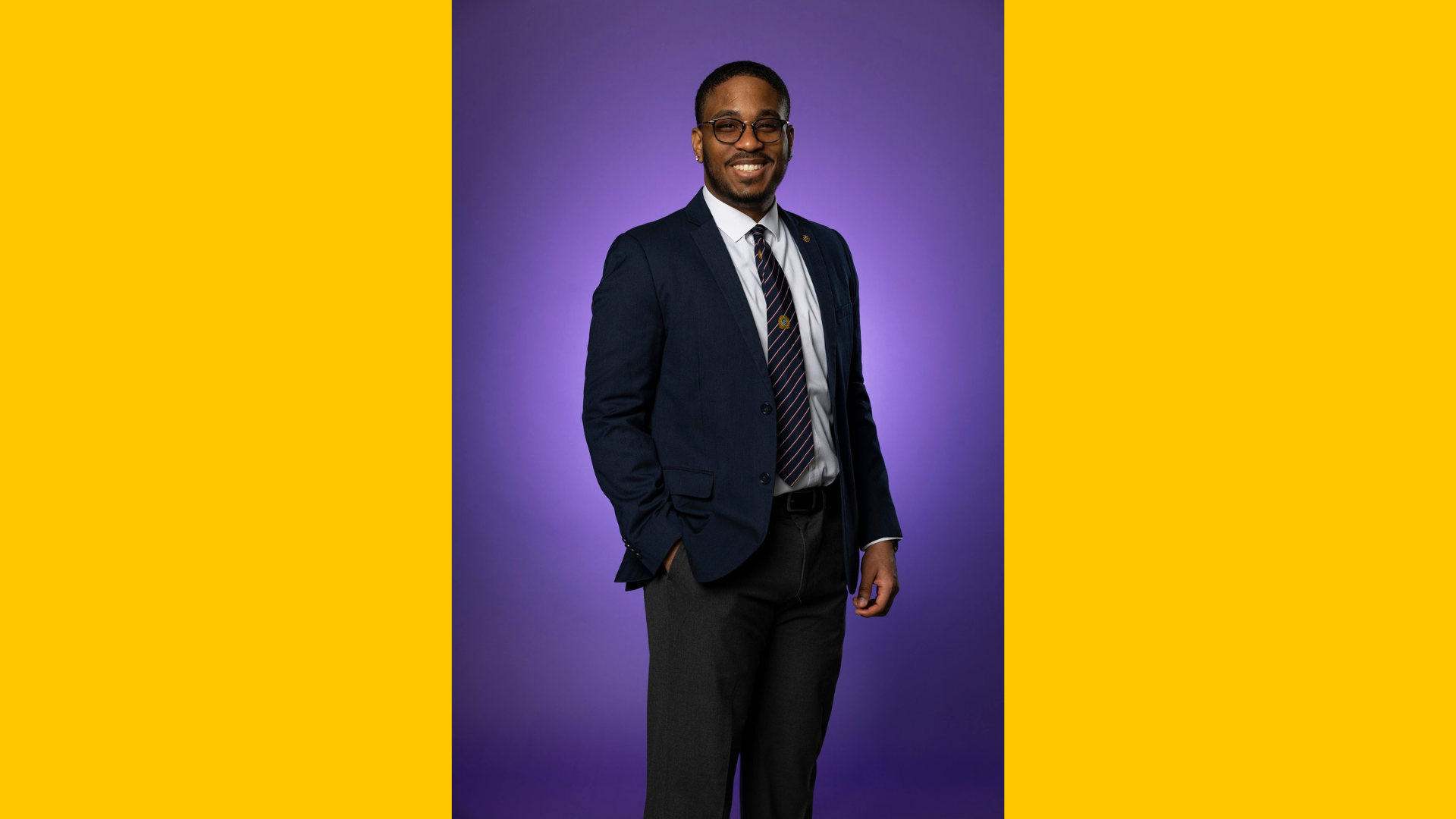
Not Just Adapting, Leading: Josie Jackson, MPA ’25

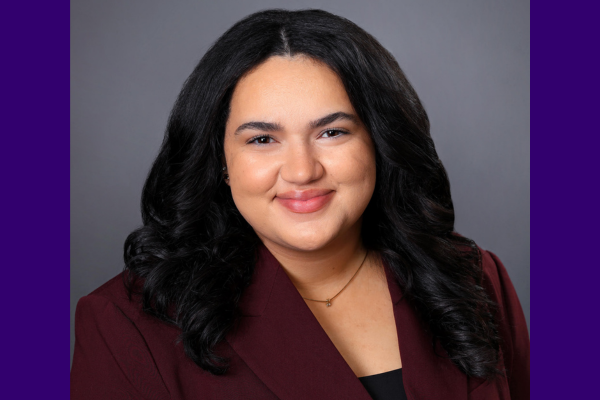
Josie Jackson

2025 Evans School MPA Convocation Speaker

Born and raised on a horse farm in rural Michigan, Josie’s earliest lessons in public service came from watching her family and neighbors show up for one another. Whether through agriculture or her early involvement in community organizations like 4H, Josie learned early on that real change starts close to home.

After earning her legal studies and political science degrees with a minor in African American studies at Grand Valley State University, she spent two years working at a legal advocacy nonprofit in Grand Rapids. Her work brought her into direct contact with communities facing systemic barriers, eventually leading her to DC to advocate for student debt relief.

That drive to make a difference led Josie to Seattle and the Evans School of Public Policy & Governance. The transition wasn’t easy. “I moved here with my best friend, but Seattle was a culture shock,” she says. “It was bigger, different, and I didn’t expect how much it would stretch me.”

Yet, Josie found herself not just adapting, but leading. Over the past two years, she served as Vice President of Students for the Evans Student Organization (ESO), placing her at the center of student advocacy. “My job was to be present, listen, and speak up,” she says. “If there was a student concern, I took it seriously. That work connected me deeply with our Evans community.”

This spring, Josie was selected to serve as the 2025 MPA student commencement speaker, a moment that she expressed still feels surreal. “I wasn’t expecting to be chosen. There is pressure, of course. You want to be encouraging but also real in the speech. We are stepping into policy work in a challenging world, and you can’t ignore that.”

She will shape her speech around two guiding ideas: pride and gratitude. “I want my classmates to feel proud of themselves and everything they’ve pushed through to get here. I want to thank the people who supported us, who helped us not lose ourselves when the world feels heavy.”

Josie credits two mentors, King County Council Member Sarah Perry and State Senator Victoria Hunt, for their steady guidance. She also highlights the hard work and dedication of Evans faculty and staff, such as Becky Corriell, Kate Sykes, and Crystal Hall, who she says “consistently show up for students.”

A passionate advocate for racial equity, Josie says one of the main reasons she chose the Evans School was their clear commitment to anti-racist work. “It wasn’t just talk. Evans named it, and that matters, especially coming from the Midwest, where those conversations aren’t always vocalized.” She hopes to carry that energy forward in her career, working to empower diverse communities and push policy beyond performative Diversity Equity and Inclusion (DEI) work and toward meaningful, systemic change.

She also sees a bright future for the Evans School. “I’m really excited for the incoming ESO leadership. They are dedicated and ready to keep pushing for progress. The school is in good hands.”

Looking ahead, Josie is attracted to environments where values and actions align, where policies are not only theoretical but also genuinely transformative. Evans reminded her of why she started this work, and she hopes to continue making a meaningful impact.
From Insights to Impact: Taylor Linke and Amy Dobbins, LPI ’25

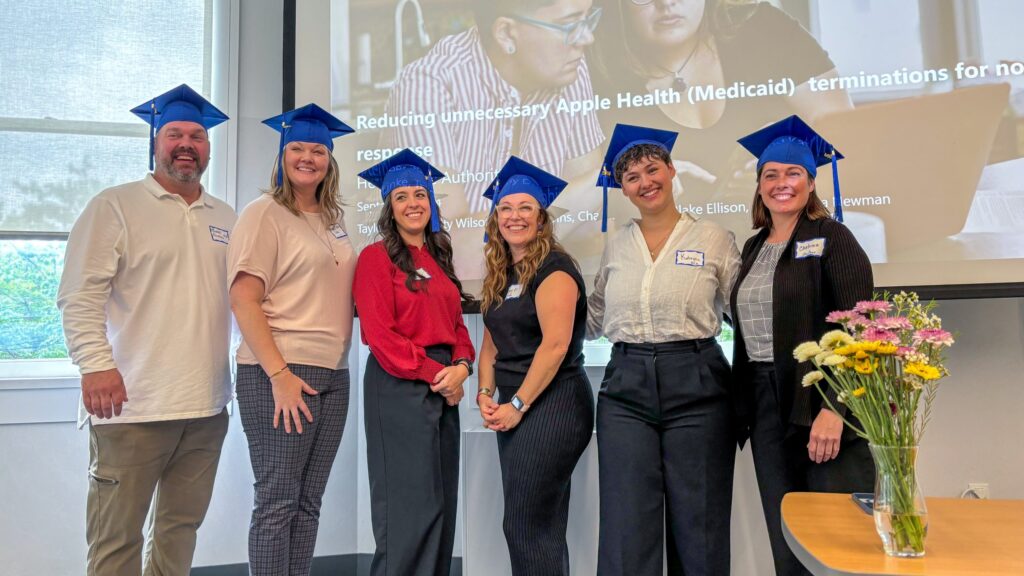
A group of six people wearing blue graduation caps in front of a presentation screen, with a vase of flowers in the foreground.
Members from the Washington State Health Care Authority team at the Leading Public Innovation Capstone Day.

HCA's Experience in the Leading Public Innovation Certificate

In early 2024, the Evans School launched the Leading Public Innovation (LPI) graduate certificate to equip working professionals in the public sector with the tools they need to improve the effectiveness, accessibility, and equity of systems within their organizations. The initial LPI cohort was comprised of 40 participants from eight public agencies. Over nine months, the cohort learned new ways to lead equity-driven, human-centered innovations and bring systems-level change to their organizations.

We sat down with two members of the pilot cohort—Chief of Staff Taylor Linke, and Customer Experience Administrator Amy Dobbins—to reflect on how the program shaped their efforts to improve service delivery at the Washington State Health Care Authority (HCA) in the months following their LPI experience. Taylor and Amy were joined by several of their colleagues from the HCA in the cohort, which sponsored the participation of a diverse team including communications experts, process designers, and executives, to move projects forward within their organization.

For the HCA team, the LPI program provided a timely opportunity to improve outreach to Medicaid participants at risk of losing coverage—not because they were ineligible, but due to minor administrative reasons. Taylor remarked, “We didn’t want to see individuals lose coverage due to the fact that there was an administrative step that could have been resolved…we wanted to tackle a real-life project within our organization that could help us move forward.” The LPI program’s curriculum rooted human-centered design helped them focus on the journey and needs of their clients. They moved quickly to implement a set of questions for their call center agents to ask to learn more about the client’s perspective and communication preferences. HCA’s team also prototyped a series of interventions, from implementing a new text messaging campaign and robocalls, to adjusting the sequencing and content of other communications.

The collective efforts of program-level staff and HCA executives helped turn the team’s insights from the program into reality. Taylor notes that the intentionality behind the team gave them the ability to “target a critical project for our organization and actually do something with what we were learning.” These dynamics enabled the seamless implementation of thoughtful, co-created solutions across the HCA.

Although the project is still in the early stages of full implementation, Amy and Taylor have already seen improvements from adjusting their processes. Changes to their communication methods have resulted in fewer Medicaid/Apple Health recipients experiencing gaps in their coverage, as more enrollees resolve minor administrative issues within the 90-day grace period.

As Amy reflects on her experience in the LPI program, she notes how the emphasis on human-centered design pushed her to reconsider her default ways of thinking. “It’s really important to check your assumptions,” she says. “I have an added sort of perspective…I’m really thinking about the importance of understanding a person’s story, the human story.” Through the internal leadership of folks who participated in LPI, the HCA is working on embedding LPI’s tools and practices across other parts of the agency’s work, such as their lean and health-equity work. Taylor added, “We’re looking at the vision of how we do this overall—not just in one-offs, but how it can embed and mature these sorts of activities moving forward.”

While balancing graduate coursework with full-time roles was challenging, both Amy and Taylor agreed the experience was well worth it—for the insights, the growth, and the strengthened team cohesion. As we look to future sessions of LPI, Taylor closed by noting she hopes their peer agencies will continue to invest in sending folks to the program, particularly groups that include leadership team members that can champion implementation. “I’m hopeful that, even with budget reductions, other agencies will continue to see the real ROI in having sent people through the program and recall this when the budget improves. There is something to learn for every level of individual in the program.”

Learn more about the Leading Public Innovation graduate certificate.

Celebrating a 2025 Husky 100 Honoree

Christopher Brathwaite

Christopher Brathwaite’s Journey of Advocacy, Leadership, and Global Impact

The University of Washington’s prestigious Husky 100 annual award recognizes students dedicated to community impact, innovative thinking, and inclusive leadership. Among this year’s honorees is Christopher Brathwaite, a second-year Master of Public Administration student at the Evans School and Fulbright Scholar from Saint James, Barbados. Christopher’s journey exemplifies resilience, global perspective, public service, and diplomacy.

Journey to Evans

Growing up in Barbados, Christopher developed a deep belief in community strength. Determined to pursue public policy, he received support from the Fulbright U.S. Student Program. After careful research and conversations with faculty, Christopher chose the Evans School for its strong academic reputation, global rankings, and demonstrated commitment to student success.

Finding Belonging and Community

Transitioning to life in Seattle was challenging for Christopher, who experienced culture shock,  isolation, and impostor syndrome. “In Seattle, I often didn’t see people who looked like me,” he noted. However, the Evans School’s commitment to inclusivity was evident in the support he received, as faculty engaged him and other international students, integrating their perspectives into the U.S.-centric course materials.

Christopher found belonging through the International Student Association and the Evans People of Color group. “Joining these groups was a turning point; I started seeing more of myself in those around me,” he reflects.

An Essential Pillar of Support

Kate Sykes, MPA ‘19, the Director of Student Services at the Evans School, has been a crucial support for Christopher throughout his academic journey. He describes her as more than an administrator; she’s a mentor who has helped him navigate academic and personal challenges. “Kate is amazing,” he says. “She’s a listener and a guide.” While many have helped him, Kate stands out the most. She even took the initiative to nominate Christopher for the Husky 100 award, rallying support from faculty for his nomination.

Significant Achievements

Christopher’s achievements embody the core values of the Husky 100 award. His summer 2024 internship as a graduate attaché at the Embassy of Barbados in Washington, D.C., funded by The Elaine Chang Endowed Fellowship for International Peace & Development and The Paul M. Rucker Fellowship for International Education, allowed him to contribute to foreign policy responses and strengthen ties between his home country, the U.S., and the Organization of American States. Aspiring to be a foreign service officer since age 16, he understands the importance of diplomacy for his island nation.

Beyond internships and the classroom, Christopher leads the Black Graduate Student Association and, as former Co-Chair of the Evans International Student Association, ensures all students feel supported. He also helped create the Evans School International Student Handbook, a vital resource for the international student community.

Advice for International Students

Christopher offers heartfelt advice for international students struggling with isolation or impostor syndrome: “Take up space. You belong here, even if you don’t always feel that way. Enjoy yourself and seize every opportunity because you won’t be in such a position again. There is a seat at the table waiting for you. Use it to shift the narrative.”

Guidance for Future Public Servants

Christopher often reflects on a powerful question posed by Barbados’ first Prime Minister, Errol Barrow: “What kind of mirror image do you see of yourself?” Christopher stresses that public service is one of the noblest responsibilities, requiring mindfulness in every decision, action, and document signed. He is profoundly aware of this responsibility and is deeply committed to foreign affairs and public service.

Looking Ahead: A Career in Foreign Affairs

Christopher’s vision extends far beyond his time at Evans. Inspired by mentors such as Ms. Donna Forde, François Jackman, and Simone Rudder, he aspires to become a foreign service officer and diplomat. He aims to eventually serve as Barbados’ Permanent Representative at the UN and, perhaps, as the Director General of Foreign Affairs for Barbados. Christopher intends to leverage the experiences and connections he has developed through Evans and Fulbright to benefit Barbados.

A Personal Reflection

Reflecting on his Husky 100 recognition, Christopher emphasizes that the honor symbolizes his personal achievements and the Evans School’s unwavering support. “This award confirms that I belong at Evans,” he says humbly. “It’s an acknowledgment of Evans’ investment in me.”

He is excited to move back to Barbados after graduation, having missed his family and friends for the past two years. He has a special connection to the beach, filled with cherished memories from weekends spent with his family and grandmother. As her youngest grandchild, he fondly remembers her advice to “stay in church and stay in school.” While everyone calls him Christopher, his grandmother was the only one who calls him “Topher,” a nickname he treasures.

Celebrating Excellence

Christopher’s narrative illustrates the profound impact one can have through dedicated service, resilience, and a global perspective. His recognition as a 2025 Husky 100 honoree is a testament to his exceptional contributions and the supportive community that shaped his UW experience.

We congratulate Christopher Brathwaite on this well-deserved honor and eagerly anticipate his continued public policy and diplomacy success.

Want to show your support? Feel free to share your congratulations or connect with Christopher to learn more about his journey.

NextGen Summer Policy Academy Launch

Skyline of DC next to UW Campus

This summer, the Volcker Alliance NextGen Summer Policy Academy is launching with 76 emerging public service leaders hosted by the Evans School and our partners at the University of California, Berkeley’s Goldman School of Public Policy and the University of Minnesota’s Humphrey School of Public Affairs.

The NextGen Summer Policy Academy is designed to equip undergraduate students who are rising seniors with the skills, networks, and experiences they will need for impactful careers in public affairs.

Students will take part in a one-week residential study program in Washington, DC, and then travel to one of the three host schools, where they will stay for two weeks and engage in hands-on policy training, leadership development, and career exploration alongside a diverse group of peers from across the country.

The Evans School is excited to welcome 26 emerging leaders:

  • Faiza Adhuna, Baruch College
  • Sarai Cecena, University of California, Los Angeles
  • Emilys Chaviano, Florida International University
  • Tamiyah Dubose, Fisk University
  • Christopher Escobedo, University of Washington
  • Samir Faruq, University of Washington
  • Annie Foo, University of California, Berkeley
  • Chrystal Gonzales, University of Washington
  • Andrea Gutierrez-Hernandez, Gonzaga University
  • Farah Haq, Baruch College
  • Taleah Ibrahim, Gonzaga University
  • Marianna Lares, Indiana University Bloomington
  • Denzel Massaley, Pennsylvania State University
  • Nahje McDowell, Baruch College
  • Xitlaly Mendoza, University of Washington
  • Senthian Mugisha, The City College of New York
  • Pamela Ortega, Baruch College
  • Amy Perez, Baruch College
  • Zion Romero, University of New Mexico
  • Natalie Sandoval, Florida International University
  • Rossy Sierra, University of Washington
  • Gurasis Singh, University of Minnesota, Twin Cities
  • Sandra Teran, University of Houston
  • Sarah Torres, Syracuse University
  • Artist Tyson, Texas Southern University
  • Arieyanna Wactor, North Carolina Central University

At the Evans School, students will be exposed to an array of nonprofit and government agencies involved in the creation and implementation of social policies that respond to pressing societal and economic issues. Specific issues of social policy include addressing poverty and inequality, social welfare programs, education policy, and criminal justice.

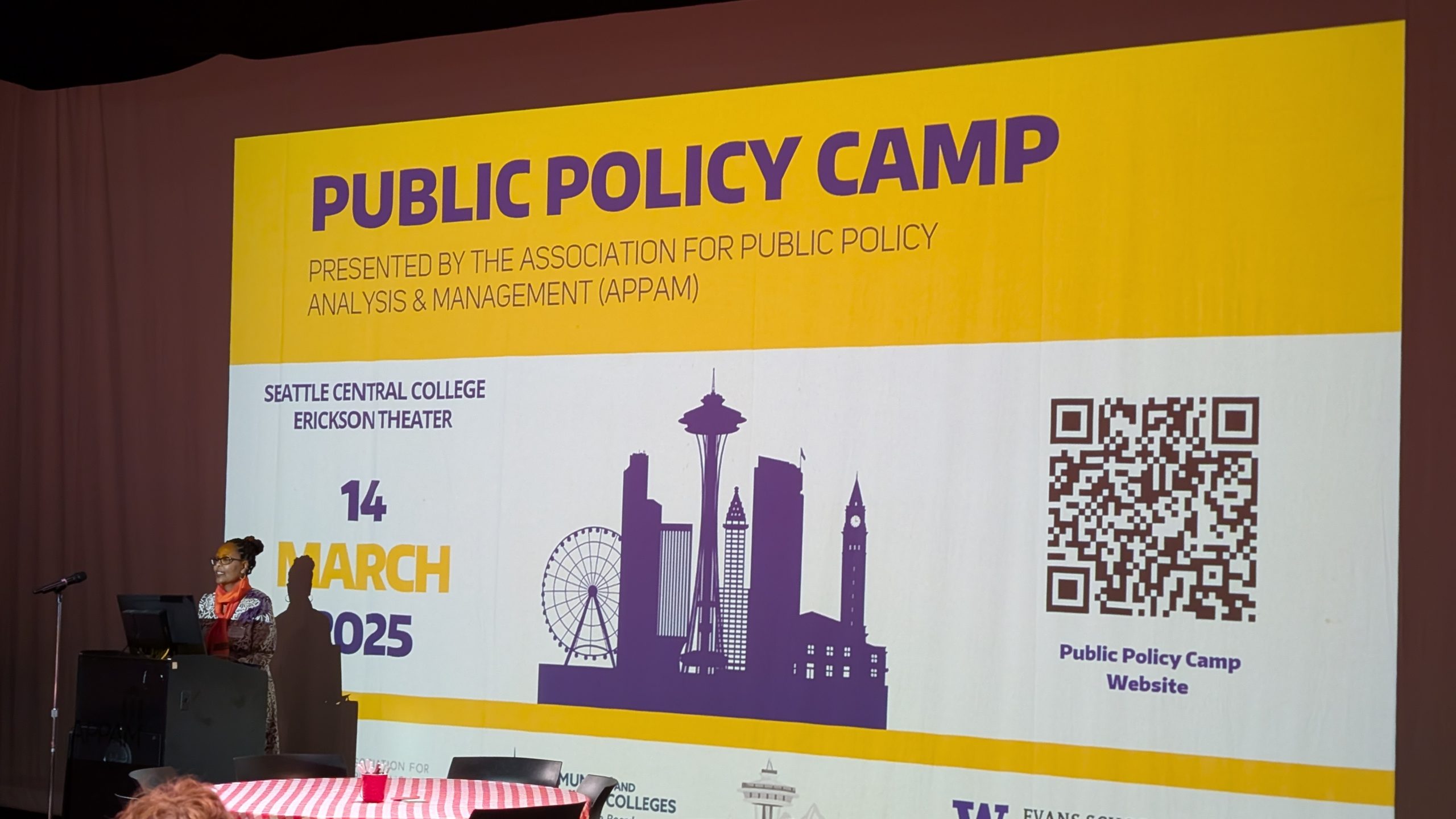
Public Policy Camp 2025

Program manager Amen Tsegai addressing room at Public Policy Camp

On Friday, March 14, the Evans School hosted our inaugural Public Policy Camp in partnership with Association for Public Policy Analysis & Management, National Forum for Black Public Administrators Seattle Chapter, Seattle Central College, and Washington SBCTC. The conference, held at Erickson Theater on the grounds of Seattle Central College, drew nearly 100 undergraduate students and speakers from local higher education institutions and public service sectors,

The conference featured a series of insightful panels, including discussions on higher education pathways, careers in public service, and the role of public policy education and practice. A notable highlight was a Policy Hackathon, where students worked with peers and mentors to apply policy analysis tools to real-life problems.

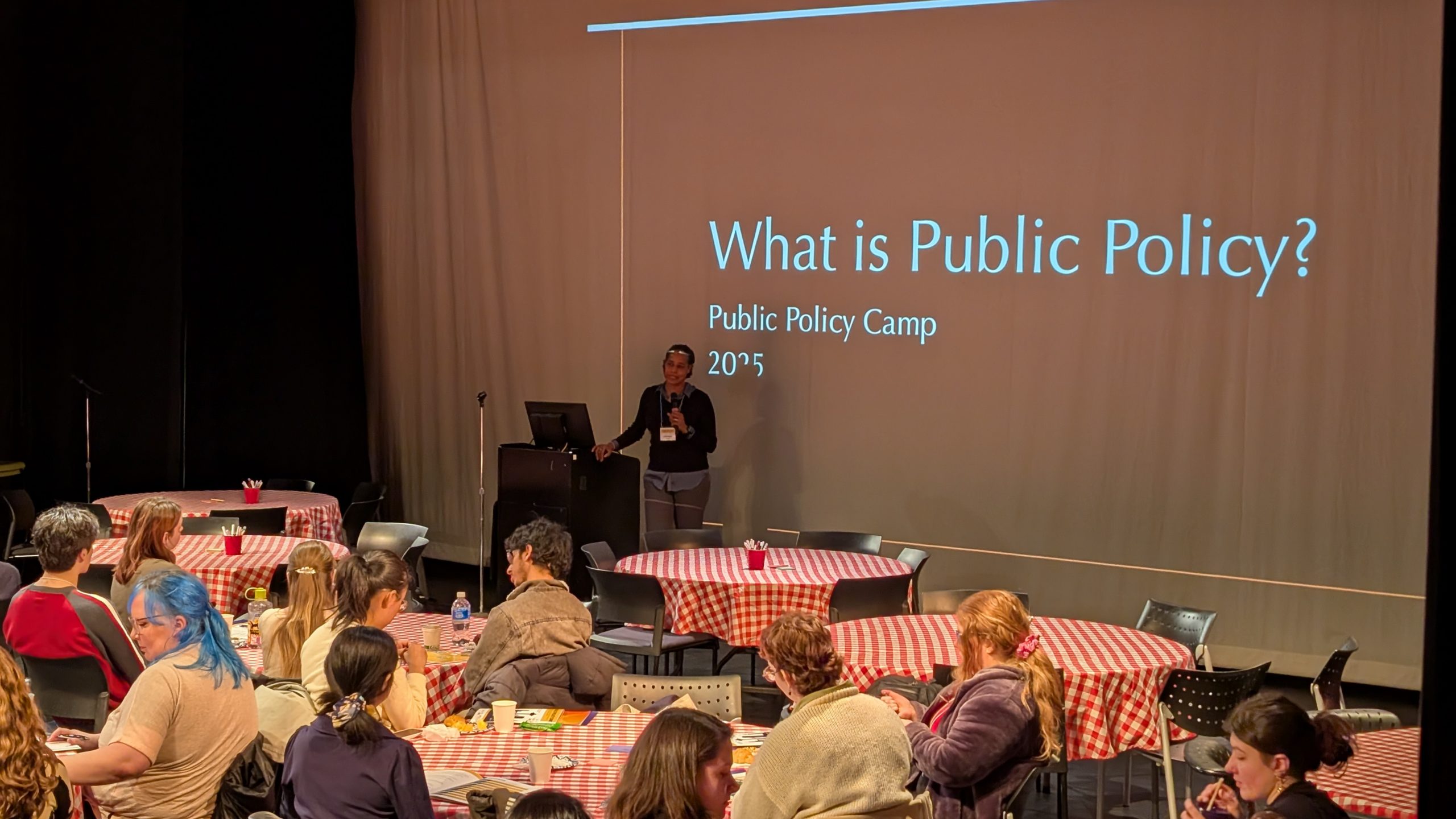
Evans faculty member Karin Martin provided an introduction to public policy, while Esther Lucero, President & CEO of the Seattle Indian Health Board, delivered an inspiring and powerful keynote address titled “Policy Wonk: An Indigenous Journey.”

Current graduate students and professionals from across the public sector, including Jamoral Bonner, Julie Thuy Underwood, Maya Esquivido-Strom (Nor Rel Muk Wintu), Isaiah Wright, MPP, Yvette Gutierrez-Morfin, and Saleena Salango, shared their journeys and answer questions.

Evans faculty member Karin Martin introducing the question what is Public Policy

Building Bridges, Inspiring Hope: The Washington Collaborative Elected Leaders Institute (WA-CELI)

By Julia Carboni

At a time when polarization feels insurmountable, the inaugural cohort of the Washington Collaborative Elected Leaders Institute (WA-CELI) offers a powerful reminder of what’s possible when we come together. This innovative program, delivered by the William D. Ruckelshaus Center and the University of Washington’s Evans School of Public Policy & Governance on behalf of the Association of Washington Cities (AWC), equips city elected officials with collaborative leadership skills to address the complex challenges facing Washington State’s communities.

In the summer and fall of 2024, we ran an inaugural cohort that included 45 elected officials representing diverse cities across the state, ensuring a balance of demographic, geographic, and political perspectives. The program’s curriculum spanned five sessions, combining in-person and virtual learning to provide participants with the tools of collaborative governance. The sessions covered topics including managing conflict, sustaining relationships, engaging the public, and framing discussions around shared interests.

The results speak for themselves:

  • Enhanced Leadership Skills: Participants reported transformative growth in collaborative skills like active listening, managing conflict, and building consensus.
  • Stronger Connections: A renewed sense of belonging emerged as leaders built meaningful relationships with peers across divides.
  • Real Impact: 96% of participants said WA-CELI made them better leaders, and 94% would recommend the program to others.

WA-CELI is a bright spot in a polarized world. It reminds us that hope and progress are possible when leaders prioritize connection over division and public service over politics.

I invite you to explore the Evaluation Report for more details on this inspiring program. Together, let’s continue to invest in building stronger democracy and the civic health of our communities.

Julia Carboni

Julia Carboni is the Director of the William D. Ruckelshaus Center and served as a facilitator for the WA-CELI program. She is also a professor in the Washington State University School of Politics, Philosophy, and Public Affairs and a distinguished scholar in the University of Washington Evans School of Public Policy and Governance. Julia is an award-winning leader with expertise in using collaboration to improve community wellbeing. She has extensive volunteer experience, regularly mentors BIPOC and female scholars, and serves on the boards of international, national, and local organizations.

Love in Parrington: A conversation with Erin Murphy MPA ’11 and Jon Hickey MPA ’08

Erin Murphy and Jon Husband
Jon and Erin at their first Evans dance together in 2009

The Evans School has helped graduates develop life-long skills, launch careers, and build networks. It’s also helped spark several romances. Erin Murphy MPA ’11 and Jon Hickey MPA ’08 share their memories of meeting at the Evans School and the different career paths they’ve taken.

Was there a Parrington Hall “meet cute” start to your relationship?

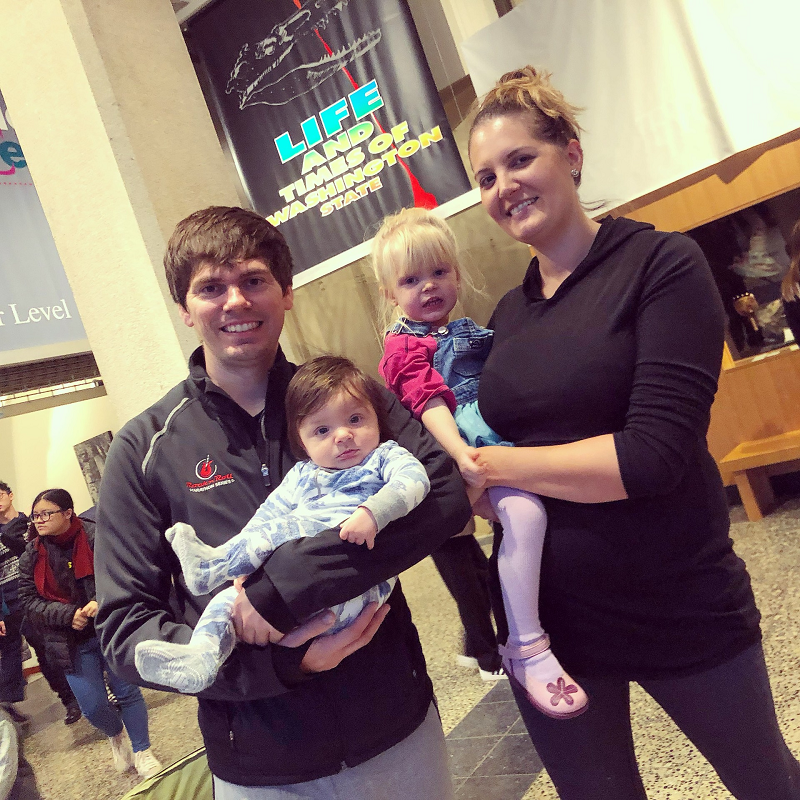
Erin: We met at a school dance! The Evans Spring Prom in 2009. Jon was a recent graduate but his prom photo booth was so popular that the student government had brought him back for more photography. I showed up way too early and spotted a guy eating at a table all by himself. I sat across from him and said, “Can I talk to you so I don’t feel awkward?” and the rest is history. There’s no photo of us at that first prom but it took place at the Burke Museum. We made sure to visit with our babies right before the Burke was renovated for old memory sake!

Erin and Jon with their kids at the old Burke Museum

What are some of your fondest moments about your time together while you were at the Evans School?

Erin: I was a concurrent student with the Jackson School and my studies took me to Kenya most summers. Jon came and visited me which was quite the commitment as broke grad students! The vast majority of our dates the first year of our relationship were simply doing homework together.

Jon: When Erin realized I was “The Love Memo” guy, she asked me for help with some videos she was producing from her time in Kenya. We got to know each other while editing together those videos, and I finally got the courage to ask her out to a movie after bringing her some chai at her student office.

Though you both have MPAs, you’ve also had very different career paths. Where did your interests take you after school? What has stuck with you from Evans?

Erin: Since Evans School, I have been in both nonprofit and public sectors. I started in advocacy work and quickly realized good communication was the key to anything being successful. So I pivoted to focus on communications. I use my memo writing skills all the time! I was part of the Seattle – King County Public Health communications team during COVID and have stories to last me multiple lifetimes. Maybe you saw the masking posters around town? I helped develop those – those were Evans skills at work! Some of my most practical skills stem from the frameworks that I learned at Evans. I appreciate how frameworks are a tool for critical thinking and analysis. In my current role at Seattle Children’s as a communications manager, I introduced communication specific frameworks that were integrated into our editorial style guide for more robust guidance around equitable language and content development.

Jon: I graduated in 2008, which was a very difficult time for public sector grads (the great recession was rough on government jobs!). I spent a couple years working for the Department of Global Health, building websites and helping out with content development. By a somewhat random twist of fate, I found a marketing job at Wizards of the Coast, which makes my favorite game ever – Magic: The Gathering. Since then, I’ve worked in various tech and gaming roles. While I ended up in the private sector, my time at Evans was invaluable. My ability to lead teams and clearly communicate my ideas stemmed from Evans (Active voice!). I also use statistics on a daily basis, which I credit to my Evans classes (regression analysis and statistical significance ftw!). No matter where you end up, your Evans education will be a major help!

What’s life like these days? Still writing memos with all your free time?!

Erin: We stayed in Seattle post-graduation but love to travel! We took our six- and eight-year-olds to the Paris Olympics last summer and made amazing memories. Jon still ran track when he was at the Evans School and it was a dream come true for him to be there in person!

Jon: Erin showed me the joys of travel, and now I’m hooked! In addition to what Erin mentioned, I’ve also had an amazing time taking the kids to UW sporting events. We also spend a ton of time outside in our yard landscaping and gardening.

Erin, John, and their kids holding an American flag at an Olympic soccor game

What advice would you give to Evans students today (romantically or otherwise!), particularly amidst a great deal of change, challenge, and uncertainty in our civic and public spaces?

Erin: Different roles are needed and important for influencing change, both inside and outside of systems. Reflect on where your strengths lay and embrace them. I’m grateful that I realized early on that my strengths are contributing to change from within systems. Evans students are needed more than ever today as we will need to rebuild and reinforce our institutions on the other side of whatever is happening now. I’m also a big advocate of setting boundaries, personally and professionally. Practicing boundaries is a muscle that needs to be built to sustain us through hard times.

Jon: There are a million things going on around, and you can’t predict how things will change in the next year (or even the next month!). Focus on what you can control. If you get caught up with the things out of your control, you’ll end up frustrated, bitter, and burned out. By narrowing in on what you control (your own actions, decisions, and how you treat others around you), you’ll have a much more positive impact on what matters most. And if you do that every day, that positive impact you have on those around you will spread and lead to bigger change than can you imagine.

Student Consulting Lab Project on Behavioral Health Quoted in Seattle Times

The Evans School Student Consulting Lab (SCL) pairs MPA students and faculty advisors with public, private, and nonprofit partners to co-create solutions to policy and organization problems. A recent “Seattle Times” article cited research done by Brad Blackburn, Hope Kalegi, and Mahdya Aldahnim – all MPA ’23 – as part of their project “Landscape of Behavioral Health Crisis Interventions for U.S. Campus Populations.”

“Programs that send mental health professionals to respond to crises as a supplement to or replacement for police officers have grown in recent years. Seattle is planning to expand its pilot program that sends crisis responders to some 911 calls. King County recently expanded its program that sends mobile crisis teams, dispatched by 988 calls, to mental health emergencies around the county.

Applying the idea to college campuses is newer. A 2023 report from students at UW’s Evans School of Public Policy and Governance identified similar crisis response programs at eight universities around the country; the oldest program, at Johns Hopkins University, launched in August 2021.”

Read the full article

Inspiring Civic Participation in the Next Generation

The University of Washington (UW) has a vision to model democracy by cultivating collaborative decision-making, respectful dialogue, civic engagement and belonging. The NextGen Civic Leader Corps puts that vision into action for our undergraduate students who are passionate about public service, community engagement, and civic leadership.  

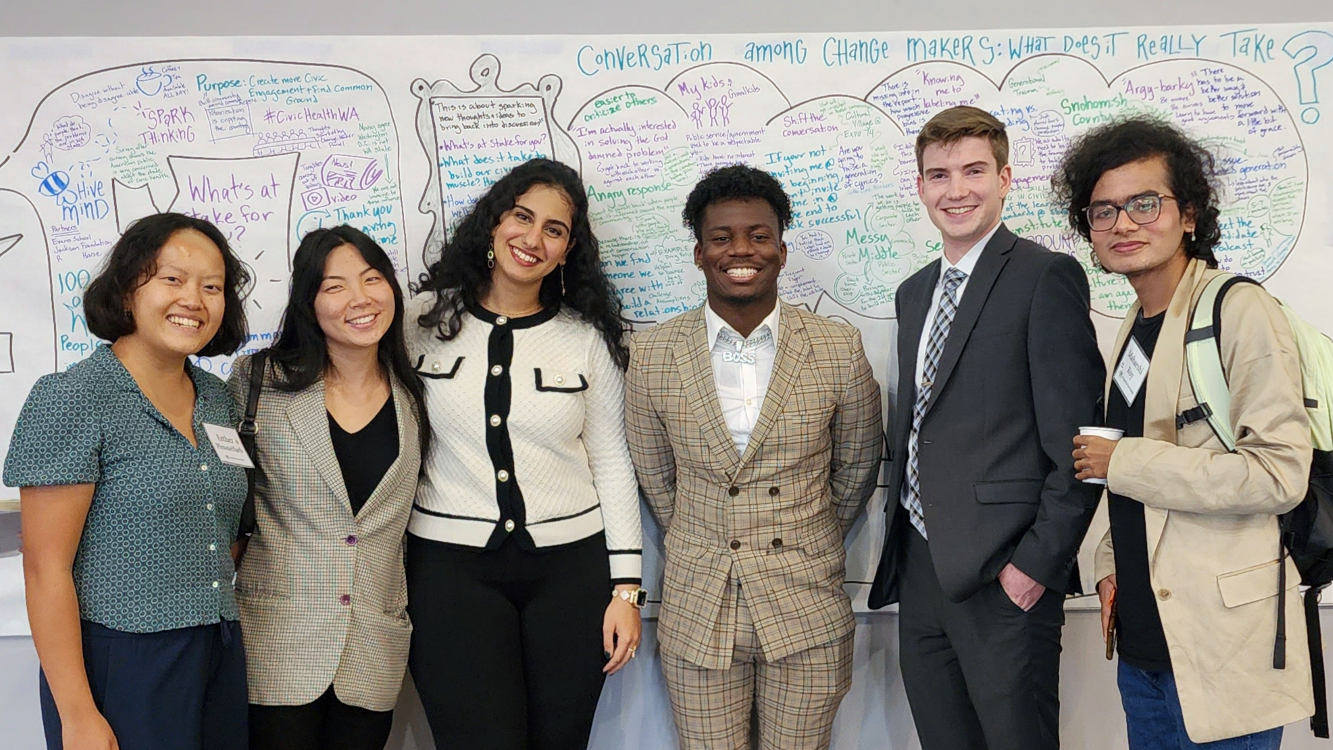
Six NextGen Civic Leader Corps participants pose together in front of a white board filled with conversation notes at the Civic Health Summit

The Evans School of Public Policy & Governance and Community Engagement and Leadership Education (CELE) center launched the initiative in 2022 to inspire and prepare undergraduate students of all majors and disciplines to become leaders in their communities and advance the public good throughout their careers 

The initiative has now expanded to Tacoma and Bothell as part of a Tri-Campus Network and undergraduates passionate about public service and civic engagement from any discipline can join to deepen their public service commitment. The NextGen Civic Leader Corps solidifies a long-term commitment to working for the public good through coursework, experiential learning, signature events, and professional network building. Students receive guided advising, participate in experiential learning and volunteer opportunities, access financial support, and connect to a larger statewide and national community of publicly motivated peers. 

NextGen’s interdisciplinary approach makes it easy for a student in any field to explore and deepen civic leadership. NextGen Civic Leader Corps currently hosts over 2,200 undergraduate students in more than 50 majors across the three UW campuses. We are part of a growing network of programs at 22 universities across the country, hosted by the Volcker Alliance, that inspires and prepares students to serve their communities and nation.

In the short term, members are part of a robust national network of civically minded leaders, receive priority consideration for scholarship opportunities and may be eligible for a credential. The long-term impact of civic participation is linked to a healthier transition into adulthood, higher educational outcomes, and higher income levels down the road.  

Hear directly from a few of our students about the impact of the NextGen Civic Leader Corps.

The tri-campus initiative is poised to expand to serve more students, and we look to our UW and Evans School community to engage with us in the work.  

There are multiple ways to engage, including providing financial support, offering paid internships, providing long-term volunteer opportunities, and speaking at a signature event. Please contact nextgenleader@uw.edu if you’d like to connect to explore ways to support our NextGen students today!  

Sisters Maddie Immel, MPA ‘22, & Audrey Immel, MPA Candidate

Immel Sisters

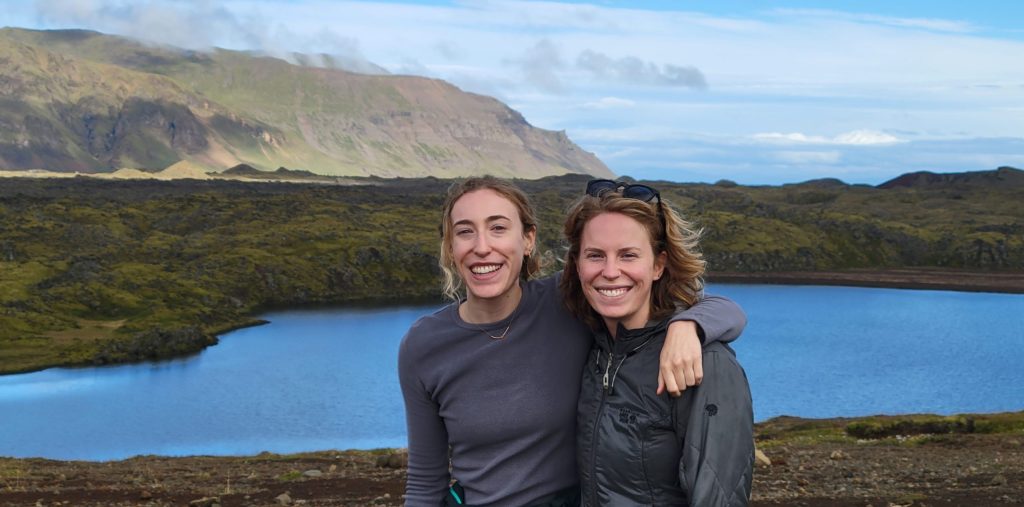
Maddie Immel, MPA ’22, and her younger sister Audrey, a Double Dawg with an undergraduate degree in Public Health-Global Health and now a first-year MPA student, recently sat down with us to discuss what brought them to Evans. Together, they reflected on the values they share and how their unique paths have influenced one another.

What inspired each of you to choose the Evans School, and how did you decide it was the right place for your graduate education?

Maddie: Seattle is the place that I wanted to be long-term, so I only actually applied to Evans. Audrey and I are from Redmond, and it’s important to us to be around family- I knew that going to a graduate program in the place I wanted to settle long term was going to be the best option professionally and personally. Evans has a wide Alumni network, and I wanted to make new friends!  I moved back to Seattle and started Evans in 2020 during the pandemic, and I feel like it was the reason I found a job that I’m passionate about and a community of friends who share similar values.

Audrey: Maddie was a huge influence on my decision to come to Evans. I was torn between staying on the East Coast for a health policy-focused program or coming back to Seattle to be near family and start building my community here. I remember Maddie took me to meet Scott Allard, who shares similar policy interests with me, like social policy and food security. I was struck by how warm the interaction was, and walking around the building felt so welcoming. I realized that I wanted to be in Seattle long-term, and having the alumni network and strong professor connections was really important to me.

Maddie, what was your experience like as an MPA student, and what advice do you have for Audrey as she navigates her own journey at Evans?

Maddie: My experience was quite different from Audrey’s because I went during COVID. The majority of my MPA program was remote learning, which, honestly, changed the experience. The professors did their best, and leadership had to make a lot of tough decisions about whether we could come back in person. But even though it was challenging, it bonded our class in a special way. I remember studying on my front porch with my friend Liz, bundled up in 30-degree weather with gloves and hot chocolate while studying for econ—it was certainly a different experience.

My advice to Audrey is to take advantage of all the job opportunities, even short-term ones, that come your way. I was able to work three different jobs in the winter quarter because the program was remote. I worked for the Milgard Women’s Initiative, did data analysis for North Seattle Community College, and working with Stephen Page and fellow Evans students for the City of Sultan on their downtown revitalization project. Working for-the City of Sultan and completing my capstone with Team Read, solidified that I want to continue supporting the public and nonprofit sector through consulting. I’ve worked for BERK Consulting for two years now, and I love that on such a wide range of projects.

Audrey, how does it feel to follow in your sister’s footsteps at Evans? Has her experience shaped or influenced your own?

Audrey: On one hand, it feels like I’m following my sister around in this world, but the cool thing is that we have very different interests and strengths. Maddie is great at managing people and community engagement, whereas I enjoy working more with numbers and data. So even though we’re in the same program, we’ll probably have very different concentrations. But so far, I’ve found it really helpful having Maddie there. She’s helped me navigate classes she liked and connected me with professors. She’s good at taking advantage of opportunities, and I sometimes need a little ‘big sister’ reminder to be proactive and make the most out of my time here.

Are there any shared values or passions that led both of you to pursue public service and policy?

Maddie: We were both really influenced by our mom, who was the main breadwinner in our family and worked for Microsoft Philanthropy for many years. She showed us that it’s possible to pursue a career aligned with your values and passion. Growing up with that example made us realize that we can both make a difference while doing something we care deeply about. I got my start at a nonprofit focused on getting young people active in democracy and social justice. That’s where I discovered my passion for registering people to vote and talking about the importance of politics at the local level. After a couple of years, I realized I wanted to have more of an impact at the policy level, so I came to Evans.

Audrey: We share a desire to use our unique skills and privileges for the common good. Growing up in the Jewish community, the value of helping others and the community was ingrained in us from a young age. I think that’s what drives both of us to pursue public service and policy—we want to make a tangible difference in people’s lives.

Looking ahead, how do you see the impact of your Evans education shaping your professional goals and shared commitment to making a difference?

Maddie: What’s great about Evans is the flexibility—it doesn’t matter where you end up, as long as you make use of the professors, job opportunities, and connections. It can be a challenge to decide your path because Evans prepares you for so many different roles, but if you leverage the community, the sky’s the limit.

Audrey: The classes and professors I’ve met so far have already challenged my narrow view of what I thought I wanted to do. I came in focused on health policy and data analysis, but after taking Sharon Kioko’s financial management course, I’m starting to realize how important it is to understand how money moves through organizations. It’s pushing me to expand my skills and see how they apply in the real world. I have no idea where I’ll end up after my two years here, but I know I’ll have transferable skills that will help me in any field. And the alumni network is a huge asset for my future.

Maddie: Exactly, Audrey! Like you said, it’s the transferable skills that matter. At BERK, I’ve worked on such a wide variety of projects—from the Pike Place Market Master Plan to a Senior Needs Assessment for the Anacortes Senior Activity Center. It’s not about being an expert in everything but about using your problem-solving skills and communication abilities to tackle challenges. I got to hone those skills at Evans and use them every day in consulting.

Anything else you two want to add?

Maddie & Audrey: Go Dawgs!