Skip to content

Advocating for the Underrepresented

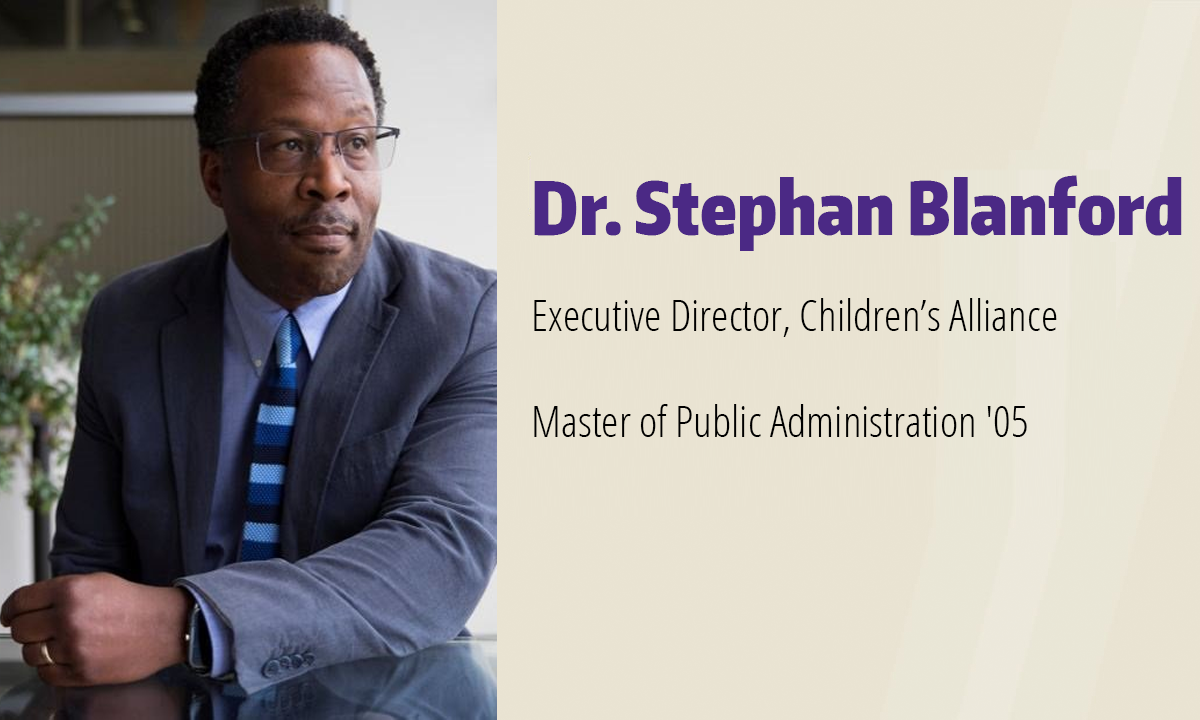
Dr. Stephan Blanford

As the Executive Director for Children’s Alliance, what is one advocacy and policymaking issue for children and families you are most passionate in solving (and why)?

Immediately upon assuming my role this summer, many stakeholders across the state alerted me to the perilous condition of childcare and early learning providers as a result of COVID-19. Since then, I’ve spoken to many members of the Washington Congressional delegation, State Legislators, philanthropists and department heads, trying to inform them how inattention to this issue will have long term consequences for our efforts to improve academic outcomes for all Washington’s children and imperil efforts to restart the state’s economy.

What contributed to your decision to pursue a career in support of the public good? Was there a defining moment in particular?

In all of the papers that I wrote at the Evans School (as well as my subsequent doctoral studies), I was interested in understanding the root causes of the inequities that we see in society, and the most potent strategies that leaders can use to address them. There has been no defining moment for this pursuit, but I frequently think about the emotions I felt while freezing on the National Mall with my family in January 2009, watching the first Obama Inauguration. It motivated me to pursue elective office myself (serving on the Seattle School Board), and has fueled my subsequent work, culminating in this new role.

What do you think the state of your field/organization will be in 2030?  What will be the same, and what will be different?

I suspect that because of this summer’s civil unrest, statewide childhood advocacy organizations will continue to shift their stance towards advocacy for children and families furthest from racial and social justice. For too long, these advocates and the institutions they targeted have pushed policies that did not take into consideration the historic neglect that many communities have faced, and have subsequently exacerbated gaps in outcomes. Hopefully, this is changing, and state legislatures are ready to listen to more racially equitable policy recommendations. I also hope that childhood advocacy organizations will adopt the stance taken by Children’s Alliance that we advocate “with children, families and communities and not for them.”

What is something you have been most proud of, professionally?

I’m probably most proud of my school board service – that I was elected with a record-setting margin of victory in a citywide race, and that I stayed true to my campaign pledge to think about and work on behalf of students who had been least well served by the school district. It meant that I was frequently ostracized by my colleagues and was on the losing end of too many 6-1 votes. But eventually, I was a part of some significant strides made by the district to focus on historically underserved students. It was the most difficult role I’ve ever held, but I feel that my sacrifice resulted in some positive progress.

What is the “GOAT” (greatest of all time) book you’ve read?

I am part of a BIPOC book group studying Ibram Kendi’s “How To Be An Antiracist” and trying to apply its principles to our respective positions of leadership. Given the tumultuous times that we are in, the book has been particularly instructive, challenging and revelatory, and I encourage all Evans School students and alumni to expose themselves and their practices to the concepts of anti-racist leadership in that book and other like it.

Who has been your strongest influence in life? Why?

The example set by my uncle, Staff Sergeant Clifford C. Sims, has been my biggest influence on my professional career. His story is almost unbelievable – after being orphaned and enduring a childhood of profound deprivation, he was drafted and served in Vietnam, where he made the ultimate sacrifice for others, throwing himself on an enemy grenade and saving the lives of many of his troops during a battle in Hue, Vietnam. He was given the highest award that a soldier could receive, the Congressional Medal of Honor, there is a large exhibit in his honor at the National Museum of African American History and Culture in Washington DC, and his example continues to inspire me to work on behalf of others.

If you could give Evans School students one piece of advice, what would it be?

The skills that you will acquire and the talents you can unleash as a result of enrollment in the Evans School are desperately needed in Washington state, the U.S. and the rest of the world. I hope that you never lose sight of the practical application of the theories that you’ve mastered, and how they can (and should be) brought to bear on some of society’s biggest problems.


We’d love to learn more about you and your tremendous contributions to the public good, so we can share your story as we connect, learn and reflect. Share your story!
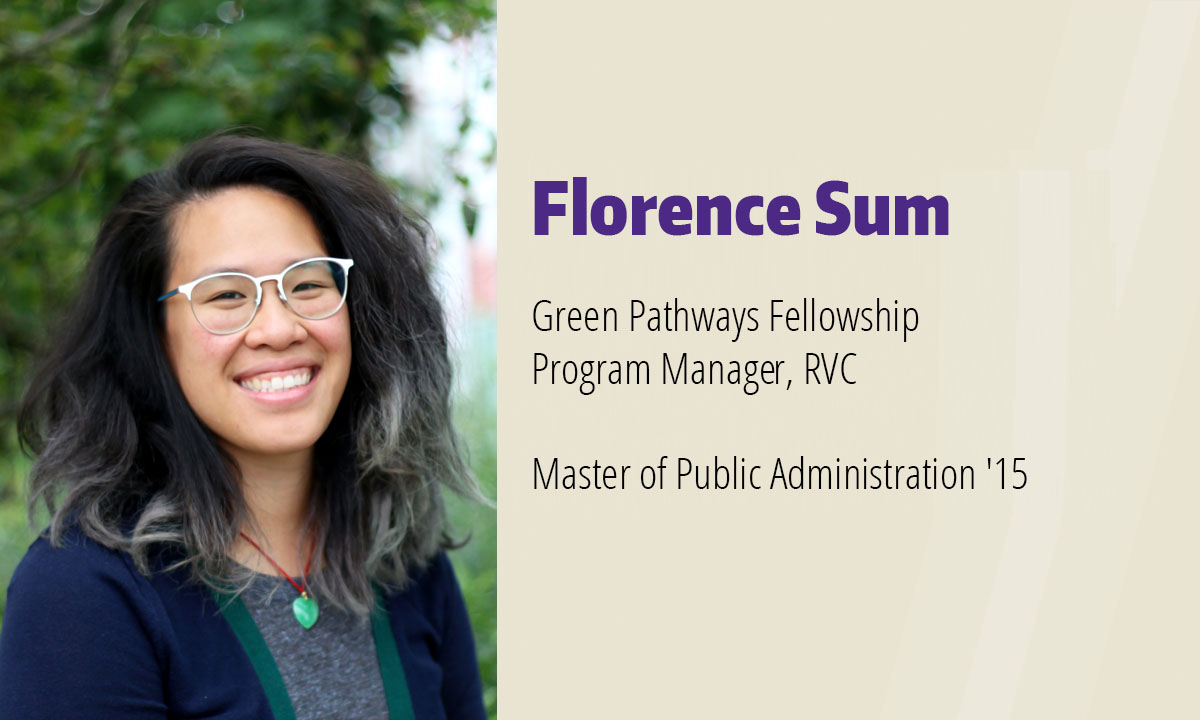
Cultivating Leaders of Color: Florence Sum, MPA ’15

Florence Sum

As a Fellowship Program Manager at RVC – a nonprofit dedicated to building and supporting emerging nonprofit leaders of color – what are key takeaways you’d like everyone to know about your work? 

As reflected in RVC’s mission, in order to promote social justice, you must cultivate leaders of color, strengthen organizations led by communities of color, and foster collaboration between diverse communities. The key takeaway is by investing in Black, Indigenous, & People of Color, Disabled,  Trans, and Non-Binary folks, we will dismantle and transform the systems that target and harm these communities.

The work I am doing with leadership development through the Green Pathways Fellowship Program at RVC is what every workplace should be doing for everyone, especially leaders of color. This includes adjusting living wages and benefits for all positions based on the area they’re living in, including identities who are typically left out of workplace policies, ensuring that professional development is counted as paid hours, having a sizeable professional development budget, onboarding that equips employees to succeed (should be longer than 2 weeks), and creating a workplan for the first 6 months so employees are prepared and know what to do.

I believe that every person deserves to have their learning invested in, an environment that doesn’t scrutinize failure, paid a contribution that supports their livelihood, and a community to rely on.

BIPOC leaders know the solution to societal issues and the work I do is to support them to move issues in a way that honors the communities they are representing.

What is the biggest challenge you’ve had in your career and how did you address it?

As an East Asian-American, I have found that the white standard of communications for someone with a female appearance has been difficult in my career. There is a false sense of how people are supposed to communicate. Often, people are too concentrated on how people are communicating versus what they are communicating.

For example, when BIPOC people are speaking “passionately,” white people might feel attacked by the way content is delivered versus deeply listening to the message. Because of my outward appearance, people have assumed and desired my communication style to be soft, polite, quiet, and non-threatening. And, that’s not how I show up in spaces especially when I’m with folks whose values aligned. So, when people’s perceptions of me (especially those in power) and who I actually am don’t align, I have gotten in trouble. For a period of time, I was deflated.

However, I’ve learned to navigate this by being honest, vulnerable and transparent about who I am. I’ll name dynamics, try and open spaces for feedback, and hold myself accountable to my impact. I have learned and am continuing to learn how to reach people more effectively and clearly. I’m honing a habit where I ask people to repeat back what they heard or confirm my reflections to ensure we are all on the same page.

What are the most critical problems faced by people who work in your field? How do you think these problems should be handled? 

Especially for BIPOC-led nonprofit organizations, there is a lack of capacity and resources. And, there’s a direct correlation between the two – the more resources a non-profit has, the more capacity it has. My hope is that organizations are not signing up for too many projects and overworking their staff, but that’s another conversation. Unrestricted Grants or Funds are super helpful and is one way to help non-profits provide resources to those in need. Now is not the time for Foundations to reduce sharing their resources in hopes of maintaining their own financial security for decades to come.

Our world is experiencing both a global health crisis and a resurgence of racial uprising and organizing against the carceral state. The time to fight is now. We need to continue to organize and build the infrastructures that BIPOC communities have been fighting for. Now is the time to invest, because we cannot go back to the way the world once was prior to the pandemic: people should not be experiencing hunger, lack of access to healthcare, be concerned about their safety through institutions like the police or ICE, and experiencing houselessness.

UW and the Evans School are committed to Diversity, Equity, and Inclusion. How are you addressing Diversity, Equity, and Inclusion in your work and personal life?

Equity is a core value reflected in my work and in my work environment – RVC consists of all staff members who are people of color. We are wrestling with how anti-blackness shows up in our organization at all levels. RVC has shown me over the years their willingness and commitment to learn, be accountable to our mistakes, and make an effort to do better based on our learnings. These types of changes are slow and can be frustrating. The phrase DEI isn’t necessarily used at RVC because it’s just the thing we do and are continuing to do so. In all that we do, we are thinking about who is at this table, who are we not connected to, how can we make sure we are accountable and building those relationships with Black, Indigenous, and people of color communities and how are we showing up (is it in a transactional way or in an authentic way?). This occurs across the board from our HR policies and our programming.

In my personal life, the way I work towards liberation is getting educated, grounded, and practiced in transformative justice. One effort towards that is through my time with the Healing Education for Accountability and Liberation (HEAL) program. HEAL works to provide healing and accountability circles for incarcerated people – the first of its kind in Washington State. Drawing on restorative justice practices, we explore topics such as trauma, shame, resilience, accountability, structural and generational violence, and their impacts. The participants engage in a rigorous accountability process, unpacking the dynamics that led to the harm, and finally, dialoguing with people in our community who have experienced profound harm. The plan was to enter the prison in March but plans have changed and we are adjusting as a collective of facilitators to move this work forward. I’m excited as to where I will grow alongside an incredible team.

We’d love to learn more about you and your tremendous contributions to the public good, so we can share your story as we connect, learn and reflect. Share your story!
Sharon Kioko

Sharon Kioko

Sharon Kioko

Jesse Burkhead Award, 2017 & 2012

For the best article published in Public Budgeting & Finance

Managing Editor (2018 – 2023)

Public Budgeting & Finance

Best Paper Award – 2016 & 2023

American Accounting Association (AAA) – Government and Nonprofit Section

Outstanding Teaching Award, 2023 & 2025

Evans School Student Association (ESO)

Citizen Commission for Performance Measurement of Tax Preferences (2020 – present)

Appointed by Governor Inslee

University Director, KUOW – Seattle NPR News Station (2019 – present)

Appointed by the University of Washington President Cauce.