Skip to content

Remembering Governor Dan Evans, ’48, ’49 and his lifetime of service and impact

Today, we join our state and the world in mourning the passing of former Governor Daniel J. Evans, ’48, ’49, a former regent, renowned statesman and tireless champion of higher education, human rights and the environment.

Dan Evans

Dan’s service to and impact on our state is virtually without equal: he served three terms as governor, five years in the U.S. Senate, eight years in the State House of Representatives, six years as the president of Evergreen State College and twelve years on the UW Board of Regents, among many other volunteer roles within the University. In every role and in all that he did, he was unshakably committed to his values and integrity, which always served as his north star. He believed deeply in civility, mutual respect and bipartisanship, and throughout his long career in public service, he refused to sacrifice his principles for the sake of expediency or personal advancement.

The example he set for future leaders is at the heart of the Daniel J. Evans School of Public Policy & Governance, whose mission and work are driven by the public service philosophy that Dan lived by. His incredible energy and stamina were often on display at the Evans School. He continued to be active and engaged there throughout his later years, speaking at seminars and meeting individually with students and fellows. His life and legacy will remain a permanent beacon for what our students can aspire to through a career in public service.

Dan and Nancy Evans at the 1999 renaming ceremony for the School of Public Affairs

Dan’s indefatigable nature was evident in every aspect of his life, and he never tired of the beauty and majesty of the state he was devoted to. His love of unspoiled wild lands and his visionary public policy instincts were instrumental in preserving more than a million acres of forest through the Washington State Wilderness Act. He especially loved to hike the Rattlesnake Ledge trail and always relished the chance to bring others with him to enjoy its phenomenal beauty. 

Young Dan Evans at Governors Desk

As governor, he led with skill and compassion, including his bold and principled commitment to welcoming immigrants to Washington. Almost 50 years ago, he declared, “You are welcome in Washington” to thousands of Vietnamese refugees seeking safe harbor. Dan’s humanity stood in contrast to the anti-immigrant stance of many other officials and set the moral standard for addressing such a humanitarian crisis.

Speaking to the 1968 Republican National Convention, Dan said, “There is no place in [the American] dream for a closed society, for a system which denies opportunity because of race, or the accident of birth, or geography or the misfortune of a family.” He will be deeply missed, but his legacy will live on in our unceasing efforts to build on his work and realize his vision of an equitable American Dream. We offer our deepest condolences to the Evans family and all who loved and honored Dan’s extraordinary life of service and principled leadership.

The family has asks that gifts made in honor of Dan Evan and his legacy, be made to the Daniel J. Evans Endowment for Excellence in Public Service.

Five Questions with Vanisha Sharma

Vanisha Sharma joined the Evans School of Public Policy & Governance this summer as a postdoctoral scholar within the Evans School Policy Analysis and Research Group (EPAR). She has a Masters in Public Administration (MPA) and a Ph.D. in Applied Economics from Cornell University. Her research program focuses on the digitization of developing, rural communities. And a fun fact – former Evans faculty Brian Dillon was on Vanisha’s dissertation committee.

Vanisha Sharma

The Evans School sat down with Vanisha in late-summer, after she had a chance to settle into Seattle, EPAR, and the Evans School.

Great to have you join our community at the Evans School! Much of your work examines the impact of digitization and internet expansion in rural India. What drew you to this area of research?

Thank you! I moved out of India for my undergraduate degree at the University of Hong Kong more than a decade ago, where I majored in Economics and double-minored in Psychology and Sociology. Every time I visited back home, I would see a slightly greater expansion of digitization as compared to when I left. The expansion started with increasing rates of adoption of mobile phones in both urban and rural areas, and then subsequently spread to applications of smartphones such as mobile payments, linking bank accounts and social security to your mobile phone, and even agricultural advisory! This fascinated me, especially since information constraints present significant barriers to economic development, and digitization, especially digital information dissemination, is a cost-effective way to potentially address this issue. That’s how I got excited about exploring the possible consequences of expanding digitization on the Indian economy!

You recently completed an impressive review of the literature examining evidence around the potential impact of digital, or data-driven, agriculture on promoting sustainable food systems. Are there any findings from this review that stood out as particularly important?

I would say the most prominent finding with digitization in agriculture and food systems is the shift of focus in literature from increasing productivity to climate resilience. With the urgency of unpredictable weather shocks, in the recent years, papers have increasingly focused on strategies that not only help improve agricultural productivity, but also make agriculture and food systems more resilient to climate shocks. Another important finding was the lack of literature on digital sustainable agriculture in developing countries, many of which are expected to face the brunt of climate shocks. Due to lack of infrastructure and investment in lower income countries, most of the empirical evidence on successes of digital agriculture are skewed because the studies are conducted in the richer countries.

One of your dissertation papers used a clever experimental design that examined how social media exposure and in-person peer interactions shaped how farmers exchanged information. Tell us more about this study design.

For this paper, my goal was to estimate the effect of WhatsApp usage on farm outcomes for farmers in rural India, and compare online interactions to in-person interactions. As you can imagine, self-selection into our social networks makes causal inference of social media very challenging since members of a specific social group share many other unobservable traits that can affect outcomes. To address this, I conducted a 2-stage randomized control trial design. Since farmers within each village already know each other, in the first stage, I randomized 108 villages and for the second stage, we randomly sampled 10 farmers within each village. This allowed me to create multiple WhatsApp groups for farmers from non-neighboring villages while maintaining the balance in the control and treatment arms. Given that the experiment was conducted in the midst of Covid-19, I had to take extra precautions to ensure the safety of the farmers and my enumerating team.

Were there any unexpected lessons or surprising findings in this experiment?

Yes! My favorite surprising finding was that farmers who were given an opportunity to meet in-person, in addition to on WhatsApp groups, shared more market-relevant information online! This implies that having an in-person connection definitely allows for better market-related communication online, at least in the context of rural south India. Aside from the technical details of the experiment, I learned several unexpected lessons about survey design, budgeting, and managing an enumerating team of 13! The most impactful and unexpected lesson for me was the importance of working around the availability of survey respondents. In a hot and sunny location such as Madanapalle in rural south India, farmers work early mornings and late evenings. For this reason, we would leave our office at 6am every day to reach the farmers before they left for their fields, so the respondents had the cognitive capacity to respond, and this also ensured reliability of our results.

Tell us about the work you’ve started with EPAR.

I’m happy to be involved in several projects at EPAR and feel so motivated to help move them forward! I’m leading a collaboration with the Borlough Institute of South Asia, where we are using spatial econometrics and machine learning to map out the costs and benefits of climate adaptation strategies, and heterogeneity in climate adaptation by gender, for all countries in South Asia. I’m also working on a project to estimate the effects of foreign aid through the Gates Foundation on inclusive agricultural transformation India. Additionally, I’m part of a team developing a data visualization tool for the Cambodian government which helps link theoretical policy predictions to real-world data to better inform policy makers as part of the 50X2030 initiative.

Thanks for chatting – welcome again to the Evans School!

Thank you!

Nurturing Tomorrow’s Public Leaders: The Evans School Junior Summer Institute

The 2024 JSI cohort poses together on the steps in front of the red brick of Parrington Hall

The Evans School of Public Policy & Governance at the University of Washington, in partnership with a national program, has once again demonstrated its commitment to shaping the next generation of public policy leaders through its Junior Summer Institute (JSI). This intensive summer program offers a unique blend of academic rigor, practical experience, and inspirational encounters that prepare aspiring public servants for the challenges and opportunities that lie ahead.

Over seven weeks, JSI Scholars have been immersed in a diverse array of activities designed to broaden their understanding of public policy and governance. From engaging seminars on pressing issues like environmental justice and criminal legal reform to workshops on research design and nonprofit management, the program provides a comprehensive foundation for future policymakers.

A standout feature of the JSI program is its emphasis on hands-on community engagement. Scholars volunteered at the U-District Food Bank, putting into practice the principles of community service, and gaining firsthand experience in addressing food insecurity.

The program’s commitment to addressing contemporary issues is evident in its seminar topics. Discussions on climate-induced migration, housing insecurity, and food security highlight the institute’s focus on preparing scholars for the complex, interconnected challenges of our time. By bringing in experts from various fields, including representatives from nonprofit organizations and government agencies, the program ensures that the Scholars receive a well-rounded perspective on these critical issues.

One of the hallmarks of the JSI program is its emphasis on real-world perspectives. The institute has hosted numerous panels featuring distinguished alumni, seasoned professionals, and current policymakers. These sessions offer the Scholars invaluable insights into various career paths and the realities of working in public service. For instance, a panel on city administration brought together officials from Tacoma and Kirkland, providing students with a ground-level view of local governance challenges and triumphs.

A particularly impactful component of the JSI experience is the opportunity for the Scholars to engage directly with high-level public officials. The field trip to Seattle City Hall exemplifies this, where scholars had the chance to meet with Mayor Bruce Harrell and participate in discussions with Deputy Mayor Adiam Emery and other city leaders. Such experiences not only inspire but also provide tangible examples of public service leadership in action.

The JSI program also recognizes the importance of practical skills in policy work. Workshops on law and op-ed writing, crafting public service narratives, and career development equip scholars with tools essential for effective communication and professional growth in the public sector.

Throughout the program, the value of diversity and inclusion in public policy is consistently emphasized. Panels and discussions frequently touch on the importance of considering multiple perspectives, addressing racial disparities, and ensuring equitable approaches in policy-making. This focus prepares the Scholars to navigate the complex social landscape they will encounter in their future roles.

Junior Summer Institute is more than just an academic experience. It’s a transformative journey that challenges the Scholars to think critically about public policy issues, exposes them to the realities of public service, and inspires them to make a difference in their communities.

The Evans School’s JSI program stands as a testament to the power of experiential learning in public policy education. By combining academic rigor with real-world exposure and community service, the program not only prepares scholars for future careers but also instills in them a deep sense of purpose and commitment to public service.

As these Scholars move forward in their academic and professional journeys, they carry with them not just knowledge and skills, but also a network of peers, mentors, and inspirational figures who will continue to support and guide them. The Junior Summer Institute is planting the seeds for a new generation of innovative, compassionate, and effective public servants who will shape tomorrow’s policies.

Celebrating the Life of Chandler Gayton, MPA ’22

Chandler Gayton, MPA ’22

Beloved by faculty and fellow classmates, the Evans School community grieves the loss of 2022 MPA graduate and dedicated public leader, Chandler Walker Gayton. Chandler passed away on July 20, 2024, at the age of 33 due to injuries sustained while riding his motorcycle. 

Chandler truly exemplified the Evans School’s values of equity, courage and service.  “This kind of loss hits a community very deeply,” shared Dean Jodi Sandfort. “To have a leader with such potential who is taken from us so soon leaves a significant mark. I will hold tight to my memories of our conversations on the steps to Parrington—about our shared work, about how his courses were preparing him to make a difference, and about the changemaking work he was already leading in the region.” 

Before shifting into a career in the public sector, Chandler showcased his leadership skills on the football field and in local real estate. He was captain of the O’Dea High School football team and went on to play in college at Simon Fraser University in B.C where he earned a Bachelor of Arts degree from the Faculty of Communication, Art, and Technology. He returned to Seattle after graduation to earn his real estate brokers’ license and work for Windemere Real Estate Company.  

In 2017, Chandler took on the role of one of three legislative aides under legendary civil rights leader and King County Councilmember Larry Gossett. Chandler handled government and public affairs matters, which he regarded as highly challenging and rewarding. After Councilmember Gossett’s retirement, Chandler began working for Councilmember Girmay Zahilay, focusing on community outreach and communications, particularly in the Skyway area of unincorporated King County. His primary focus was working on affordable housing and land use, where he was extremely successful. He was encouraged and supported to pursue his MPA while working for Gossett and Zahilay, and he was awarded the Dr. Constance W. and Norman B. Rice Endowed Graduate Fellowship. 

Beginning in 2023, Chandler’s primary professional role was as a strategic advisor for public safety in Seattle Mayor Bruce Harrell’s office. His job involved community outreach and communications, which he thoroughly enjoyed. He had also started to explore the possibility of running for office. 

Chandler was a Seattle native with a deep commitment to his community. He served on the Board of Homestead Community Land Trust, which creates stability, equity and opportunity by developing land and housing in trust, giving lower-income households the opportunity to own a home that remains affordable. He also served on the Treehouse for Kids Young Professionals Board and was a mentor for several students in his local community.  

What shone through most in the memories shared by family, friends, and colleagues at his celebration of life on August 15 was Chandler’s kindness, consideration of others, and his adventurous spirit. May his memory serve as an inspiration to future generations of public service leaders.  

The Evans School extends our deepest condolences to the Gayton family, who have been involved with the Evans School and UW for decades. Chandler’s father, Carver Gayton (BA ‘60, MPA ’72, Ph.D. ‘76) is an alum, former staff and faculty member, and served on the Evans School’s Advisory Committee and numerous other volunteer leadership positions across the UW.  

To read more or share a memory, please visit Chandler’s memorial page 

In lieu of flowers, donations may be made to one of the following:

Alumni Spotlight: Tatiana Brown, MPA ’24

Tatiana Brown

Like many public policy students, Tatiana Brown did not initially intend on studying public policy. Brown, this year’s Hubert G. Locke Diversity award recipient, grew up in Vienna, Virginia, a suburb of Washington D.C., and though she was raised in the shadow of the nation’s capital, she was not exposed to the important role public policy has to play in communities.

She instead pursued a degree in biomedical engineering from the Virginia Commonwealth University in Richmond, Virginia. It was there that she began noticing problems that weren’t present in her hometown.

“It was so hard to vote,” Brown said. “I had just voted the year prior at home and of course it was no problem at all. And now I’m going to three different polling places that are all closing, and I don’t know why. I also didn’t have access to a grocery store. I had to go to a corner market without fresh produce.”

Brown realized that pursuing a degree in biomedical engineering wouldn’t help reach her ultimate goal: helping people. So, she switched to studying medical anthropology and started doing public health research and working on the Virginia Medicaid Expansion project. While working with communities that, for various reasons, didn’t have access to health care, Brown grew frustrated with the lack of empathy in the system for these communities. She decided in her final year of her undergrad that she wanted to focus her post-grad career on public health.

“I definitely knew coming out of my final year in my undergrad that I wanted to get a master’s of public health, and I wanted a degree in public policy because I felt like that was the toolkit I had no idea about,” said Brown. “I knew that policy was really important to what I wanted to do, which was create long-lasting change and create better realities for communities of color, and I didn’t have the skill set to do it.”

In 2021, Brown found her way to the UW and pursued a dual master’s in public health and public policy. She was drawn to the Evans School because not many “programs are outspoken about the need to center justice.” While at Evans, she has held positions on the Equity and Inclusion Council and the Dean’s Council and has earned recognition from Evans faculty and fellow students. Additionally, Brown is the associate program director for the Campus Sustainability Fund and is the youth representative on the Washington State Environmental Justice Council.

Brown’s time spent at the Evans School and UW broadly has affirmed her belief in the role of policy to create a sustainable society and has prepared her to take her learnings outside the university. “I’ve actively been able to practice, and it has given me a lot more gratitude for what we actually learn,” Brown said. “Public policy is one of the few disciplines that is so pervasively connected to community well-being. Policy determines who is actively engaged in their governance, our built environment, who gains access to healthcare and a long life, the presence of public goods like mass transit, and how wealth is distributed in our nation. It determines our ability to build a sustainable society that promotes people over profit. We hold the power to determine our future and that begins with radically envisioning a different for our communities.”

Now that she has graduated with a Masters of Public Administration and a Masters of Public Health, Brown will remain in her role at the Campus Sustainability Fund and intends to continue working on ways for communities of color to engage in co-governance, developing models for localized regenerative economy, and other methods to improve community well-being.

Learn more about the Evans MPA

NOVA Highlights Research by EPIC on Ballot Rejection Rates

Researchers present their findings on rejected mailed ballots in Washington State
Scott Allard (left) and Jake Grumbach (right) presenting findings of the Washington State Mailed Ballots project

Washingtonians have been voting by mail for over a decade and voter turnout in Washington routinely is among the highest in the country. Despite the success of vote-by-mail, a research study by the Evans School of Public Policy & Governance at the University of Washington examined why ballots are rejected to improve the voter experience and inform efforts by state and county leaders to continue to reduce the number of ballots rejected in any election.

The Evans Policy Innovation Collaborative (EPIC) worked alongside the Secretary of State’s Office to explore ballot signature verification practices along with investigating individual voters’ understanding and communication around the signature verification process, and education and outreach methods. Through an analysis of voter- and county-level ballot data from the past 10 years of primary and general elections along with engagements, interviews, and surveys of county elections staff, individual voters, and community organizations, and the added help of a project advisory board, several key findings about voters’ experiences with vote-by-mail in Washington emerged –

Between 2012 and 2022, Washington State voters cast nearly 45 million ballots in primary and general elections. Annually, 25,000 to 35,000 ballots are rejected, primarily due to late arrival, and some for missing or mismatched signatures (0.5 to 0.6% of all ballots). There is evidence that voters of color often have higher ballot rejection rates than White voters. Voters of color, such as Hispanic and Asian voters, faced rejection rates double that of White voters in the 2020 General Election. Black voters experienced rejection rates 50% higher than White voters. Male-identifying voters and younger voters also had higher rejection rates, with nearly 5% of ballots from voters aged 18-25 being rejected in the 2022 general election. About 60% of ballots with signature issues have been corrected before final results are submitted since 2020.

NOVA and Northwest Public Broadcasting, launching a series on the significance and impact of data grabbed onto the importance of this work, particularly around the methods researchers employed to estimate race. Since Washington State does not collect racial data alongside voter registration, the study had to impute race to understand racial trends. While estimating race is not perfect, it is critical that we look at data to better understand how our systems, like electoral systems, impact and serve all people. All Washington voters should feel empowered and knowledgeable to vote.

The study concluded with a number of recommendations to improve the voter experience in Washington State and hopefully improve ballot rejection rates, including creating a universal ballot envelope design for all Washington counties, forging a stronger role and relationships with community-based organizations, encouraging increased opportunities for voters to update their signature on record, pursuing evaluation of innovative practices like text messaging and automatic signature verification, as well as plenty of opportunities for future research.

Evans School Launches Public Service ReDesign Toolkit

Many of today’s practices, programs, and policies were designed narrowly to respond to a need, crisis, or a subset of the population. They don’t take into consideration the complexity and interconnectedness of various systems and the communities they affect. The fragmented thinking and the operational realities that grow from it significantly limit the effectiveness of publicly funded services. Current operations do not respond to what people need when they turn to governments or nonprofits for assistance.

To make intentional systemic improvements, the Evans School believes it is important to have a clear methodology of change making. A methodology is an articulation of why – why is this work carried out in this way? It provides underlying concepts that clarify purpose and allow intentional application of a particular method or tool.

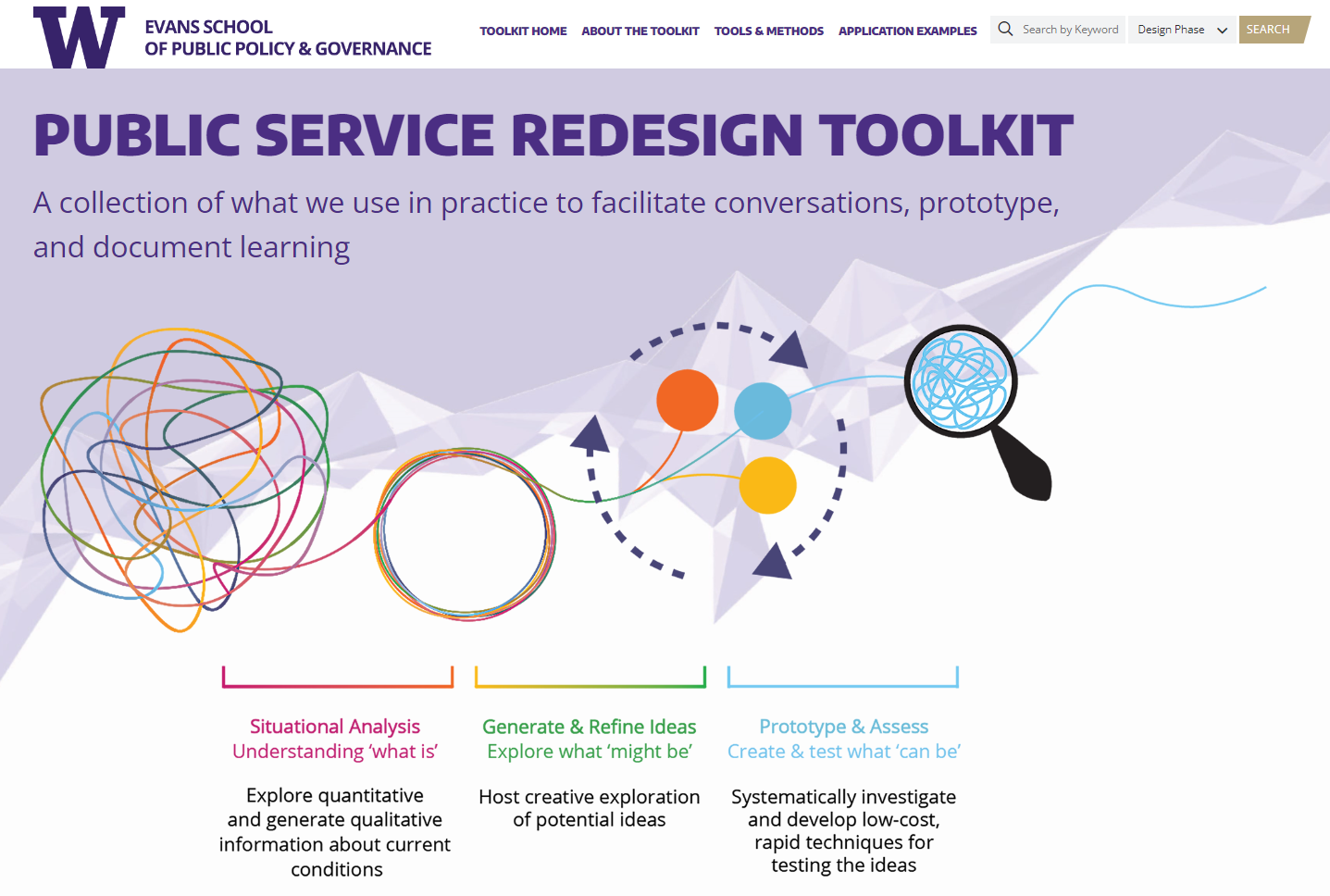
In winter quarter of 2024, the Evans School launched the Public Service ReDesign Toolkit as a public collection of what we use in practice to facilitate conversations, prototype, and document learning. The toolkit is organized into sections that correspond to the three-phase iterative approach to human-centered design processes we use in working with complex systems that focus on action and inquiry:

  • Situational Analysis: understanding ‘what is’
  • Generate & Refine Ideas: explore what ‘might be’
  • Prototype & Assess: create & test what ‘can be’

So far we have actively used this as a resource in our new Leading Public Innovation certificate program, documented tools and methods from engagement trainings within the public health sector, and recorded how tools and methods were implemented by Evans’ policy lab – EPIC (Evans Policy Innovation Collaborative) in recent engagements. As the Toolkit continues to be used, we continue to iterate to meet emerging needs.

We invite you explore this Toolkit! As you browse through, remember – the resources shared here alone won’t make change. Clarify the underlying methodology of change, as it is the foundation for what other elements will be used and how.

Wolfle Action Lab @EPIC

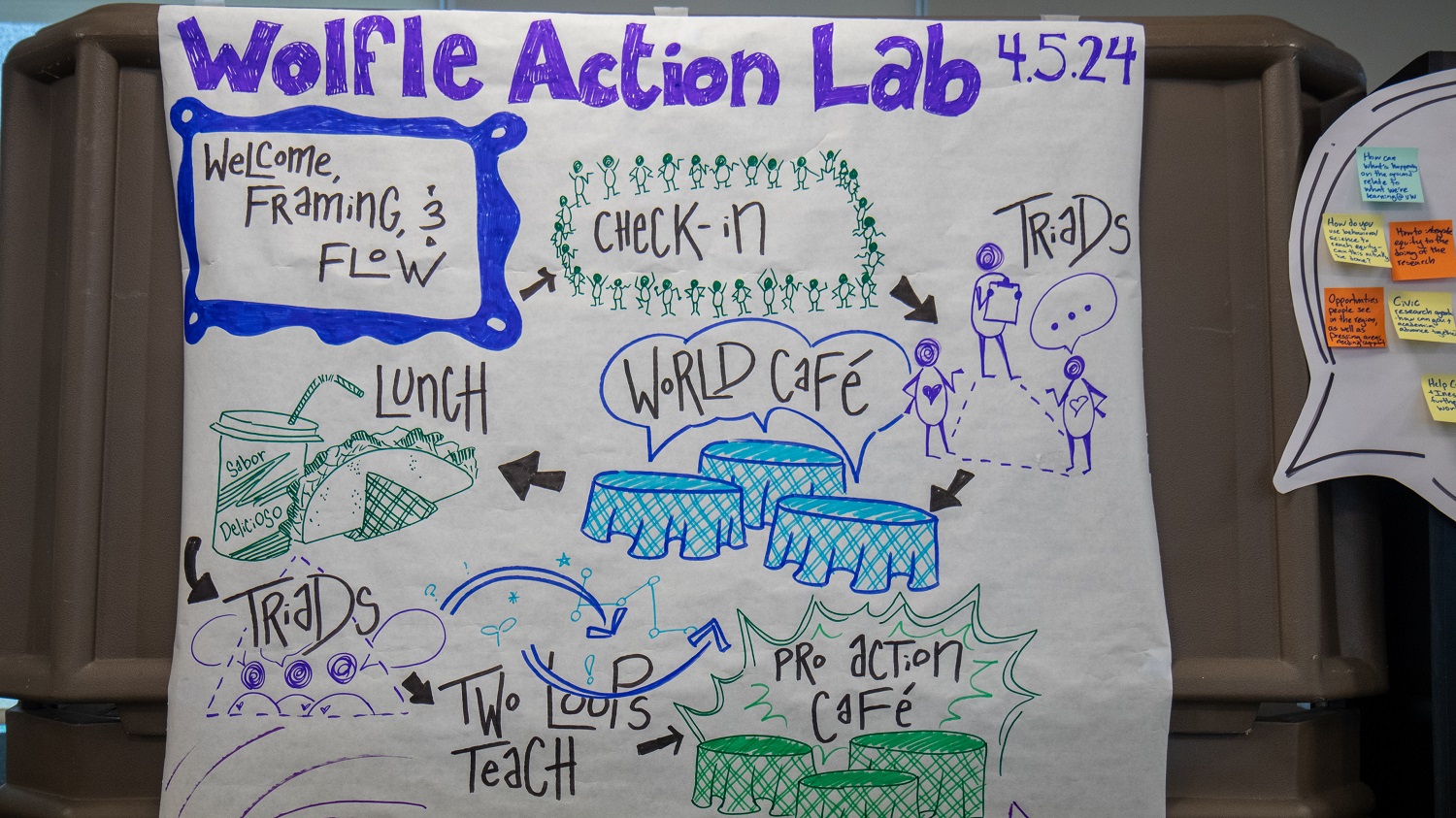
Wolfle Action Lab Flow

The Wolfle Action Lab @EPIC is an important way to engage faculty in the school’s mission to “host communities to co-create solutions to pressing societal problems.” It’s premised on the idea that dialogue and exchange across diverse fields of expertise is necessary for the development and adoption of solutions. The Action Lab draws upon the skilled facilitation tools of EPIC – Evans Policy Innovation Collaborative – staff to host sessions where researchers, practitioners, those with expertise from lived experiences, and policymakers engage in meaningful dialogue across differences. More than simply sharing ideas, research findings, and perspectives, Wolfle Action Labs are intended to develop collaborative planning for program or system redesign, implementation strategies that can be administered in real-time, and feasible policy recommendations. The Wolfle Action Lab convenings and projects operates consistently with the Evans School’s values of equity, courage, and public service.

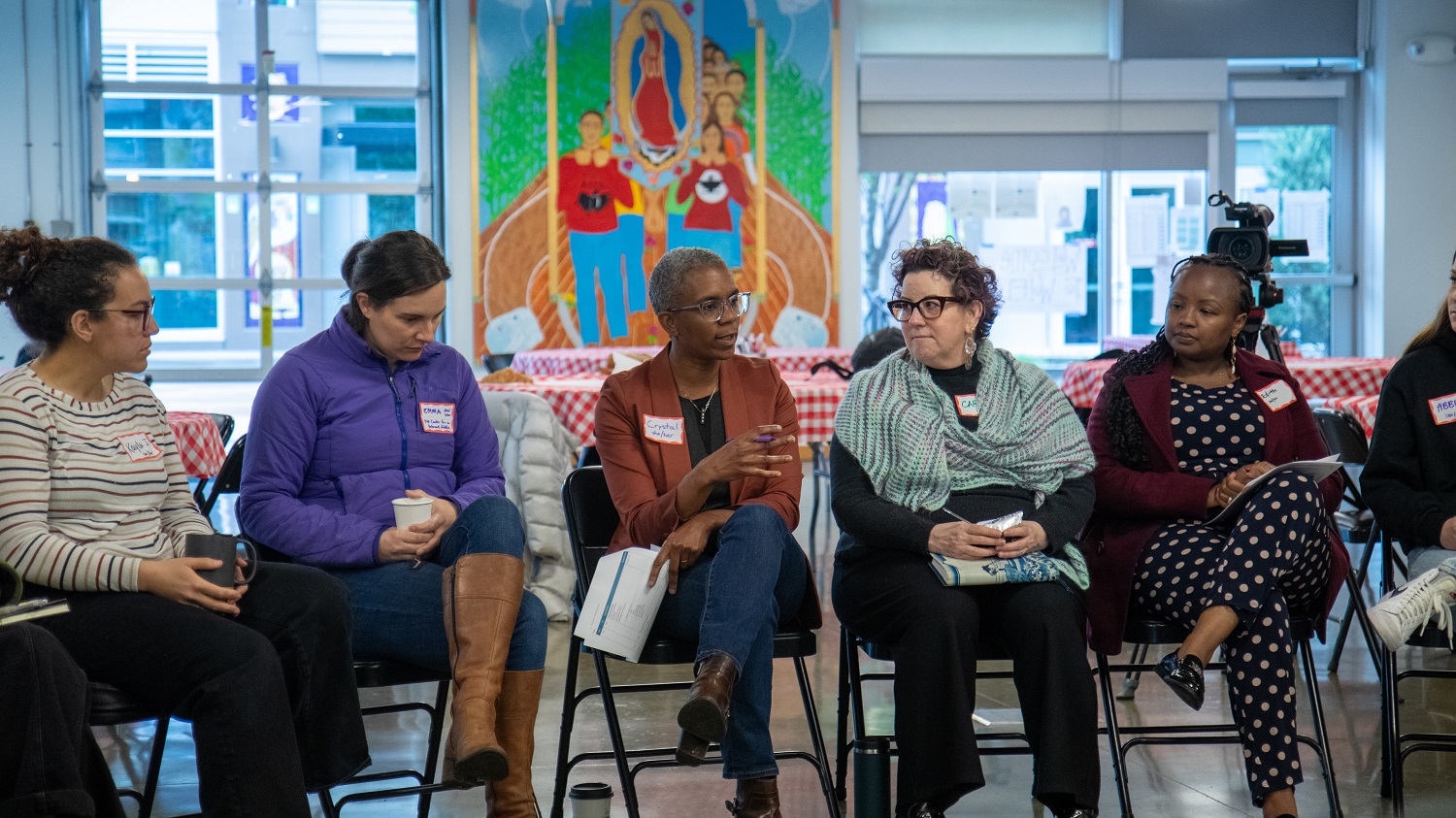
Crystal Hall speaks to circle of participants

On April 5, 2024, Evans School faculty members Crystal Hall and Ines Jurcevic and the EPIC team hosted the inaugural Wolfle Action Lab convening at El Centro de la Raza. They gathered with people from community-based organizations, academia, and government to spark learning, share promising practices, and make authentic connections that seed relationships among people leading equity and behavioral science to enable community-informed change in the public interest. Throughout the day they engaged in various small group discussions around the following questions:

  • When and why did you step into this work?
  • What is the environment you are working in?
  • What are the challenges you confront in trying to change the way you work to better incorporate an equity lens?
  • What successes have you experienced bringing an equity or behavioral science lens to your work?
  • What are opportunities you see in front of you to integrate your commitments to equity-based work with behavioral science?
  • How does your own Identity shape your ability to lead change in your context?

These conversations centered around working to effect systems change were followed by a group teach and discussion on Two Loops – a framework for describing how systems rise and fall, as well as types of roles that often occur as this process unfolds. They wrapped up the afternoon with another conversation process called Pro Action Café, where participants had the opportunity to call on the collective wisdom of the group with calls, questions, or projects they wanted to workshop.

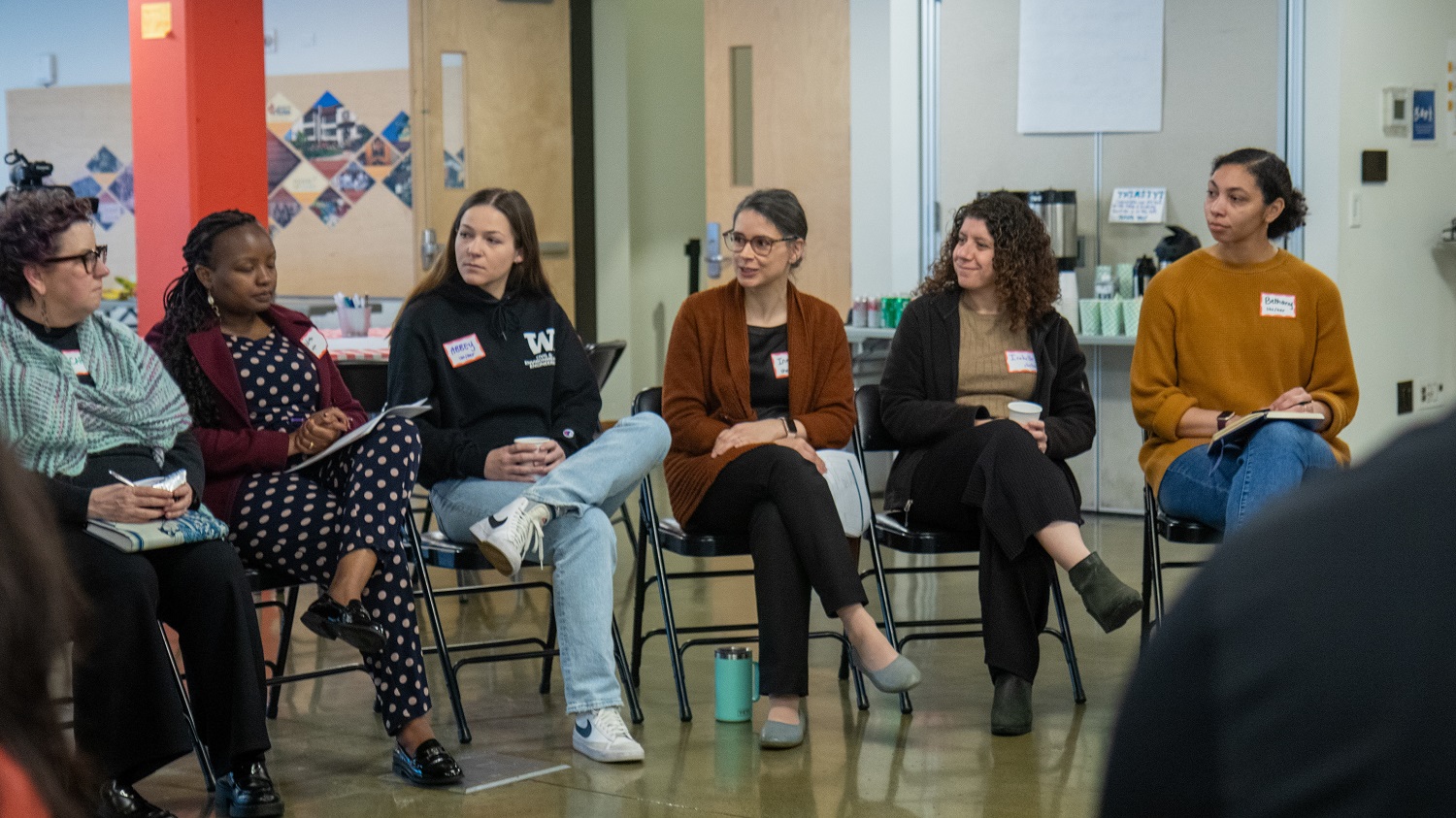
Ines talks to a circle of participants

Interested in learning more?

Theory to Practice: Leading People in a Post-Pandemic World

Theory to Practice logo

Theory to Practice is an ongoing series of discussions hosted by the Evans School that brings together academics and researchers at UW with practitioners in the field to explore key policy, governance, and social sector topics.

On May 9, 2024, the Evans School of Public Policy & Governance hosted a compelling conversation on the challenges and opportunities of managing and leading a public workforce in our post-pandemic world.

Our panelists shared insights and experiences from their work at both local and federal levels, offering valuable perspectives on adapting to remote work, fostering employee resilience, and reimagining service delivery. From research-backed strategies to real-world practices, we delved into the complex issues facing public sector leaders today. Attendees engaged in an honest exploration of the hurdles ahead and the innovative strategies needed to navigate them effectively in today’s workforce.

Resources

Speakers

Lisa Pearson

Lisa Pearson serves as the PBS Regional Commissioner for the Northwest/Arctic Region of the U.S. General Services Administration, providing leadership to the region in delivering programs and services for a portfolio of 504 owned and leased buildings across Alaska, Idaho, Oregon, and Washington.

Pearson began her career with GSA in 2001 as an Employee & Labor Relations Specialist in the Great Lakes Region. She has since held several senior level positions including two stints as Acting PBS Regional Commissioner.

She completed a Bachelor’s in Sociology & Urban Studies at Northwestern University and holds a Master’s Degree in Public Policy from Harvard University’s John F. Kennedy School of Government.

Sebawit (Sebu) Bishu

Sebawit (Seba) Bishu is an Assistant Professor of Public Management at the Evans School of Public Policy and Governance at the University of Washington, Seattle.

Her scholarly work explores race and gender relations in public organizations with a focus on leadership, street-level bureaucracy, identity, and organizational behavior. Bishu’s research asks the question “how do societal, organizational and managerial level factors shape public organizations’ and bureaucrats’ behaviors and decisions, and what are the implications for access to, and quality of, public services?”

Bishu’s work is published in academic journals such as Journal of Public Administration Research and Theory, Public Administration Review, the American Review of Public Administration, and the Review of Public Personnel Administration.  She is currently conducting qualitative research using data from 143 interviews with municipal managers across the United States.

Stephanie Lucash

Stephanie Lucash is Deputy City Manager at the City of Kenmore. She has 30 years of municipal government experience including management and leadership positions at the Cities of Kenmore, Seattle, and Covington. In Kenmore, she oversees an array of critical areas such as economic development, public safety, housing and human services, and more. Her exemplary work in Kenmore has earned her two statewide award.

Lucash is President of the Board of Directors for the Washington City/County Management Association. She also serves on the Association of Washington Cities Board of Directors and as Vice Chair of the Washington Secretary of State’s Archives, Library and Legacy Foundation Board of Trustees.

Before joining Kenmore, Lucash was Director of Citywide HR Planning and Innovation at the City of Seattle where she played a key role in the City’s pandemic response and launched nine citywide human resources projects.

Lucash has a Master’s of Public Administration from the Evans School of Public Policy & Governance at the University of Washington and is a Lean Six Sigma Green Belt, certified Crucial Conversations trainer and Peacekeeper.

Alumni Spotlight: Eduardo & Erica Campos, EMPA ’15

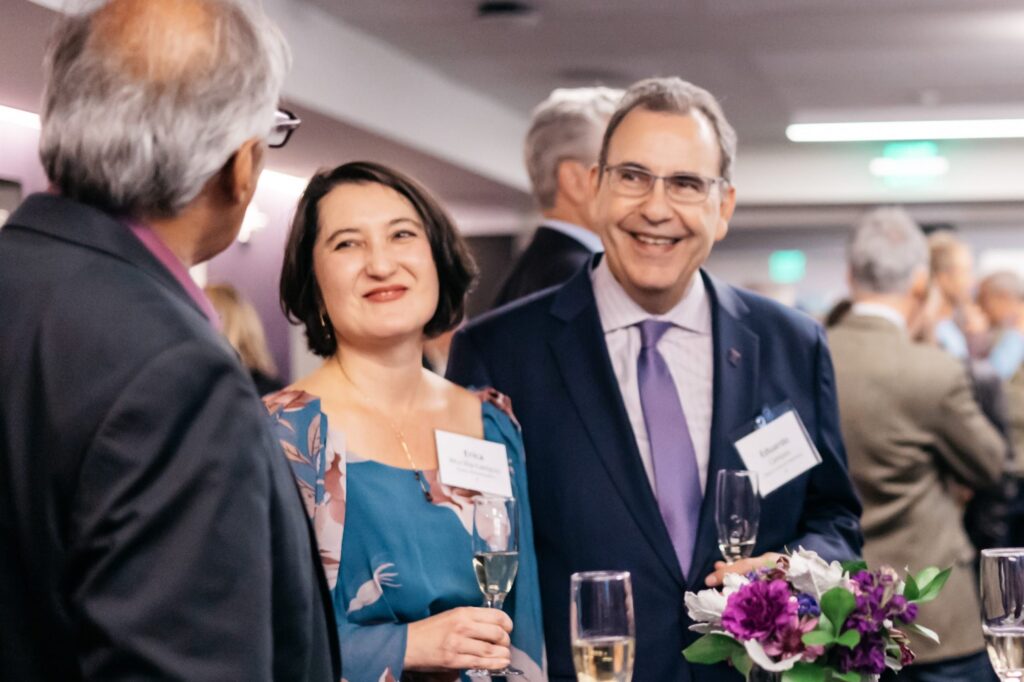
Eduardo and Erica Campos chat with a fellow Evans event attendee while holding glasses of champagne

With the flurry of spring EMPA applications underway here at the Evans School, we wanted to take a moment to celebrate and thank two amazingly committed EMPA alumni: Eduardo and Erica Campos.  

Eduardo Campos and his wife, Erica Campos, came to the U.S. from Brazil in 2003 to work for Microsoft. They quickly fell in love with the U.S. and realized it was where they wanted to put down roots. “As global executives, we were encouraged to pursue a business degree,” said Eduardo. “But we decided that was not our purpose — we wanted to have a broad impact in the community.”  

Both Eduardo and Erica were raised by families dedicated to public service. Erica’s father worked for a utilities department, and her mother was a public-school teacher and principal. Eduardo’s mother was also a teacher, and his father spent 35-years as a tax auditor in Brazil. The values of integrity and compassion, and a commitment to listening to diverse perspectives have driven their lives.  

“And that’s why we chose the Evans School,” said Eduardo. “Beyond critical thinking skill and academic rigor, the faculty helped us learn how to be better human beings, better professionals, and better citizens. And we practiced ways to compromise and bridge the divide on issues.” 

In 2015, the Camposes graduated from the Evans School’s EMPA program. And in 2022, after a long journey, they became U.S. citizens, voting in their first election that November. “It fulfilled our dream, to be able to participate in an important democratic system,” said Eduardo. 

Right after graduation, the Camposes decided they wanted to remain involved at the Evans School and became engaged volunteers and supporters. “We wanted to help other people realize their dreams to serve the community,” said Eduardo, who has served on various Evans School boards including the Advisory Committee since 2017 and the Dean’s Council since 2021. Erica is a member of the Evans School’s Community of Ambassadors.  

“As Dean of the Evans School, I’ve had the privilege to see the impact that Erica and Eduardo have made here at the school—their strategic guidance, their support for our campaign to renovate Parrington, and their hands-on partnerships with our programs, like hosting our Junior Summer Institute scholars for a site visit to Microsoft,” said Jodi Sandfort. “We thank them for their unwavering commitment to our mission and the next generation of leaders.”

Help spread the word about the Evans School’s EMPA, a work-compatible leadership program designed for mid-career public service professionals! The deadline to join the autumn 2024 cohort is May 15, 2024.