Skip to content

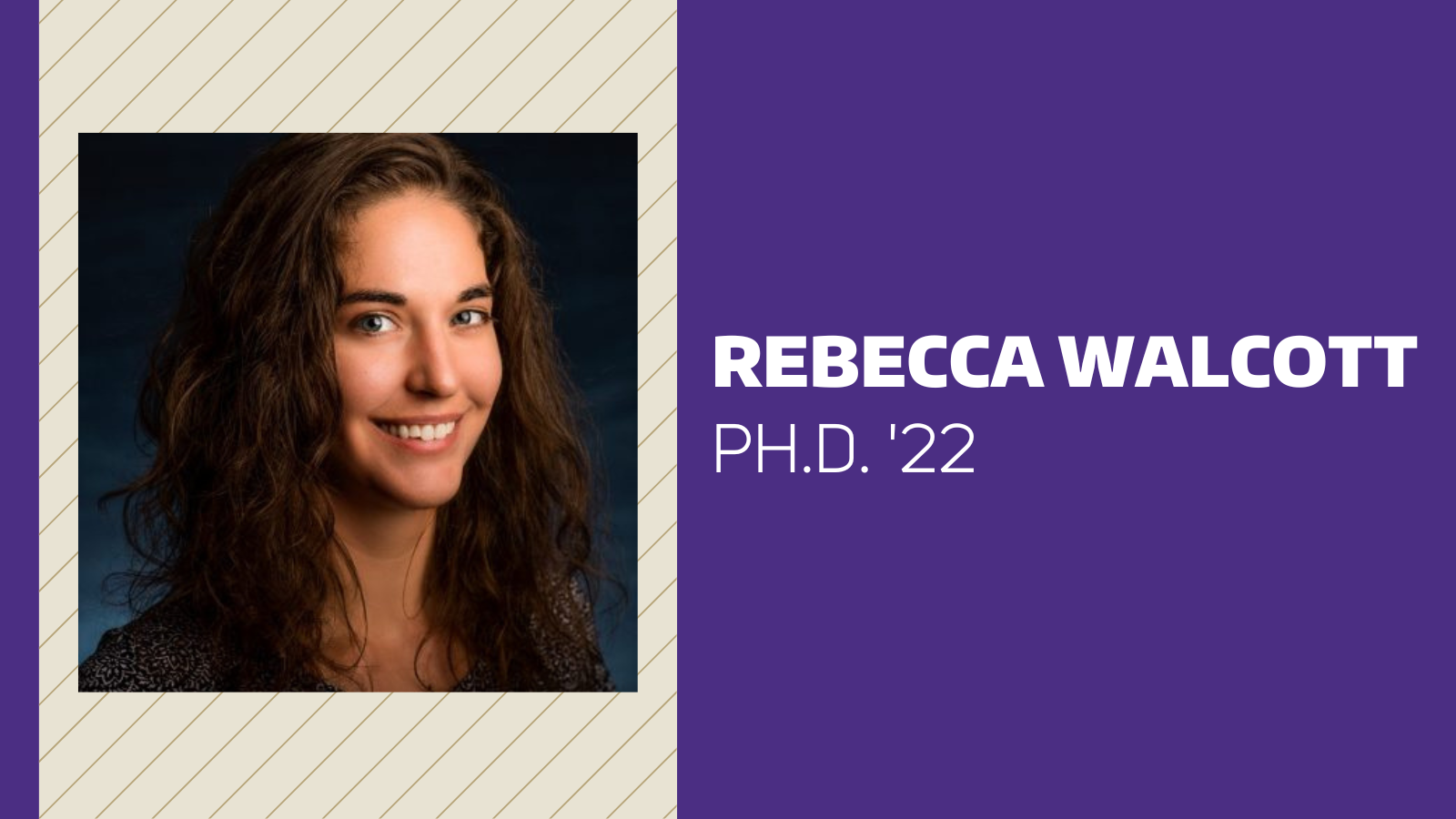
Alumni Spotlight: Rebecca Walcott, Ph.D. ’22

Rebecca Walcott Ph.D. '22

Becka Walcott finished her Ph.D. at the Evans School in December 2022, with dissertation work focused on mobile money and financial inclusion tools in sub-Saharan Africa. The Evans School spoke early in the new year with Becka about her dissertation project.

Evans School: Congratulations on your dissertation defense. Your project examined innovative mobile money tools in sub-Saharan Africa. What is mobile money and why are these critical finance tools for households in sub-Saharan Africa?

Becka: Mobile money refers to financial transactions that take place over SMS networks on mobile phones. SMS is just regular texting – so users don’t need a smartphone or Wi-Fi connection. Plus, mobile money is usually administered through a telecoms company with agents in village bodegas, which means people don’t need to access formal banks to use it. Thus, mobile money is broadly accessible to populations without internet infrastructure or brick and mortar banks.

Evans School: In one study from your dissertation, you find that earned interest can encourage households to use their mobile wallets to store money. You also find increases in mobile savings do not reduce conventional bank account use, rather mobile wallets may lead to greater use of conventional savings bank accounts. These stand out as important findings – tell us more about the original insights of this study.

Becka: Mobile money regulations vary across countries, and Tanzania was the first country to require mobile money providers to distribute interest to mobile wallet accounts. The banks were worried that the ability to earn mobile wallet interest would cause people to pull their money out of formal savings accounts – or act as a disincentive from opening such accounts. My study was the first to examine the effects of providing mobile interest – and I was able to demonstrate that interest can encourage mobile savings without harming the banking sector. Hopefully this evidence can mitigate the concerns of the banking sector and also encourage other countries to offer more mobile financial tools.

Evans School: Another study in your dissertation examined preferences for digital repayment among microfinance borrowers in Uganda. Here you use a mixed methods research design to understand why individuals would opt for digital repayment. Tell us why it was so valuable to have both quantitative and qualitative evidence in this instance?

Becka: The quantitative data could tell us a borrower’s repayment preference at the time the question was asked, plus some important contextual data – but we needed the qualitative data to learn about how each borrower was framing the repayment options. Some were updating their preferences with new information, some were not receiving that new information, and some were influenced by other borrowers. The qualitative data revealed these important nuances that contributed to repayment preference.

Evans School:  You also examine how countries adopt policies governing identity verification across mobile money tools. What did you learn about when countries enact identity verification regulation?

Becka: I learned that policy diffusion from regional neighbors likely plays a large role in adoption timing for these policies. I was surprised that I didn’t find more support for hypotheses around domestic factors and policy adoption, and I think there is room for a deeper examination of the way the domestic political economy can influence the diffusion of mobile money regulations.

Evans School: You must have had a great winter break following your dissertation defense. What’s up next?

Becka: I just started my new job as an economist at the American Institutes for Research, primarily working on international development projects. I’m super excited for this new chapter!

Evans School: Congrats on all your success!

Becka: Thanks!

Evans School Ph.D. Alum Serves as National Poverty Fellow

Evans School Ph.D. alum Sarah Charnes is serving as a National Poverty Fellow for the 2022-23 academic year with the University of Wisconsin’s Institute for Research on Poverty (IRP). Sarah is working in Washington, D.C. for the Division of Data and Improvement (DDI), Office of Planning, Research, and Evaluation (OPRE), U.S. Department of Health and Human Services. Her postdoctoral research fellowship also will provide mentorship from IRP’s network of scholars as she continues to pursue her own research program.

A Q&A with Sarah E. Charnes (PhD ’21)

Sarah Charnes finished her Ph.D. at the Evans School in December 2021, where her dissertation research focused on food assistance and food insecurity. The Evans School caught up with Sarah recently to talk about key findings from her research. 

Your dissertation focuses on food assistance policy and food hardship in the U.S. — what drew you to those policy research areas? 

Before starting my Ph.D. at the Evans School, from 2006 to 2013, I worked as a macroeconomist in the Office of Economic Policy at the U.S. Department of the Treasury in DC. While there, I worked on a wide variety of topics, including income inequality. When I decided to return to school for a Ph.D., it was with the intention of taking a deeper dive into issues of income inequality. At Evans my work around inequality initially focused on social policy and means-tested public benefits. Over time, I realized that my long-standing interests in food behaviors and my training in holistic health counseling gave me unique insights into the realities of food assistance and food insecurity – timely social policy topics.  

Given your work around food assistance policy, what are some of the biggest misconceptions Americans have around food assistance and food hardship? 

First, I would say the common belief that food insecurity “isn’t a problem in the United States” and that it’s only a problem in developing countries, which means it’s not a problem worth addressing through public policy solutions. To the contrary, the most recent estimate by the U.S. Department of Agriculture’s Economic Research Service estimates 10.5 percent of U.S. households are food insecure. That translates into 13.8 million households, which is a large number. The national food insecurity rate reached as high as 14.6 percent during the Great Recession. Those estimates are only the tip of the iceberg, which make food insecurity in the U.S. a problem worth investigating and addressing. 

There are many other misconceptions around food assistance and food hardship that come to mind. What I have observed over the past several years is that food assistance and food hardship is a space where people often have a hard time getting past their own personal beliefs  – especially if they haven’t experienced food insecurity or witnessed it first-hand. For example, if someone becomes convinced that SNAP (the Supplemental Nutrition Assistance Program, the modern-day food stamp program) recipients are prone to commit fraud, it can be very challenging (if not impossible) to change that person’s mind. In reality, fraud is very uncommon. 

Another misconception is that there is a one-size-fits-all, or simple, solution to food insecurity. Food insecurity arises out of a wide array of risk factors operating at different tiers. Short of creating a form of universal income for food consisting of an adequate benefit level, it seems likely that there will need to be a continuation of a rather complicated, multi-pronged approach to tackling the problem of food insecurity through public-, nonprofit-, and private-sector efforts. That said, the idea of universal income for food has gotten some traction recently, so it’s possible that a policy window for this could eventually emerge. 

As you reflect on the dissertation project, which research findings stand out to you as really important for current debates around food policy? 

My dissertation involved three papers that covered a fairly broad range of topics related to food insecurity and food and nutrition assistance policy. The first paper evaluated a program designed to streamline the SNAP application process for recipients of Supplemental Security Income and found evidence suggesting that different modes of implementation for the program were more effective for some subpopulations than others – a point that does not always seem to be the primary focus when interventions are designed to try to improve access to means-tested benefit programs. The second paper tested the extent to which a relatively holistic measure of food access moderates the high degree of association between household disability and food insecurity status. Here, I find that access does not account for much of this relationship (Note: this paper has been accepted for publication in Physiology & Behavior and can be found online here.) The third paper examined acquisitions of free food – food having no price attached to it, such as meals from family or friends – as a function of the amount of time that has passed since a SNAP household received its last benefit payment. In this paper, I find little variability in the acquisition of free food across the SNAP month. This has potential implications for current debates about the behavioral mechanisms driving what is referred to as the “SNAP cycle,” where benefits are typically redeemed in their entirety within the first few days of receipt, rather than being consumed in a smooth fashion across the month as some might expect. I’m excited to dive deeper into the third paper, in particular, as I progress forward with the portions of the dissertation that I have not yet attempted to publish. 

Prior to finishing your Ph.D. at Evans, you worked in the Department of Treasury. Given your experiences in both worlds – how can researchers do a better job of presenting and translating their research for policy audiences? 

Presenting and translating research to policymakers really comes down to one skill: learning how to say what you want to say within 30 seconds. By “30 seconds,” I truly mean 30 seconds. That is MUCH easier said than done – and a skill that does not always seem to be very highly valued within academia. 

I think a great way to practice is to create two or three “highlights” (i.e., brief bullet/talking points) about one’s research – as is asked for by several peer-reviewed academic journals upon submission. Bonus: this encourages clear thinking all around, which is never a bad thing. 

What’s up next for you? 

Currently – meaning, from January through June 2022 – I’ll be an instructor in the Evans School’s MPA program. Specifically, I’m teaching both of the quantitative analysis courses in the first-year core course sequence, with which I was heavily involved during my Ph.D. (as both a pre-doctoral lecturer and a teaching assistant). I’m really happy to be working with this year’s first-year cohort. I’m also currently on the job market for longer-term employment. Please cross your fingers for me! 

Fingers crossed!  It sounds like there are lots of good things in the future.  Thanks for chatting! 

Thank you! 

A Q&A with Rebeca de Buen Kalman (PhD ’21)

This past summer, Rebeca de Buen Kalman completed her Ph.D. at the Evans School, where she focused on the intersections between environmental policy, climate change policy, transportation, and public health. Evans had a chance to sit down with her for a few minutes to talk about her dissertation research.

Your dissertation project is titled, “Pueblos Bicicleteros: Three Essays on Cycling Policy in Mexican Cities,” but you use the evolution of cycling policy in Mexico as a lens into contemporary urban environmental policy. Explain why cycling policy is so central to how major cities address today’s climate challenges.

Transportation is one of the largest and fastest-growing sources of greenhouse gas emissions globally and thus a critical area for climate mitigation policy. Increasing cycling commutes and trips in cities has the potential to reduce emissions and improve and health. Cycling policy can be especially compelling when it is integrated within a larger transportation strategy combined with transit.

Safety and equity concerns, however, must be present as we rethink transit policies. In the cities I studied, most urban cyclists are low-income workers who mostly cycle out of necessity. Framing a bicycle as “one less car” erases the experiences of these cyclists who might perceive the bicycle as a marker of poverty and whose perspective and needs are usually left out of cycling plans.

Why do you think cities in Mexico, as well as in the U.S. and in other places around the globe, struggle to better incorporate cycling within urban transportation strategies?

There are many reasons why incorporating cycling into transportation can be tricky in cities where low cycling rates are the status quo. Most barriers revolve around our current model of mobility, or ‘automobility’, which is centered around the cars and car-centric culture. In most cities, public policies, public spending, and regulations related to street design have historically favored car mobility at the expense of other modes like transit, walking, and cycling, which further entrenches car-centric life-styles. In many places, like the cities I studied in Mexico, some people associate cycling with low economic status and cars with progress and social mobility. Another common cultural barrier relates to society’s tendency to consider bikes as toys or means of recreation, rather than part of the transportation system.

While there are a lot of barriers, there is also a growing appetite from some sectors of the population to move towards multimodal lifestyles that include cycling. Evidence from travel-behavior data reveals an opportunity to reduce car use and substitute cycling for short trips, especially in core urban areas. There also is mounting evidence that younger generations are more environmentally conscious and inclined toward shared and multi-modal transportation when these are available.

We also might not think of cycling policy as a critical element of tackling inequality in modern cities. How does your dissertation show this is anything but the case?

The relationship between cycling and equity is not straightforward. Cycling policy can absolutely be a tool to tackle inequality, but bicycles and cycling policy are not inherently equitable. Bikes are a low-cost and efficient form of getting around in a city. In urban areas like the ones I studied in my dissertation, roughly one-fifth of trips are done by car but the vast majority of public funds for mobility are invested in car infrastructure. Improving cycling conditions through a variety of measures can be a way to improve people’s access to services and opportunities at a very low cost. Improving cycling conditions can also have benefits to pedestrians through improved street design, with important equity implications since riders from vulnerable communities are more likely to be hit by cars as pedestrians.

Measures that are meant to improve cycling conditions, however, are often implemented in visible central city areas and not necessarily accessible to lower-income people who might benefit the most from them. Cycling lanes are frequently implemented on sidewalks or at the expense of sidewalks, limiting pedestrian mobility and accessibility. Sometimes cycling-related policy can even further marginalize cyclists since cycling infrastructure is often determined once motor traffic needs have been prioritized, without addressing the fundamental asymmetry of power that makes cycling unattractive or unsafe.

Readers will be impressed with your research design, which involved the integration of many different data from many different parts of Mexico. How might environmental policy scholars use mixed methods designs to better inform policymaking?

The development of any project related to the built environment is situated in a complex web of actors, institutions, and social processes, where data is often scarce and disperse. I think that mixed methods are crucial for understanding these types of social phenomena. In my dissertation, I studied the trajectories of ten mid-sized and large cities who have implemented cycling infrastructure to different extents. I also took a deep dive into the local social movements that have sparked the adoption of cycling related policies. I used various qualitative and quantitative methods that leverage diverse data sources, including open source and crowdsourced transportation data on infrastructure and travel, administrative data, policy documents, and interview data.

The questions I asked in my dissertation were oriented towards understanding processes and mechanisms rather than questions of cause and effect. To have a full story on each of my cases and parameters that could be compared systematically in my analysis, I had to draw from a variety of sources. I also needed to be through for purposes of validation and triangulation.

Considering the bigger picture, in public policy and management, we ask cause and effect questions because we want to know how interventions impact our desired outcome. But we also need to know how to get things done, the mechanisms at play, and the nuances involved. There is an implementation process between a policy and its effect that requires organizations, institutions, and people. Policy and management are also contextual. We need to draw on various methods to situate ourselves to understand the nuances of public problems and potential policy solutions. Mixed methods are therefore a powerful tool for policy research to become more relevant to policymaking and implementation.

Tell us what you’ll be doing next for your next project at the Evans School.

I am a postdoctoral fellow for Ocean Nexus at the UW EarthLab and the Evans School. Ocean Nexus is an international network of ocean governance scholars based at the UW. Our team at the Evans School works with network members to develop applied policy analysis with an explicit focus on social equity. We are developing a framework to guide the operationalization of equity in ocean governance-related policy analysis through this process. We are also studying how policy problems are discussed in ocean governance research to identify gaps that reduce the applied impact of policy research in this field. Our ultimate goals are to help ocean governance scholars make their research more policy relevant and bring equity to the forefront of policy analysis.

Learn more about people mentioned in this post

Evans Ph.D. Student Ellie Terry Examines Impact of Free Pre-K

Working with co-authors Elias Ilin and Samantha ShampineEvans PhD student Ellie Terry recently published a research working paper at the Federal Reserve Bank of Kansas City entitled, “Does Access to Free Pre-Kindergarten Increase Maternal Labor Supply?” The paper examines the relationship between pre-K program provision and labor force participation of women with young children across all U.S. states. Findings suggest that access to free Pre-K programs increases overall maternal labor force participation by 2.3 percentage points.  Click here to read the paper. 

Learn more about people mentioned in this post

Several Evans Ph.D. students were recognized at the Harry Bridges Center for Labor Studies Annual Awards

Several Evans PhD students were recognized at the Harry Bridges Center for Labor Studies Annual Awards dinner this week. Elizabeth Pelletier was honored for a Washington State Labor Research Grant looking at employment instability around the time of a birth.  Ellie Terry also received a Washington State Labor Research Grant for a project that models the impact of a proposed Guaranteed Income Program in Washington State.  Matt Fowle received a Graduate Student Research Grant for a collaborative project on criminal justice monetary sanctions and labor market participation, with co-author Lindsey Beach from Sociology.

A Q&A with Ben Glasner (PhD ’21)

This past summer, Ben Glasner completed his Ph.D. at the Evans School with expertise in labor market policy and the gig economy. He took some time from his work as a postdoctoral research scientist at Columbia University recently to chat about his dissertation work. 

Your dissertation research focused on self-employment and the gig economy – explain why this is such a critical portion of the labor market for scholars and policymakers alike?

Self-employment work arrangements, and specifically work within the gig economy, are becoming increasingly commonplace. Yet, these types of work arrangements often are excluded from labor policy or regulations intended to protect and support workers. As a result, policy tools like the minimum wage are not designed for the self-employed. Workers who are operating simultaneously under multiple firms at a single point in time (e.g., driving for Uber and Lyft simultaneously), or whose hours are prohibitively difficult to track don’t receive the same coverage as a traditional hourly payroll employee who punches a time clock. 

Such exclusions are nothing new. When the minimum wage was first introduced through the Fair Labor Standards Act, a number of jobs were not covered and those exclusions meant a significant share of black and female workers were not covered by the first minimum wage laws. Such exclusions remained in place well into the 1960s and were key parts of the civil rights movement. 

Today, the remnants of past exclusions persist. We have ended up with a patchwork system of supporting workers. From health care to minimum standards of living, where a person works and how that work is done has important consequences to what protections or benefits they receive. I think the gig economy is really the front line of the debate over social support and the division between efficient labor markets and fair labor markets. 

How does your dissertation research extend our understanding of the impact of minimum wage laws? 

My dissertation project fills key gaps in the minimum wage literature. One key gap I explored was whether higher minimum wages changed the demand for workers or jobs exempted from minimum wage laws. When minimum wages increase, I find evidence of an increase in participation in the uncovered labor market, but it is driven by urban areas with access to the online gig economy. Another part of my dissertation project examines the question of minimum wage effects on multiple jobholding. The puzzle here is that if minimum wages theoretically could both increase and lower multiple jobholding. My work, however, I found that minimum wages had no significant impact on multiple jobholding in aggregate. 

What are the key policy research questions we should be asking to better understand the experiences of workers holding multiple jobs? 

Today, I’d say there are two key features about multiple jobholding to explore. One, hours and schedules can be difficult to coordinate between employers, which leads to unstable scheduling. Two, because individuals are more commonly combining earnings from payroll positions with self-employment, some workers may use on-demand “employment” through the gig economy to help fill the gaps of an instable schedule. We don’t know a lot about how workers make decisions about holding multiple jobs or balancing hours across jobs. This is particularly important when we consider the different experience of multiple jobholders with high earnings and those with multiple jobs who still struggle to keep their heads above water. 

When you talk to state and local policymakers about raising the minimum wage, what advice or guidance would you give them? 

Primarily, I’d encourage policymakers to consider the differences between federal, state, and local minimum wage rates in a given setting. I believe minimum wage increases are a positive tool for improving work outcomes, but they are not the solution to all issues of job quality or underemployment. In fact, minimum wage laws can be rather limited tools because they miss workers who are working in the uncovered or the informal labor market. This often means the most vulnerable workers will not be reached by these policies. 

Tell us about what you’ve been up to since finishing your dissertation work. 

I have just started a new position as a Postdoctoral Research Scientist with the Center on Poverty and Social Policy at Columbia University. While there I’ll be conducting analyses of the effects of major social policies and reforms on the poverty rate and other indicators of well-being. These analyses will include long-term studies of the intergenerational transmission of poverty, but also studies of contemporary policies and their effects. All the work will be under the great team headed by Irwin Garfinkel, Jane Waldfogel, and Christopher Wimer.

A Q&A with Veda Patwardhan (PhD ’21)

Veda Patwardhan recently finished her Ph.D. at the Evans School with expertise in household economics and gender. We caught up with her during a break in her day at the Institute for HealthMetrics and Evaluation (IHME) to talk about her dissertation project.

Your dissertation research focuses on how policy interventions and contextual factors shape the roles of women within households in India and Malawi. How did this project emerge over the course of your training at the Evans School?

As a Research Assistant for the Evans Policy Analysis and Research group (EPAR) during my first year as a doctoral student at Evans, I worked on a project conceptualizing the pathways through which empowering female farmers in low and middle-income countries may yield economic benefits. Thinking about the theory behind why gender differences AND inequalities have real consequences for individuals and families piqued a long-term research interest in this area. As that work progressed, I knew I wanted to focus on the intersection of public policy and gender inequality.

I also was motivated by the fact that women’s economic empowerment is an important policy objective internationally. Multi-lateral organizations, foundations, and several governments worldwide are making substantial commitments to gender equality and women’s economic empowerment. Many low and middle-income countries have implemented female-centric social protection and financial inclusion programs. For example, cash transfer schemes, self-help groups, microcredit, bank account provision and public works programs often explicitly target female beneficiaries.

Early in your dissertation, you powerfully note that “control over income is a crucial aspect of women’s economic empowerment.” What were some of the most important insights you discovered about factors shaping how women have control over household income and what having that power means for them and their families?

There are many important findings in my work. One that stands out relates to how the source of household income matters for women’ control over income (WCI). My work in Malawi finds that women have higher sole decision-making for income from public transfer sources like cash and food transfers, as well as remittances, compared with salaries, wages, and farm income. This is very interesting, as research on women’s economic empowerment hasn’t so far considered how the source of household income can really matter for who controls it! My findings in Malawi show women have higher control over transfers than other income sources, even when men are present in the household, suggesting that targeting transfers to women may yield benefits. This also helps unpack why maternal cash transfers like the Mamata Scheme in India (which I examine in another one of my dissertation chapters) have positive effects on children’s health.

This project analyzes data from two quite different settings. How might insights from your dissertation work shape your approach to comparative policy research in the future?

This is a great question. I think that conducting comparative policy research is important for the international development field, as generalizing across regions is difficult and may not always be desirable or accurate. The underlying theme of my work in India and Malawi is similar, but in India, I analyze the effect of a maternal cash transfer program on child outcomes, while my work in Malawi looks at the household and contextual drivers of women’s control over income. Over the course of my dissertation writing, I also realized that analyzing different types of research questions in these two geographies helped solidify my understanding of the existing literature, theoretical perspectives, and research gaps on women’s control over income. I look forward to conducting cross-country analyses in my future research.

What would you say are the biggest takeaways from your work for policymakers and nongovernmental organizations working to empower women in different contexts around the globe?

Policy design is incredibly important. For instance, while examining the impact of a maternal cash transfer scheme in India on child nutrition, I find that children in the poorest households benefit significantly less than those in wealthier households. This suggests that marginalized populations may face obstacles to participation and suggests changes in policy design. For example, policymakers may wish to modify eligibility criteria, or behavioral requirements — such as receiving prenatal care – that could hinder access for marginalized groups.

Paying attention to what drives women’s empowerment is important as well. In Malawi, I find that women’s decision-making over farm income increases following drought. However, this may not reflect an improvement in women’s well-being, if women have a higher workload on the farm and at home. Female farmers tend to have less access to information on climate change and climate-smart-agricultural practices, leading to lower adoption rates compared to men. So, we need policy to recognize the role climatic factors play in women’s farm decision-making. Interventions to improve women’s land tenure security, access to agricultural inputs, and safety nets like cash transfers can play an important role here.

Tell us a little about what’s next for you.

I am excited to start a Postdoctoral Scholar position with the Institute for Health Metrics and Evaluation (IHME), which is a global health research center based at the University of Washington. My work will focus on examining gender inequalities in health.