Skip to content

Reducing Child Marriage Through Community Intervention

An empty classroom with wooden desks and a blackboard

Evans faculty Isabelle Cohen co-authored an article in the journal Nature that looks at how a northern Nigerian program is helping to dramatically reduce child marriage rates. “Pathways to Choice” is a woman and Nigerian-led program run by the Centre for Girls Education that uses a range of community approaches to support girls schooling. By working with engaged community and religious leaders, the Pathways program provides girls with safe-space groups, remedial education, and help reenrolling in school or vocation training.

Isabelle brought her background as an economist with nearly fifteen years’ experience working in developing countries to figure out how best to conduct quality research and evaluate the program’s impact. The research team surveyed 1,181 unmarried girls between 12 and 17 years-old across 18 communities before half of communities were randomized into the program in 2018, then surveyed the same girls again after the program had ended in 2020. They found that 79% of girls in communities that participated in the program remained unmarried, compared with only 13.8% in communities who did not.

Isabelle and her colleagues concluded that the Pathways program increased the perceived value of girls’ education and reduced the stigma of delaying marriage. With more than 12 million girls marrying before the age of 18 every year, leading to less schooling and autonomy and greater health risks around childbirth, the results from the Pathways program offer promising solutions.

Currently, variations of Pathways are being tested in 40 communities in Kaduna State in Nigeria to further inform cost-efficient scale. The Centre for Girls Education is partnering with CARE to adapt the program in neighboring Niger. Both projects are funded by the Gates Foundation.

Read the Policy Brief

Postsecondary Education in Washington

Washington stands out nationally for its robust network of 34 community colleges and six public universities. The state has also earned recognition as a pioneer in longitudinal data systems that connect education directly to workforce outcomes. Building on these powerful foundations, we collaborate with state agencies, policy innovators, and diverse stakeholders to equitably transform Washington’s higher education landscape. Our dynamic initiatives have tackled transfer pathway redesign, expanded community college baccalaureate opportunities, improved data utilization in CTE programs, and forged strategic partnerships with individual institutions to boost student success.

Publications

Theory to Practice: “Antiracist by Design” Book Launch

Theory to Practice logo

Theory to Practice is an ongoing series of discussions hosted by the Evans School that brings together academics and researchers at UW with practitioners in the field to explore key policy, governance, and social sector topics.

On December 11, 2024, the Evans School of Public Policy & Governance hosted our Theory to Practice: Antiracist by Design Book Launch with Associate Professor Crystal C. Hall. This thought-provoking event celebrated the launch of her powerful new book on advancing antiracist practices in policy and design.

The evening featured an engaging interview led by Charmila Ajmera, MPA ’20, who explored the book’s themes and its inspiring call to action for creating equitable systems through intentional design. The discussion illuminated the real-world implications of antiracist work and the challenges and opportunities of embedding these principles into practice.

Attendees were invited to join a dynamic Q&A session, where thoughtful questions deepened the conversation around antiracism and systemic change. This meaningful exchange set the stage for a community-driven dialogue, fostering connections and shared commitments to advancing equity in policy and governance.

Resources

Speakers

Crystal Hall joined the Evans School faculty in 2008. Her courses include Quantitative Analysis, Psychology for Policy Analysis, Intergroup Relations for Public Policy, and Race and Equity for Policy and Governance.

Her research explores decision making in the context of poverty, using the methods of social and cognitive psychology, along with behavioral economics. This work has had a particular focus on financial decision making and economic opportunity for low-income families. In addition to broadening the theoretical understanding of the behavior of this population, her work has also explored new ways of incorporating these insights into policy design and implementation. She has a record of serving government agencies at the local, state, and federal level – including having served as a Fellow on the White House Social and Behavioral Sciences Team and the Federal Office of Evaluation Sciences at the General Services Administration.

Professor Hall holds an appointment as an Adjunct Associate Professor of Psychology in the University of Washington Department of Psychology. She is also an Academic Affiliate of ideas42, an Affiliated Scientist of the Behavioral Change for Good Initiative, and a Faculty Affiliate at both the University of Washington’s West Coast Poverty Center (WCPC) and Center for Studies in Demography and Ecology (CSDE).

In addition to her scholarly work, Professor Hall has provided guidance and training to community organizations, nonprofits, and government agencies seeking to implement tools from psychology and behavioral economics into the design and delivery of their programs and services. She holds a PhD and MA in Psychology from Princeton University. In addition, she holds a BS from Carnegie Mellon University in both Decision Science and Policy and Management.

Charmila Ajmera is Environmental Justice Policy senior manager in the Environmental Public Health division of the Washington State Department of Health. Prior to joining the agency, she worked with the environmental justice coalition, Front & Centered to help draft and pass the 2021 Healthy Environment for All (HEAL) act, and served as an Inclusion Manager at Tableau and Salesforce. She has been a staunch and effective advocate for equity and anti-racist policies and practices both in her professional and academic careers for the last 15 years. Outside of work, she loves enjoying the beauty of the PNW with her 2 year old daughter, partner, and pup.

Dean’s Forum: Trust on the Ballot

Dean's Forum Logo

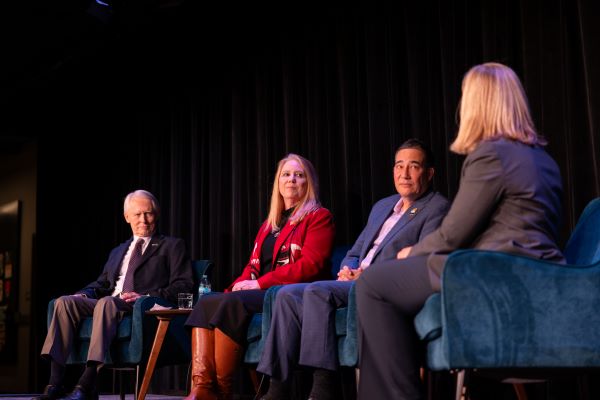
On Thursday, November 7, the University of Washington’s College of Arts & Sciences and the Evans School of Public Policy & Governance hosted Trust on the Ballot: Voting in Washington. The forum brought together three Washington Secretaries of State to explore the history and evolution of voting systems in Washington, examining both the successes and challenges within the current polarized climate following the November 5, 2024, General Election.

The panel discussion featured insights from current Secretary of State Steve Hobbs, along with former Secretaries Kim Wyman and Sam Reed. Together, they discussed how Washington’s voting systems have adapted over the years and the factors shaping election integrity and voter trust today. Their collective experience provided an in-depth look at the complexities of securing elections in an era marked by increasing challenges to democratic processes.

Event Panelists

Panelists sit in chairs on stage

Sam Reed, Former Washington Secretary of State
Kim Wyman, Former Washington Secretary of State
Steve Hobbs, Washington Secretary of State
Jodi Sandfort, Dean & Professor, Evans School

Evans faculty Crystal Hall co-authors new book on antiracist behavioral design

Antiracist by Design is a compact and informative guide for organizations, policymakers, and everyday people who want to use the tools of behavioral science in practical ways to design and implement policies and practices that drive racial equity forward.

Two Antiracist by design books with yellow covers floating in front of a pale blue background

Co-authored by Crystal Hall, an Associate Professor at the Evans School, and Mindy Hernandez, the Living Lab for Equitable Climate Action at the World Resources Institute, Antiracist by Design is a call to action, providing tools and a roadmap for an antiracist approach to applied behavioral science.

The book begins by tracing the history of applied behavioral science and how the field has historically shied away from tackling systemic issues. Hall and Hernandez then offer an antiracist framework for updating the mechanics of behavioral design, blending scholarly research alongside accessible stories, examples, and concrete steps for moving racial justice forward.

Reflecting on the process, Hall shared, “Mindy and I are thrilled for the release of Antiracist by Design. This book represents years of conversations and reflections on the missteps of the field (starting with our own!). My teaching and scholarship at the Evans School have been so influential throughout this process, especially my work with students. I’m so delighted that I’ll have the opportunity to celebrate the book and its implications with our community.”

Antiracist by Design will be released on November 19 by MIT Press. Hall will hold a hybrid book talk on December 11 as part of the Evans School’s Theory to Practice lecture series.

Dean’s Forum: Political Participation & Voting Access

Dean's Forum Logo

The Dean’s Forum series focuses on the intersection of race and public policy in support of the Evans School of Public Policy & Governance’s mission to host community conversations that inspire public leaders.

On April 19, 2024, Dean Jodi Sandfort hosted a conversation with Vincent Hutchings, Garth Fell, and Calista Jahn that probed the national historic and contemporary dynamics around the most basic of our rights as citizens in a democracy. During this election year, we are constantly reminded of the importance of voting and other acts of political participation. This election comes at a time when racial and ethnic disparities in voting and participation persist. The election system is under scrutiny and federal protections against racialized disenfranchisement, such as the Voting Rights Act, have been invalidated by the Supreme Court. Understanding these matters is critical if we are to strengthen institutions of democracy nationally and to continue Washington State’s leading work around election administration integrity.

Event Panelists

Vincent Hutchings

Vincent Hutchings
Diversity and Social Transformation Professor; Hanes Walton, Jr. Collegiate Professor of Political Science and Afroamerican and African Studies
University of Michigan

Garth Fell

Garth Fell
County Auditor
Snohomish County Auditor’s Office

Cali Jahn

Calista (Cali) Jahn
EPIC Innovation and Engagement Manager
University of Washington

Dean Jodi Sandfort

Jodi Sandfort
Dean
University of Washington
Evans School of Public Policy & Governance

Event Recording

Dean’s Forum: Data Informed Practices and Consumer Protections

Dean's Forum Logo

The Dean’s Forum series focuses on the intersection of race and public policy in support of the Evans School of Public Policy & Governance’s mission to host community conversations that inspire public leaders.

On February 2, 2024, Dean Jodi Sandfort hosted a conversation with Dalié Jiménez, Claire Johnson Raba, and Raphaël Charron-Cheniér about navigating consumer debt and the difficulties faced by individuals, disproportionately affecting people from communities of color. Data-driven investigations are important to inform policies, interventions, and strategies that actively promote more equitable consumer protection. Federal and state laws that intervene in the market provide some basic protections but much of their impact hinges upon implementation. In this Dean’s Forum, the panelists discussed how policy, programs, and litigation play roles in trying to address the historic inequities in debt burden.

Event Panelists

Raphael Charron-Chenier

Raphaël Charron-Chénier
Associate Professor SST Justice and Social Inquiry
Arizona State University

Dalié Jiménez

Dalié Jiménez
Professor of Law
University of California Irvine
School of Law

Claire Johnson Raba

Claire Johnson Raba
Assistant Professor of Law
University of Illinois Chicago Law

Dean Jodi Sandfort

Jodi Sandfort
Dean & Professor
Evans School of Public Policy & Governance
University of Washington

Event Recording

Conversation Resources

Panelist Deck

Public Cash Assistance and Spatial Predation: How State Cash-Transfer Environments Shape Payday Lender Geography Megan Dohert Bea, Mariana Amorim, and Terri Friedline

Predatory Inclusion in Consumer Credit: Explaining Black and White Disparities in Payday Loan Use Raphaël Charron-Chénier

Are High-Interest Loans Predatory? Theory and Evidence from Payday Lending Hunt Allcott, Joshua Kim, Dmitry Taubinsky, Jonathan Zinman

Rethinking Credit as Social Provision Abbye Atkinson

Native Communities Face Sustained Challenges to Building Financial Resilience Kassandra Martinchek,
Alexander Carther

Dirty Debts Sold Dirt Cheap Dalié Jiménez

Auto Lending Last Week Tonight with John Oliver

Advancing Justice for All in Debt Collection Lawsuits Michigan Justice for All Commission

Judges in Lawyerless Courts Anna E. Carpenter, Colleen F. Shanahan, Jessikca K. Steinberg, Alyx Mark

What Parents Say About Using Washington Paid Leave for Physical Health

Evans Professor Heather D. Hill and MPA Student Diana Rucavado have published a new Evans Research Brief on Paid Family Medical Leave. The Washington Paid Family and Medical Leave Program (WA Paid Leave) provides up to 12 weeks of paid leave for workers who need time to care for their own medical needs, care for a familymember, or bond with a new child. In interviews with parents who used WA Paid Leave for physical health reasons, either their own or a family member’s, we find that the program allowed the parents to take the time needed to address health issues with less stress about work or income. However, for some taking leave was financially challenging or offered insufficient time for recovery or illness management. The findings of the study provide insight on how specific economic circumstances and/or health conditions affected workers’ experiences during leave.

Read the full brief.