Skip to content

Alison Cullen Leads Research on Wildfire Risk

Wildfire

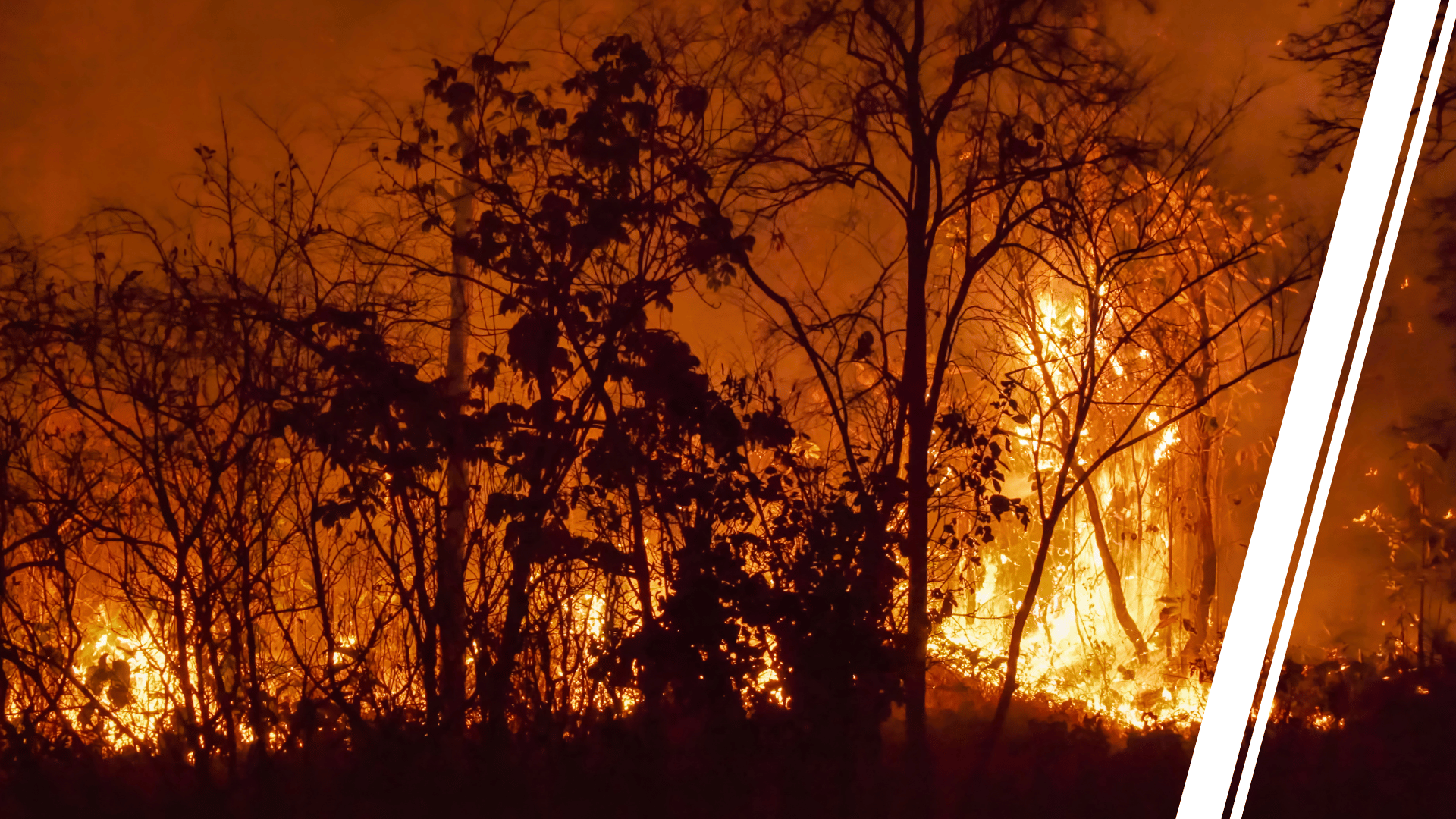
Alison Cullen, the Daniel J. Evans Endowed Professor of Environmental Policy at the Evans School, along with researchers from University of Washington, NCAR (National Center for Atmospheric Research), and University of California, Merced, leads an NSF-funded project titled, ”Managing Future Risk of Increasing Simultaneous Megafires,“ that explores the challenges megafires currently pose to decision makers and stakeholders, and supports proactive planning for future scenarios to mitigate risk. This interdisciplinary research team brings expertise in decision science, climate science, statistics, and fire science to collaborations with a host of decision makers including fire managers, fire ecologists, and land managers for tribal and U.S. government agencies.

Emblematic of this work have been two recent co-authored publications the explore wildfire risk and managements strategies. In June 2022, Evans Ph.D. student Sunniva Bloem, along with Cullen and co-authors, published an article, “The Role of International Resource Sharing Arrangements in Managing Fire in the Face of Climate Change,” in the journal, Fire. Longer and more impactful fire seasons are proving to outstrip national fire suppression capacity in many settings, which have led to resource sharing arrangements between countries across the globe. The authors explore the recent emergence of these partnerships and identify paths to strengthening cross-national resource sharing agreements.

More recently, Cullen contributed to the work of a large team that published an article entitled, “Reimagine Fire Science for the Anthropocene,” in Proceedings of the National Academy of Sciences (PNAS) Nexus. Amid rising fire dangers globally, the article develops a cross-disciplinary research agenda essential to improving mitigation of and response to an “increasingly flammable world.”

NextGen Civic Leader Corps Launch

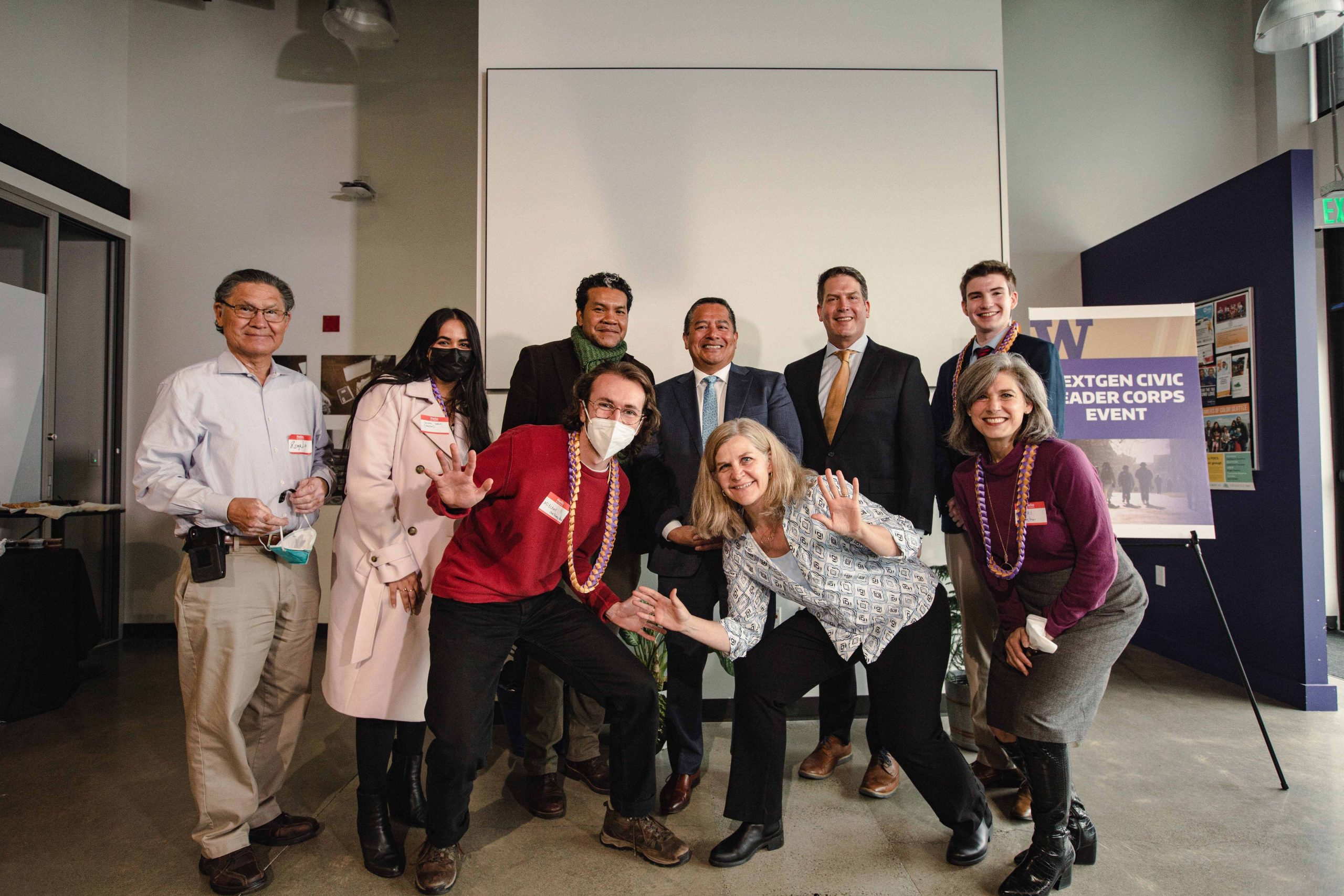
NextGen students and community leaders celebrate the launch of NextGen Civic Leader corps

On Friday, May 6, 2022, a formal launch and celebration of NextGen Civic Leader Corps program was held at the Othello-UW Commons. The new program, a collaborative effort between the Evans School of Public Policy & Governance and the Community Engagement & Leadership Education (CELE) Center is designed to allow undergraduate students to recognize and deepen their commitment to community engagement and public service.

Joining the celebration were university and community leaders who came together to honor and recognize students in the pilot program who completed program requirements. Featured speakers included UW President Ana Mari Cauce; Brian Surratt, president and CEO of Greater Seattle Partners; Alex Ybarra, Washington State representative for the 13th District; and Brett Hunt, director of Next Generation Service Initiatives at the Volcker Alliance.

Speakers reflected on the value of and commitment to public service and the importance of cross-sector collaborative approach to solving complex, societal challenges.

Sari Feinberg ’22, one of the students in the first UW cohort, shared:

Through the NextGen required coursework my fellow colleagues and I have much better understanding of just how complex and interconnected our world is and how society's wicked problems such as homelessness, global warming, and racism will in fact not be solved by a single non-profit, government, or corporation. These problems and many others require character-driven leaders with a social mission who collaborate and co-create solutions.

Speakers

Dean Jodi Sandfort

Jodi Sandfort
Dean
University of Washington
Evans School of Public Policy & Governance

Brian Surratt, a man with dark curly hair with a white streak, wearing a brown corduroy coat and a large green scarf

Brian Surratt
President & CEO
Greater Seattle Partners

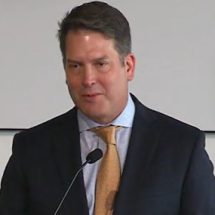
Brett Hunt, a white man with brown hair in a suit with blue shirt and yellow tie

Brett Hunt
Director
Next Generation Service Initiatives
The Volcker Alliance

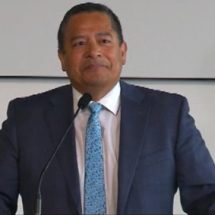
Alex Ybarra, a Latino man with short dark hair, wearing a blue suit, white shirt, and light blue tie

Alex Ybarra
Representative
13th Legislative District
State of Washington

Ana Mari Cauce

Ani Mari Cauce
President
University of Washington

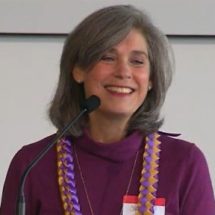
Sari Feinberg, White woman with shoulder length greying hair wearing a purple blouse

Sari Feinberg
Class of 2022
NextGen Civic Leader Corps

Event Recording

Public Health Policy for Pandemic Preparedness

Lessons from the Seattle Flu Study

Wolfle Memorial Lecture in Science & Policy 2022

The Dael L. Wolfle Memorial Lecture Series honors distinguished careers and contributions to the field of science and public affairs, and is made possible by the Dael L. Wolfle  Endowment for Excellence in Public Affairs. Established in 1986, its purpose is to bring distinguished scholars and practitioners in science and public policy to campus to share their ideas with the University community.

Early in the pandemic, a team of University of Washington research scientists were the first to identify community transmission of the SARS-CoV-2 (COVID-19) virus in the United States. This critical discovery changed the course of U.S. public health policy responses to the pandemic and was attributable to the team science that led to the creation of the Seattle Flu Study in 2018 — a prototype early detection system created to improve pandemic response to influenza and other pathogens.

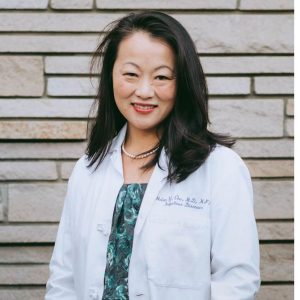
Dr. Helen Chu discussed the origins of the Seattle Flu Study and her work with public health departments, policy makers, and community partners to develop strategies for COVID-19 testing, viral variant sequencing, and community spread mapping. Dr. Chu also shared how the Seattle Flu Study developed ways to measure immune response to the virus that aided in the development of COVID-19 vaccines and therapeutics. Much of this work informed public health responses within schools and universities statewide, as well as strategies to address vaccine hesitancy within Seattle’s most vulnerable communities. Reflecting on her work, Dr. Chu mapped a path forward and identified key public health policies that will allow us to be better prepared for the next pandemic.

Helen Chu


Dr. Helen Chu

Adjunct Associate Professor, Epidemiology
Associate Professor, Medicine – Allergy and Infectious Dis.
Adjunct Associate Professor, Global Health
University of Washington

Dean’s Forum: Assessing Where We Are in Racial Reckoning

Dean's Forum Logo

On April 22, 2022, the Evans School of Public Policy and Governance hosted a conversation about how race influences the shaping and implementation of public policy.  

During the event, Dean Sandfort was joined by Dr. Jennifer Chudy who presented her research on white “racial sympathy.” Washington state policy leaders Sarita Siqueiros Thornburg and Dr. Stephan Blanford reflected on how changing attention to racial justice continues influencing conditions in Washington at the state and local levels. 

Speakers

Jennifer Chudy

Jennifer Chudy
Knafel Assistant Professor of Social Sciences
Department of Political Science
Wellesley College

Dean Jodi Sandfort

Jodi Sandfort
Dean
University of Washington
Evans School of Public Policy & Governance

Stephan Blanford

Stephan Blanford
Executive Director
Children’s Alliance

Sarita Siqueiros Thornburg

Sarita Siqueiros Thornburg
Executive Director of Strategy, Evaluation & Learning
Puget Sound Educational Service District

Event Recording

Changing the Future of Colorado’s Healthcare: Hannah Sieben, MPA ’21

Hannah Sieben

After finishing her MPA in 2021, Hannah Sieben returned to her home state of Colorado, where she is using her experience and the skills she gained at the Evans School for the public good. In her current work as a Policy Analyst with Connect for Health Colorado, Hannah is working to create greater public health care access for all Coloradans.

Can you tell us a little about yourself?

The week that I graduated from Evans, I moved back to Colorado, adopted a puppy (Fig! 7 lbs of chihuahua/terrier perfection!), and started a new job. I love being in Colorado; my whole family is here, the mountains and sunshine are a great combo, and there is so much to see and do. In my free time, I’ve been participating in a Master Composter program (to teach Denverites how to start their own compost pile), reading for fun, and scouring Facebook Marketplace for my next DIY project.

What contributed to your decision to pursue an MPA degree? Was there a defining moment in particular?

After returning from Peace Corps service in Namibia, I worked as a civic engagement program manager at a nonprofit. I helped more than 5,000 high school students register to vote during this time, but I knew that I needed to learn so much more if I wanted to contribute to the vision and direction of an organization instead of just the day-to-day responsibilities if I wanted to have the career I was interested in. Pursuing an MPA seemed like the ideal way to gain experience and practice to complement my policy and legislative interests.

Looking back on your Evans School experience, what stands out as being particularly impactful while you were a student?

I was part of the Covid Cohort, MPA Class of 2021, so more than a year and a half of my time at the Evans School was virtual. While that alone was impactful, it also provided me the opportunity to collaborate with my peers in different ways. I learned so much about working as a team with people you may have never gotten to meet in person before, which has been an asset in my current position. I also served as the Vice President of External Affairs for the Graduate and Professional Student Senate and managed to rope in so many of my Evans peers to help us with our legislative priorities. Together, we passed important legislation to get graduate student representation on the Washington Student Achievement Council. All that to say, I was surrounded by incredibly smart and encouraging people at the Evans School, which gives me a lot of confidence about the future of public policy.

Can you share about where you work and your current role?

I’m currently working at Connect for Health Colorado, the official Marketplace for health insurance in Colorado, as a policy analyst. We are technically a non-profit but are really a quasi-governmental organization that implements the Affordable Care Act. I provide a wide range of research and support on policy and legislative issues, including advocacy, education, research, and analysis to help Coloradans get access to more affordable health care.

Can you tell us about some of the projects you are working on or excited about?

Colorado is truly a leader in the health insurance marketplace space, and it’s been inspiring to be a part of the policy and implementation team at Connect for Health Colorado. One of the most impactful projects I am working on is around providing low-income undocumented Coloradans with state-subsidized health insurance. We are the first state to implement this type of program and much of my research has been around the health needs, barriers to health care access, and the eligibility requirements of our undocumented communities. In 2023, more than 9,000 undocumented people will have affordable, quality health coverage for the first time! It’s amazing to lay the groundwork for other states to implement similar programs and really put our money where our mouth is when talking about equity and inclusion.

Are there any specific skills from your time at Evans that have been crucial to the work you are doing today?

One of the best things that I was able to practice at Evans was taking complex pieces of information and distilling them into something that non-policy people can understand. I have coworkers who specialize in communications and product development without a public health or policy background, so I use this skill all the time. I am also a confident public speaker, something that I practiced all throughout my time at Evans.

What are one or two resources that inspire you personally or professionally?

I recently read Dear America, Notes from an Undocumented Citizen by Jose Antonio Vargas. He later joined my colleagues and me to discuss his book and his organization, “Define American”, and to explain how he thought we could do our work in a better, more inclusive way. Both his book and organization really highlight the diversity and uniqueness of undocumented narratives.

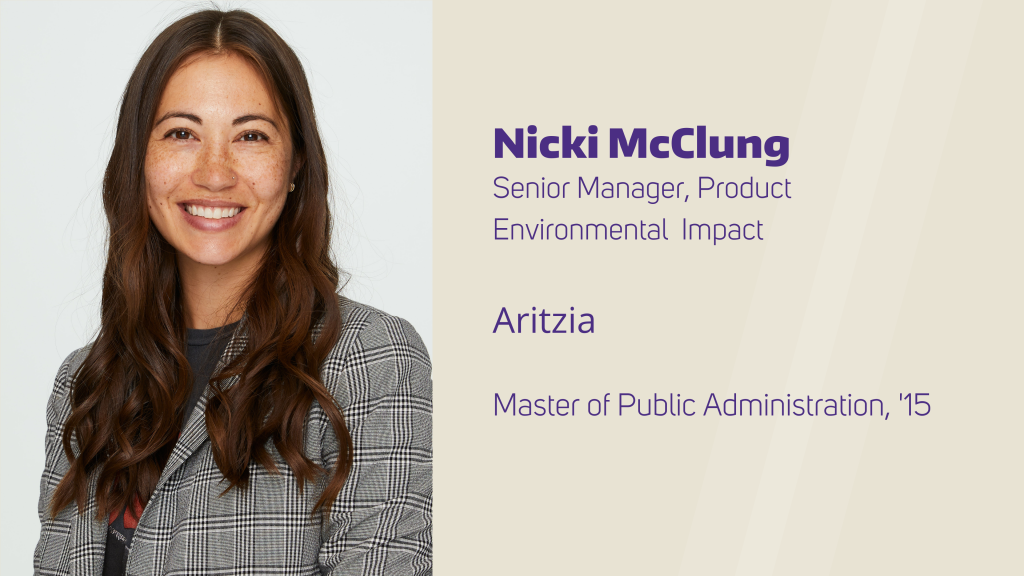
Sustainability and Impact: Nicki McClung, MPA ’15

Nicki McClung

Evans Alum and Aritzia’s Senior Manager of Product Environmental Impact, Nicki McClung (MPA ’15), is leveraging her experience, Evans education, and passion for social justice to positively impact product sustainability and climate strategy.

Can you tell us a little about yourself? 

My name is Nicki and I use she/her pronouns. I grew up in a tiny town in the foothills of the Canadian Rocky Mountains. I am of mixed Japanese/Irish ancestry, which was a bit of a novelty where I grew up. My undergrad is in accounting and finance, and after a couple of years living and working in Banff, Alberta, South Korea, and Australia and doing some travel in between, I landed in Seattle with my then-boyfriend trying to make it in a new city. 

Fast forward a few years and I left Seattle in the middle of the pandemic to relocate to a small ski town in British Columbia with my husband, two kiddos, and dog. I work remotely with Aritzia, a contemporary women’s wear brand based out of Vancouver, BC, and whenever I can, I’m biking, skiing, or somehow enjoying the outdoors with my family.

What contributed to your decision to pursue an MPA degree? Was there a defining moment in particular?

When I moved to Seattle, I thought I would have no trouble finding a role in my field. With the boom in tech, and my corporate finance and accounting background, surely someone would sponsor me.

My theory proved to be wrong.

I wanted to go back to school to have work eligibility primarily, and someone suggested I look into an MPA. For me, I already had worked in huge corporations, I could make a business case, I could operate easily in the private sector, so an MBA seemed redundant.

The MPA program was like an MBA but with the lens of impact and social justice. Through the wonderful support of the admissions team at Evans, I was able to determine it was the right fit for me, and they helped me through the process.

Looking back on your Evans School experience, what stands out as being particularly impactful while you were a student?

So much changed during my time at Evans, both personally and professionally. There were a lot of social and political changes happening during that time. George Zimmerman had just been acquitted in the homicide of Trayvon Martin, and Michael Brown and Eric Garner were murdered months later. The conversation shifted dramatically I found, especially as a newcomer to the US, from bi-partisan politics to the deep and entrenched racism prevalent in the country (and bi-partisan politics).

I learned so much from my professors and cohort at Evans. I’m still learning, but my time at Evans shifted my perspective. I finally had the opportunity to embrace my own identity and my intersectionality. I began to work through the questions and traumas of my own experience, and it has helped me immensely in my career, as a leader, and community member.

Can you share a bit about the work you are currently doing and what a typical day in your work looks like?

I currently work on the sustainability team at Aritzia. Officially I am the senior manager of product environmental impact, but my scope includes beyond just product. I’ve been working on what our climate strategy looks like, both from a high-level organizational view and then specifically what we are doing along parts of our value chain.

My days are nicely varied, but it’s a lot of internal and external stakeholder engagement – and report and memo writing! Thanks, Evans!

As an MPA working in the private sector, how has your Evans education contributed to your work?

Other than the stakeholder engagement and writing pieces I already mentioned – probably critical thinking! Specifically how to dig into the sources of information, and not cherry-pick data! Embracing the data – good and bad – is so hard to do but Evans taught me how to work through that.

I think something else that I credit Evans for is the reminder to always think about the bigger impact and the danger of inappropriate interventions.

Can you tell us about some of the projects you are working on or excited about?

I am so excited about some big projects coming up soon. In the past, many teams worked in silos, with different goals and KPIs, that didn’t all track towards a common objective. Now, we are entering a very exciting phase of being able to set a comprehensive environmental impact strategy. I hope to be able to share more soon!

What are one or two resources that inspire you?

Overdressed: The Shockingly High Cost of Cheap Fashion by Elizabeth Cline is probably one of the most realistic portrayals of how products are made and what factories are like. It doesn’t tell the whole picture, but it’s a great primer for anyone interested in the industry.

This New York Times piece on organic cotton is super fascinating and extremely relevant to my world: That Organic Cotton T-Shirt May Not Be as Organic As You Think.

Harvard Business Review’s article The Myth of Sustainable Fashion is a little depressing, but some good guiding principles.

2022 Annual State of School

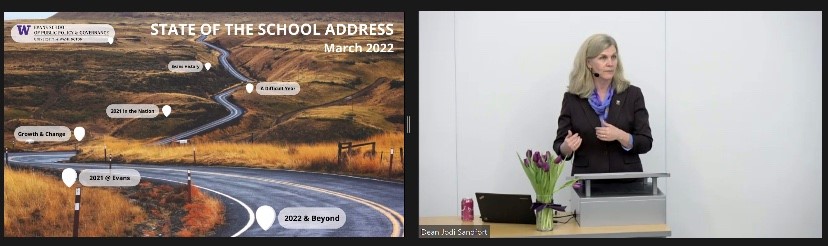
Dean Jodi Sandfort presenting at the State of the School

On March 4, 2022, the Evans School hosted the first annual State of the School Address where Dean Jodi Sandfort offered her reflections on 2021, the School’s 60th anniversary, and shared insights and encouraged conversation about where we are aiming our efforts and priorities in 2022. This event featured Dean’s Council members Eduardo Campos and Absa Samba as moderators.

Recording

Community Design Session

After the State of the School Address, community members engaged in a Community Design Session with Dean Sandfort. This session provided an opportunity to continue the conversation and built upon the future state as outlined in the State of the School address. Faculty, staff, student leaders, and community volunteers participated in the dynamic session to crowd-source ideas and resources in service to the people stepping into and leading innovative school projects and initiatives on these topics:

  • Evident Washington
  • Washington Courts
  • Boating Safety
  • Emergency Response
  • Public Institution Redesign micro-credential
  • Technology & Governance micro-credential
  • International Program in Public Health Leadership (IPPHL)
  • NextGen Civic Leader Corps

Effectiveness of Balanced Budget Laws 

Carved bank sign on building

Nearly all states have adopted balanced budget laws that limit spending and borrowing to ensure budgeting processes rely on currently available resources. However, despite their salience in statehouses, there isn’t clear evidence of how balanced budget requirements affect state budgets.

Using a unique mix of budgeting and accounting data, Evans School Associate Professor Sharon Kioko, and University of Georgia Assistant Professor Michelle L. Lofton examine how different types of balanced budget laws affect the health of state budgets. Their study finds evidence that most balanced budget requirements don’t dramatically increase the likelihood a state will report a balanced budget or higher balances in the General Fund. The authors largely attribute these findings to the fact that balanced budget requirements are from the late 1800s and are not well-suited for the complexities in state budgets today. Kioko and Lofton conclude, “without reforms to their structure and operation, [balanced budget requirements] BBRs will likely continue to be ineffective instruments of budget constraints.” Kioko and Lofton published their findings in a recent Public Finance Review article entitled, “Balanced Budget Requirements Revisited.”

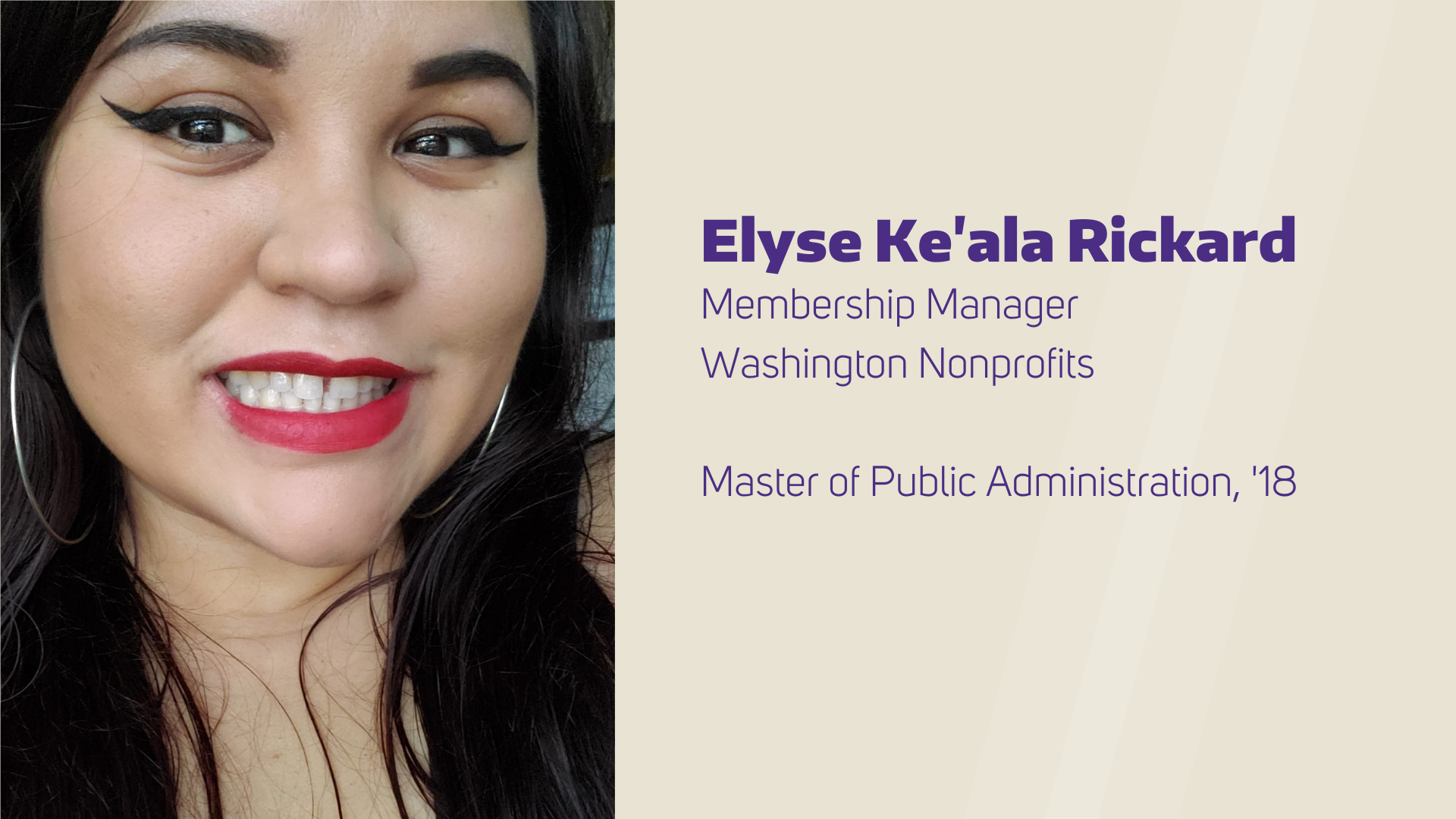
Ensuring Washington Nonprofits Thrive: Elyse Ke’ala Rickard, MPA ’18

Elyse Ke'ala Richard

Elyse Ke‘ala Rickard, MPA ’18, is driven by a passion for equity, justice, and service. As the Membership Manager at Washington Nonprofits, she works to ensure that nonprofit organizations in Washington have access to the resources they need to prosper.

What contributed to your decision to pursue a career in support of the public good? Was there a defining moment in particular?

I grew up in the Los Angeles Harbor area in a blue-collar union family, where I learned to identify how different institutions perpetuate racist, sexist, and classist policies and was encouraged to speak out against these injustices. As I moved through my higher education journey, I majored in sociology and knew that I wanted to enter a field that worked on addressing and dismantling inequities through structural change. During my senior year of undergrad, I had a mentor who was also a Pacific Islander woman and a first-generation student who encouraged and supported me in applying to graduate school. Because of the support of my family and other BIPOC mentors, I wanted to pursue a career that builds upon the work of those who came before me and continue to carry on their work of creating a more equitable society.

Can you share a bit about the work you are currently doing and what a typical day in your work looks like?

I was promoted to Membership Manager at Washington Nonprofits earlier this month and have been with the organization since August 2021. Right now, my work focuses on fostering relationships with our current members and connecting with other nonprofits across the state who may benefit from being a member of our organization. My daily work is composed of providing assistance to our members (that could range from membership renewals, answering questions about member benefits, etc.), promoting our programs and events, and working with colleagues on how to increase access to memberships for nonprofits across the state.

What’s one thing you want everyone to know about your work?

I believe that listening to my intuition has helped me to carve the professional path that I am currently on. If you are doing work that you do not feel connected to or does not align with your values or goals, do not be afraid to speak out or seek out new opportunities that will allow you to grow.

Looking back on your time as an Evans student, do you have any memorable experiences that really stand out to you?

To be honest, I’ve had a variety of experiences at Evans. I met people who are now lifelong friends, learned skills that I sought out, and conducted an impactful capstone with colleagues, which is currently being used in a lawsuit to address racial and gender inequities in the Seattle Parks and Recreation department.

I also faced barriers that graduate students from historically marginalized communities must navigate, including speaking out against curriculum and practices that perpetuate white supremacy. I remember a meeting that I and four other students held with a professor to discuss how they framed the Department of Justice’s report for the City of Baltimore’s police department—their framing felt insensitive to BIPOC students because they did not want to address the historical impact of race and policing. I remember having another meeting with a white professor who had a kapa moe (Native Hawaiian quilt) in their office who was teaching about Indigenous environmental policy who told me they would not, and did not, want to discuss Native Hawaiian environmental issues. However, despite these difficulties, I was able to connect and build relationships with other students, faculty, and staff who did advocate and support for marginalized people in our program and that is something that I will always remember from my time as a student at Evans.

How does your Evans education inform how you approach your work today? Are there two or three things that directly impact your work?

My time at Evans has heavily influenced my career path. I work in an organization that focuses on providing nonprofit education courses across the state, which I feel is a continuation of my own education as well. I have worked on projects where I utilized my analysis and evaluation skills, ranging from implementing new systems, improving administrative procedures, and conducting policy research. Finally, the most important skill that I have learned from Evans is project management because I am collaborating with other people and entities frequently, which includes keeping track of several tasks and deadlines, as I did in most classes during my time as a student.

In what ways are Diversity, Equity, and Inclusion part of the work you have done and continue doing?

As a mixed Native Hawaiian/Latina woman, holding these identities radicalized me from a young age to speak about racism and other societal inequities. During my undergraduate years, I took part in student organizing around a variety of issues and worked in positions that focused on providing support to other BIPOC students.

While at Evans, I became involved in Evans People of Color and worked with other Student Interest Groups (SIGS)–later known as the Coalition–to organize around addressing issues within the Evans school and public policy issues beyond the campus. I am proud of my colleagues, the alumni who laid down the work before us, and the current students who are continuing the work to create a more equitable environment for Evans ’students and beyond.

In the work that I currently do, there are a lot of nonprofits in Washington State that are doing amazing things in their communities, especially those whose work is guided and led by marginalized communities. However, there are several barriers that these organizations face, which can hinder their growth and ability to provide programs or services they are offering to their constituents. Some of these barriers can range from lack of financial resources to unclear guidance from local, state, and federal partners. I hope that in my role I can serve as a point of contact for people to access the resources they may need so that these organizations can continue to focus on serving and thriving in their communities.

What are one or two resources that inspire you personally or professionally?

I recently finished From a Native Daughter by the late Dr. Haunani Kay-Trask. As someone who is a mixed Native Hawaiian woman, I have felt, seen, and heard many of the things discussed in her book, especially in the latter half, where Dr. Haunani Kay-Trask discusses her experiences with the University of Hawai’i. I feel inspired that her work remains relevant in 2022 and will continue to do so beyond my lifetime. I am also very into listening to podcasts and a favorite of mine that I recommend to folks is Code Switch by NPR. Every week they focus on a different story, connect the story to larger themes of race, and connect listeners to resources they can follow up on if they want to learn more about that week’s topic.

Evans Faculty Crystal Hall Receives Prestigious Career Service Award

Crystal Hall

Evans Associate Professor Crystal Hall has received the Society for Judgment and Decision Making’s (SDJM) 2021-22 Castellan Service Award. This award recognizes Professor Hall’s many important leadership and professional contributions to SDJM.

Of particular importance is Professor Hall’s service for the past two years as chair of SDJM’s first-ever Diversity & Inclusion Committee. In that role, she has centered equity and inclusion within SDJM’s work to better support scholars from underrepresented and historically excluded backgrounds.

Upon receiving the Castellan Service Award, Professor Hall noted: “SJDM has been my primary academic community. And, despite its interdisciplinary nature, it has historically fallen short in the creation of a diverse community of scholars. I hope some of the deep structural changes we are pursuing as a professional association will result in an inclusive environment that will be reflected in both the nature of our research and the way that research is applied to a wide range of social challenges.”

Professor Hall’s leadership within SDJM echoes her field-leading research and many contributions to the Evans School. Associate Dean for Research and Engagement Scott W. Allard underscored, “Professor Crystal Hall is a singular scholarly voice challenging behavioral science to confront structural racism. Her work within the Evans School also has been integral to our school’s commitments to promote equity, address racial bias, and train the next generation of public service leaders to dismantle systems of oppression.”