Skip to content

Sheila Edwards Lange, MPA ’00, Selected as UW Tacoma Chancellor

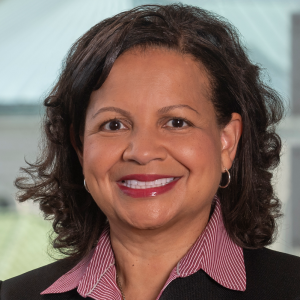
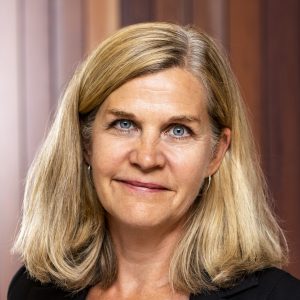
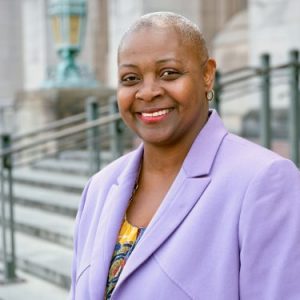
University of Washington President Ana Mari Cauce and Provost Mark A. Richards announced the selection of Sheila Edwards Lange, president of Seattle Central College, as chancellor of the University of Washington Tacoma. Her appointment, pending approval by the UW Board of Regents, is set to begin September 16, 2021.

Edwards Lange has many years of experience in higher education and she is well known throughout the UW, having served as the vice president for Minority Affairs and Diversity from 2007 to 2015. As president of Seattle Central College, Edwards Lange leads all college operations, including instruction, student services, fiscal resources, human resources, facilities and community relations. She works closely and collaboratively with leadership across the Seattle College District to ensure students receive high quality and responsive education and services.

“I was attracted to UW Tacoma’s urban-serving mission, commitment to equity, diversity and inclusion, and its stellar academic programs. That unique combination has enabled UW Tacoma to be an active partner in economic development and prosperity in the South Sound,” Edwards Lange said. “I am excited about being part of this work and look forward to leading the institution at this critical time in its history.”

Edwards Lange earned her doctorate in educational leadership and policy studies, as well as her master’s in public administration – from the Evans School of Public Policy & Governance in 2000 – and her bachelor’s degree from the University of California, Irvine. She began her career at Western Washington University, before taking on leadership roles at Seattle Community Colleges. While earning her doctorate at the UW, she developed research and teaching interests in higher education policy, diversity in higher education, assessment and program evaluation, and underrepresented student access STEM fields. She taught a graduate level course on race and public policy for several years in the UW Evans School.

NAPA Social Equity Leadership Conference

The 20th Annual National Academy of Public Administration (NAPA) Social Equity Leadership Conference (SELC) was held June 9 – 11, 2021. The theme, “Fostering Social Equity: Innovation and Change,” emphasized developing and promoting concrete actions with lasting impact. The conference provided a space to discuss how public administrators can develop a broader understanding of social equity and recognize social equity’s implications within the administrative context.

Social equity—a key pillar of public administration alongside economy, efficiency, and effectiveness—addresses fairness, justice, and equity within a variety of public contexts. In its continuing fight for social equity in public administration, NAPA envisions transforming the public administration landscape and the public it serves by developing a framework that would enable public administrators, policy makers, legislators, and other like-minded organizations at all levels of government to assess the social equity impact of proposed legislation, regulations and policies and make necessary adjustments before they are implemented.

Q&A with Dean Jodi Sandfort and Gary Glickman, Standing Panel on Social Equity in Governance Chair, NAPA

Understanding Social and Economic Factors of Social Infrastructure

Given events of the last few years, many things are changing in our political, economic, and social lives.  This panel provides cutting edge research to help us understand some of these changes, from the racial reckoning and social response that pulled down confederate statutes to changes in the workforce and contracting practices during COVID and in recent years.

Blueprint for a Just & Equitable Future: Washington State’s 10-Year Plan to Dismantle Poverty

Stubbornly high rates of poverty are the product of inherently unjust and unequal policies, programs, and practices that have underwritten our economy for decades. In response, Washington state Governor Jay Inslee created a Poverty Reduction Work Group (PRWG) in 2018, tasking the group with the creation of a comprehensive, 10-year plan to dismantle poverty. With sincerity and humor, PRWG members Jennifer Bereskin, Drayton Jackson, Lori Pfingst, and Shereese Rhodes will share the journey to create the plan – the trials and tribulations of overcoming institutional distrust of agencies, the implicit biases we hold about people experiencing poverty and those serving them, how we are all undermined by systems underwritten by white supremacy, and the power in recognizing each other’s humanity.

Racial Justice: Not a Zero Sum Game - Government’s Role in the Racial Justice Reckoning

Panelists from the Seattle Office for Civil Rights discuss about the growing polarization and entrenchment surrounding the racial justice reckoning the country is experiencing; how the Seattle Office for Civil Rights’ Race and Social Justice Initiative is structured and works; our journey to rebuild accountability to community; and how city departments make the work of antiracism their own.

Public Matters 2021

Public Matters 2021: Transforming Public Service Logo

On May 13, the Evans School community convened for Public Matters 2021. We heard from six amazing and dynamic storytellers as they shared their own reflections on this year’s theme, “Transforming Public Service.” Attendees were invited to listen and learn, and called upon to engage and commit to a new vision for anti-racist public service by sharing their gifts with the Evans School – whether they be time, experience, or financial gifts – as we build a community of reciprocity.

The inaugural Public Matters was a true celebration of the knowledge of our wider community. Watch the recording, learn more about our storytellers and their work, explore the takeaways, and join us as together we envision inclusively built societies powered by brave leadership, rigorous action, and collective wisdom.

Watch the Full Recording:

Our Public Matters Storytellers:

Priya D. Saxena, MPA (They/Them)

Founder + President of Equitable Future

Equitable Future is a strategic anti-racism and justice consulting firm that works with change makers across the Puget Sound region to reimagine and transform our communities. They do this by envisioning an unapologetically equitable future, unpacking white supremacy culture from our values, relationships, and institutions, telling bold truths to make strategic, fact-based decisions, and redistributing power to generate enduring, positive change. Priya is queer and nonbinary; they live in Tacoma with their partner, two cats, and growing houseplant collection.

Karen A. Johnson, Ph.D. (She/Her)

Director of the Washington State Office of Equity

Appointed by Gov. Jay Inslee to this post in February, 2021, Johnson’s office will work with WA agencies to increase access to equitable opportunities in order to bridge opportunity gaps and reduce disparities. Dr. Johnson has worked for the US Department of Veterans Affairs, and serves as adjunct faculty at The Evergreen State College, teaching courses in dismantling racism and identifying bias in public service settings for the master of public administration program. She holds both a PhD and Master of Public Administration.

Amanda Lee (They/Them)

Volunteer Field Director at The Heron’s Nest Outdoor

They are based out of Seattle, WA, on unceded Duwamish Territory. Both initiatives are focused on restorative justice through land restoration and sustainable education. Amanda is working collectively with The Duwamish Tribe and local community organizations to reimagine an equitable community powered future. Follow them on social media: @sharedspacesfoundation, @heronsnestoutdoor

Sara Levin, MPA (She/Her)

Vice President of Community Services at United Way of King County

Sara thrives working across sectors, connecting communities and people to resources, and keeping racial equity central to her work. Her 30-year career in Seattle has offered exciting and varied experiences from direct service with Russian-speaking refugees, to a stop at the Evans School, then leadership roles in government and philanthropy, including an unforgettable opportunity in 2018 helping members of Pearl Jam amplify the issue of homelessness in King County.

Evan Cook, EMPA (He/Him)

Community advocate and leader in the City of Federal Way and surrounding areas.

As a philanthropist on a mission to heal the community, he founded Restoring Mindz LLC, a public speaking and clothing company. His mission is to rebuild this world through service and inspiration helping at risk youth find their purpose. Support his work, and follow him on Instagram: @Iam_evancook

Jodi Sandfort, Ph.D. (She/Her)

Dean and Professor at the Evans School of Public Policy & Governance

Jodi Sandfort, joined the Evans School as dean in January 2021. Her work focuses on improving the implementation of social policy, particularly those policies designed to support low-income children and their families. She is an elected member of the National Academy of Public Administration, a distinguished honor recognizing her innovative leadership in the field. Dean Sandfort has worked as a consultant with national and statewide foundations, think tanks, and other nonprofit human service organizations.

Thank you to our sponsors

  • The Hon. Bobbe & Mr. Jonathan Bridge
  • Nancy & Ben Remak
  • Amazon
  • The Association of Washington Cities
  • Cascadia Consulting Group
  • Civic Ventures
  • Costco Wholesale
  • University of Washington Alumni Association
  • University of Washington Office of External Affairs
  • The William D. Ruckelshaus Center

Dean’s Forum: Leading and Managing Anti-Racist Organizations

Dean's Forum Logo

At the heart of the Evans School’s mission is a call to host community conversations that support and inspire public leaders, and our Dean’s Forum events have focused on the intersection of race and public policy. The series continued with a live conversation between Dr. Susan Gooden, Dean of the L. Douglas Wilder School of Government and Public Affairs at Virginia Commonwealth University, and Dr. Jodi Sandfort, Dean of the Evans School of Public Policy & Governance at the University of Washington, as they discussed ways to advance anti-racist public administration and management.

Speakers

Susan Gooden

Susan T. Gooden, Ph.D., is dean and professor of the L. Douglas Wilder School of Government and Public Affairs at Virginia Commonwealth University. She is an internationally recognized expert on social equity. Gooden is an elected fellow of the congressionally chartered National Academy of Public Administration and is past president of the American Society for Public Administration.

Dean Jodi Sandfort

Dr. Jodi Sandfort joined the Evans School of Public Policy & Governance as dean in January 2021. Formerly a professor at the Humphrey School of Public Affairs, University of Minnesota, her work focuses on improving the implementation of social policy, particularly those policies designed to support low-income children and their families.

Event Recording

Conversation Resources

Continuum on Becoming an Anti-Racist Multicultural Organization Crossroads Ministry

How to Be an Anti-Racist Ibram X. Kendi

Stamped from the Beginning Ibram X. Kendi

Equity and Empowerment Lens Multnomah County Office of Diversity & Equity

20th Annual Social Equity Leadership Conference National Academy of Public Administration

Not Even Past: Social Vulnerability and the Legacy of Redlining The Digital Scholarship Lab and the National Community Reinvestment Coalition

Vaccination Equity in Virginia Research Institute for Social Equity (RISE) at the Wilder School, Virginia Commonwealth University

Plessy v. Ferguson and the Legacy of “Separate but Equal” After 125 Years Russell Sage Foundation

Racial Restrictive Covenants  The Seattle Civil Rights & Labor History Project

Building a Relational Culture Seattle’s Race and Social Justice Team

A Rubric for Evaluating Team Members’ Contributions to an Inclusive Culture Chelsea Troy

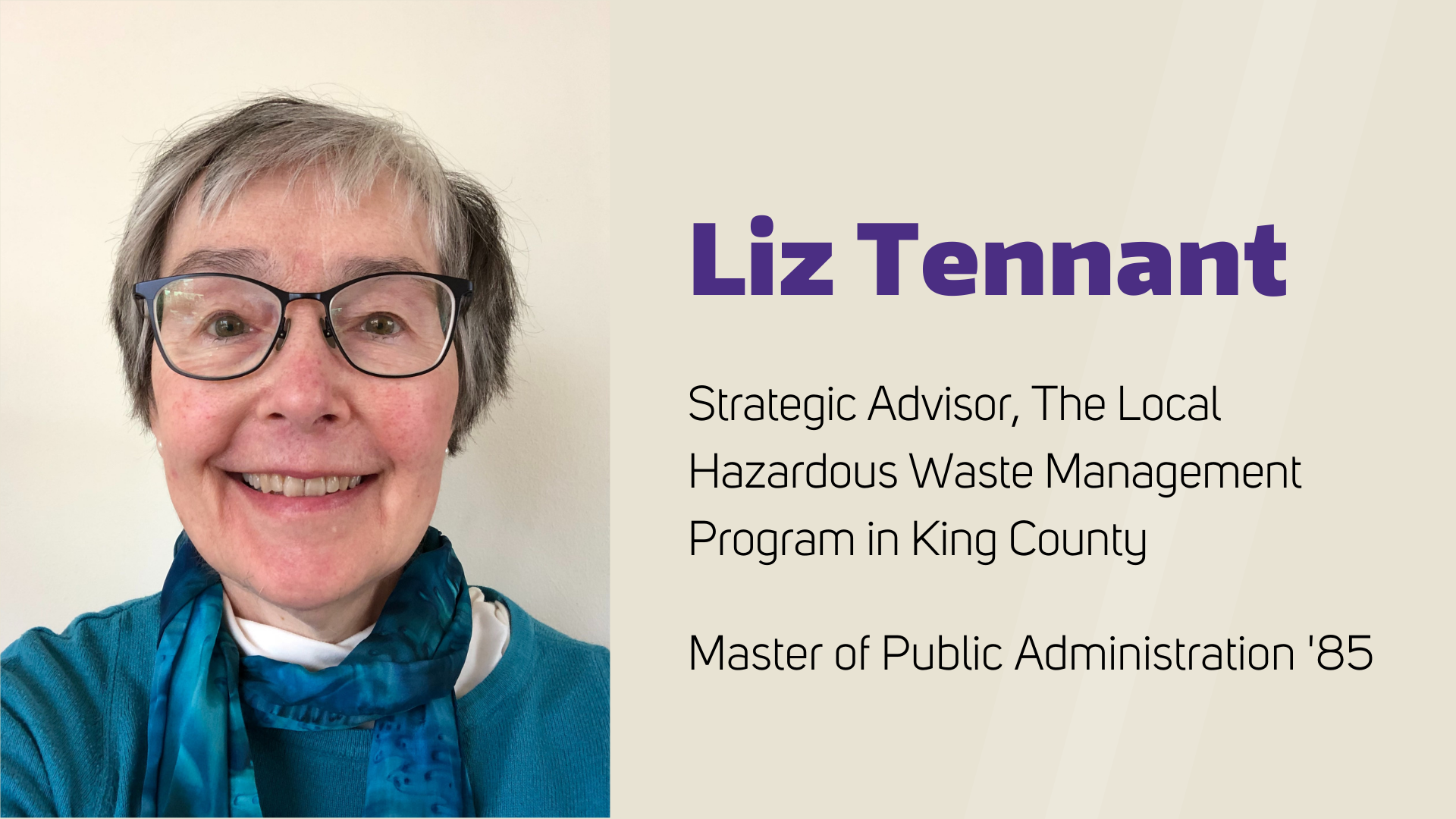
Advancing Equity through Targeted Universalism: Liz Tennant, MPA ’85

Liz Tennant Headshot

What contributed to your decision to dedicate your career to serving the greater good?

For as long as I can remember I have had a strong drive to serve the greater good. I explored a couple of different paths before deciding to work on protecting public health and the environment.

Before retiring from an extensive career with the Local Hazardous Waste Management Program in King County, you were involved in creating the program’s racial equity strategic plan and program. How did you address this critical work?

The Hazardous Waste Management Program (Haz Waste) is a regional program in King County that works to prevent human and environmental exposure to hazardous materials and products. Program partners include Public Health, Seattle & King County, King County Water and Land Resources Division, King County Solid Waste Division, Seattle Public Utilities, 37 cities and towns and two tribes. Haz Waste has been working since 1990 to provide relevant and effective services to King County’s 2.1 million residents and 60,000 businesses. I served as Strategic Advisor to the Program Director.

The planning process:

For over 20 years, Haz Waste partnered with the City of Seattle Public Utilities (SPU) to integrate environmental justice and service equity in Haz Waste programs and services. It became increasingly clear that we needed to approach this work more holistically, thoughtfully, and strategically. In 2017, Haz Waste and SPU’s Environmental Justice and Service Equity Team launched a joint planning effort to improve Haz Waste’s operations, policies, practices, and services. The Director and I were on the planning team.

  • During Phase 1 we worked with our multi-jurisdictional Management Coordination Committee (MCC) to develop a racial equity vision for the Haz Waste Program and for each function and service. We gathered feedback from Haz Waste staff and other stakeholders and refined the vision. During this same period, we gathered information, reports and data on racial equity initiatives and performance and gathered the perspectives of staff on multi-agency program teams, project managers, agency managers and Haz Waste managers. We also gathered information about best management practices in each area.
  • During Phase 2 we conducted a gaps analysis, and identified gaps, needs, challenges and opportunities in each project area. We developed initial recommendations. We expanded the Racial Equity Planning Team in 2018 to help refine the recommendations and develop SMART goals for their topic areas. High level observations were shared with staff, the Leadership Team and MCC.
  • During Phase 3 recommendations were refined and finalized in two separate but related documents: 1) a Racial Equity Strategic Plan, which sets the strategic direction and provides a high-level summary of key steps that Haz Waste will take to advance racial equity and 2) A Racial Equity Implementation plan which describes key actions that Haz Waste will take over the next three years to promote racial equity in our services and operations. It is an internal guidance document. These documents were shared with staff and iterated with them. The final documents were adopted by the MCC on October 16, 2018.

Key strategies:

The Plan commits Haz Waste to lead with racial equity by implementing a racial justice framework to address root causes and eliminate inequities in how the program operates and in the services it delivers. Key strategies for doing this included:

  • Adopting a Targeted Universalism approach that recognizes that different populations in King County face different barriers in accessing and benefiting from Haz Waste services, and by working with communities to identify and implement targeted programmatic efforts.
  • Defining racial equity commitments, performance goals and performance measures in each program area and function; building those into annual work plans for each area; and reporting on quarterly progress.
  • Involving community-based organizations and community members at every step of the process to update the Program’s State-Adopted Management Plan. This community centered planning process that centers voices of underserved and overburdened communities including Black, Indigenous and other people of color, refugees, immigrants and other marginalized residents and workers.
  • Committing to the development of a performance measurement system that uses Results Based Accountability using a racial equity lens.
  • Hiring a full-time Racial Equity Manager to ensure accountability.

Key learnings:

  • Be flexible. Plans give you a place to start and a framework for being accountable. It is important to establish your goal and work plan as clearly as you can. That said, you probably will need to accept that things move more slowly than you want, and that you will need to adapt and modify as you go along. For example, almost immediately after adopting the plan, we realized that we needed to establish cross-program work teams to advance work in four important areas. Getting these off the ground took longer than we anticipated.
  • Look for where your program can help to address root causes of disparities. Look for opportunities to partner with others to leverage resources to have greater impact.
  • Approach racial equity work with an open mind, curiosity, humility, and kindness. We are all in this together and need to work together to undo unjust procedures, laws, and systems. Try things out, learn from them and allow for imperfection
  • Look for opportunities to keep growing and learning in your individual understanding of racial equities and through the Evans School, your work and in the community.

What is the biggest challenge you have had in your career and how did you address it?

Probably the biggest challenge was being appropriately classified and compensated for the work I was doing. I loved the work I was doing and it took me a number of years—and a supportive boss—to finally be paid at the level I should have been. I am glad that women are more vocal about getting fair pay these days.

What are your favorite podcasts? What is a great book you have read recently?

I have several favorite podcasts that I listen to. Among my favorites are:

  • On Being with Krista Tippett, who interviews widely ranging thinkers, theologians, community activists, scientists, civil rights leaders, poets and others to think through how we best navigate these times we live in.
  • The Daily with Michael Barbaro of the New York Times, who interviews knowledgeable New York Times reporters on key issues in the news.
  • Throughline, which I have come to recently. It traces how issues we are facing today have roots in the past, with significant focus on racial disparities.

I enjoy reading a variety of books. One great book I read recently is Native Seattle: Histories of the Crossing-Over Place by Coll Thrush. It is about Seattle area tribes, settlement and the ongoing interaction of settler and tribal lives economies and stories.

What inspires you to support your alma mater and our incredible students?

I think the Evans School does a wonderful job of training people in public administration and public policy. We need smart, thoughtful people with good analytical skills to help address the problems in the world. I am particularly excited to be able to support students of color. I think it is hugely important to continue to diversify the workforce.

If you could give Evans School students one piece of advice, what would it be?

Focus your assignments in required courses on questions/issues that will help you to grow in your particular area(s) of interest. Also, look for courses throughout the UW that will enrich your understanding of your area of interest. Have a wonderful education!

We’d love to learn more about you and your tremendous contributions to the public good, so we can share your story as we connect, learn, and reflect. Share your story!

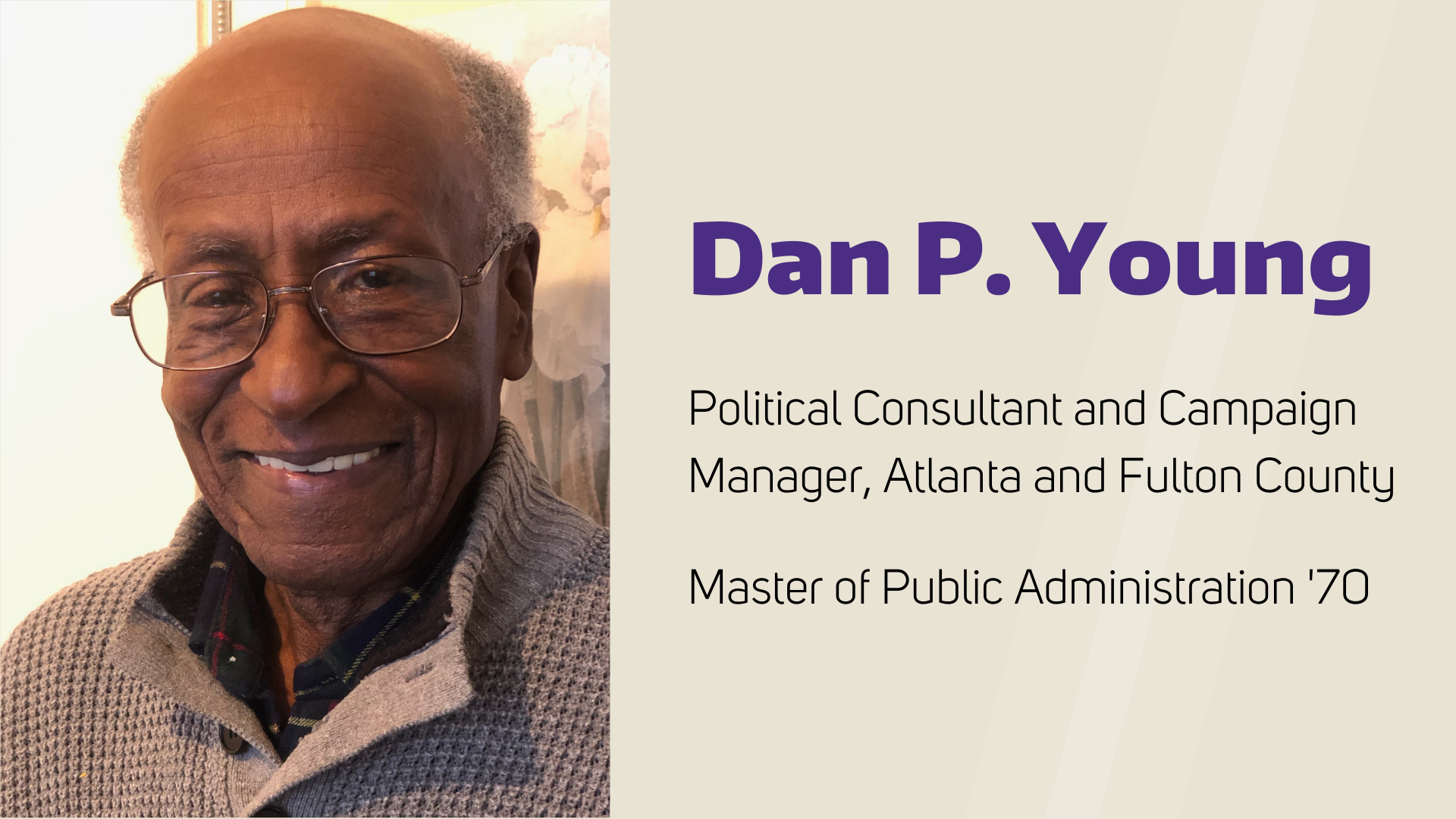
Politics and Public Administration: Dan P. Young, MPA ’70

Dan P. Young

What would you consider one of your greatest professional successes?

My greatest professional success was that of having a significant role in the funding, design and implementation of a new Master of Public Administration program at Atlanta University, Atlanta Georgia. Prior to joining the faculty at Atlanta University, I held the positions of Assistant Professor in political science at Benedict College (Columbia, SC) and Xavier University in New Orleans, LA. Each of these institutions are identified as “Historically Black Colleges & Universities” (HBCUs). This description applies to private and public black colleges and universities.

I attended a professional conference of Black political scientists while on the faculty at Xavier University. One of the attendees was chair of the Department of Political Science at Atlanta University. As we held various group meetings discussing a range of issues, the chair from Atlanta University asked me about by academic background and the name of institutions attended. When I told him that I earned the Master of Public Administration from the University of Washington, the chair stated that the Board of Trustees of Atlanta University had approved a Department of Public Administration and had received a letter from the Federal Department of Health, Education and Welfare which stated that funds were available to fund the program, if a detailed program proposal was submitted. We continued our discussion and the next day, the chair asked if I would be interested in joining the faculty as an Assistant Professor to develop the proposed program. I told him I would discuss with my wife the offer and if she would support our move to Atlanta, GA. I told the chair the next day that I would accept the position.

I later traveled to Atlanta to make a presentation to the political science faculty and students in the existing political science program. I joined Atlanta University in 1973 for the Fall semester. I wrote the grant application and if I remember correctly, it was approved in the amount of $275,000.00.

Additional faculty were hired to teach courses described in the grant for funding. Therefore, students who entered Atlanta University to study for the MPA were taught by me and other faculty and received their MPA degrees from Atlanta University under the auspices of the Department of Political Science.

I developed contacts with a number of elected officials in city and county governments in relation to paid internships for our students at the end of their first year of study. Local government officials were excited about the opportunity to make a contribution to the program. While students did not receive academic credit for their summer internships, the experiences of working in a local government agency provided unique opportunities to participate in basic operations of these governmental units. When these students returned to Atlanta University to complete their final academic year in the program, I developed several seminars which provided an opportunity for each student to discuss their experiences.

In 1975, a chair was hired to head the new Department of Public Administration. I remained as an Associate Professor for the following two academic years. The Department of Public Administration was approved for NASSPAA Accreditation and has retained this very important accreditation to today for a period of 45 years.

What is the biggest challenge you’ve had in your career and how did you address it?

My professional career in public administration totaled 50 years in a number of settings which included teaching at the undergraduate and graduate level in colleges/universities, certified teacher in the Atlanta Public Schools, and Project Director for a research study conducted by Clark Atlanta University School of Social Work. The Clark Atlanta University School of Social Work was selected to conduct a research study which focused on Grandparents as Primary Caregivers of Grandchildren. The contract for this research study was approved by the Department of Human Resources State of Georgia.

One of the primary objectives for my professional involvement in a number of public agencies and programs, was to examine a number of strategies/pathways which would lead to integration of selected theories of public administration into administrative settings of programs. The ultimate objective was to increase their efficiency and accountability.

I decided that it would be important to become directly involved as a paid professional or possibly volunteer in selected agencies. I was also aware that some agency staff could resist and resent involvement of someone from an academic setting. The Dean of the Clark Atlanta University School of Social Work hired me as director of the research project described above. We were involved with a number of agencies in the community as part of the research project. Agency personnel were very receptive to work with staff from an academic institution. We discussed various concepts related to public administration and public policies which could benefit and improve operation of their respective programs. The research study was completed on schedule and filed with the Department of Human Resources, Division of Family and Children Services, Atlanta Georgia.

What are the most critical problems faced by people who work in your field? How do you  think these problems should be handled? OR-what is an issue in public administration and how do you think this problem should be handled?

Based on my professional experience in the profession over a relatively extensive period of time, I believe that some professionals feel “isolated.” This isolation may be the result of a lack of connecting public administration and public policy decisions with some of the critical issues which administrators face. For example, public administration practice does not happen in a “vacuum.” There are complex political environments in organizations which have direct and indirect influence on the decision-making process. Persons who are in elected positions such as council members, state legislators, and county commissioners have bases of constituents who expect administrative staff to implement some of the basic policies which the now elected official campaigned on.

I reside in Atlanta, Georgia which is in Fulton County. This is a very political region in terms of why voters select certain candidates over others to represent them. Many articles and essays have been written related to the non-political aspect of managing public sector affairs. The vast majority of professionally trained persons who come from academic backgrounds in public administration and public policy, have not developed successful strategies to function in most of these settings.

I believe the origin of the problem is not in the behavior of professionally trained administrators, the problem is generally related to academic courses and professors who may dismiss any discussion of the interaction and relation between politics and the day-to-day management of a public agency as a topic which does not meet academic “standards.” I believe it is very important for graduate schools of public administration and public policy to take time and review this issue. I believe graduate students would welcome such a discussion which could be developed as part of their selected courses as they move on to become professional public administrators.

What is your favorite podcast these days? What is a great book you have read recently? Or the “GOAT” (greatest of all time) book you’ve read?

I have read dozens of books during my professional career. However, I decided a number of years ago to include in my readings books which provided clear and factual explanations related to changes in American society after the Civil War. I was particularly interested in the types political, social, and economic responses which were designed to address a wide range of policies and programs related to African Americans that were recently freed as a direct outcome of the Civil War.

A number of public systems were developed to address these needs such as the Freedmen’s Bureau, school systems and training, etc. I have selected three books related to this topic:

  • W.E.B. Dubois (1934). Black Reconstruction in America- 1860–1880.
  • George R. Bentley (1955). A History of the Freedmen’s Bureau
  • A final publication Jacqueline Jones (1992). The Dispossessed /America’s Underclass From the Civil War to the Present.

UW and the Evans School are committed to Diversity, Equity, and Inclusion. How are you addressing Diversity, Equity, and Inclusion in your work and personal life? Or-why is DEI work so important for our society?

The American society is obviously a very complex social system. The key to DEI in such a system is to permanently remove barriers which prevents each American from full and fair participation in this society. During the past 50 years significant changes have been made to make sure that DEI works. I was very active in local civil rights activities in Seattle during the 1960s.

I was an active participant in the Congress of Racial Equality which focused on issues such as fair housing, employment opportunities, a fair judicial system, etc. There were a number of faculty and staff from the University of Washington who were very active in the organization. The collective actions of dozens of persons from a variety of racial and ethnic groups successfully worked and lobbied for a large number of changes such as employment, home rental and purchases, etc.

The University of Washington press published a book titled “Seattle in Black and White.” I am mentioned on page 95 of the book as the coordinator of the Negro Labor Council. One of the key objectives of the Negro Labor Council focused on improving opportunities for Blacks and other racial groups to obtain construction contracts. The book was published in 2011.

If you could give Evans School students one piece of advice, what would it be?

My advice to students enrolled in the Evans School is a recommendation to review their professional interests at this point in their program of studies and to identify several professional areas which they are interested in. Based on their selections, I am recommending that each student use the web and review the legislative structure of Washington State Government in relation to State Senators and Representatives. The website will provide details related to each committee and the function of that committee, etc. Once a student identifies a committee or committees which has legislative jurisdiction over one or more policy areas which they are currently studying, review the agendas and send an e-mail to the chair asking to be included in their e-mail system. This will provide opportunities for a student to follow the development of legislation and he or she will also see the role which politics has in the formulation of public policies at the state level.

I would encourage students to repeat this process with the King County Board of Commissioners. These experiences will enhance the academic courses and also show in real time how a wide range of public policies are formulated and eventually become law.
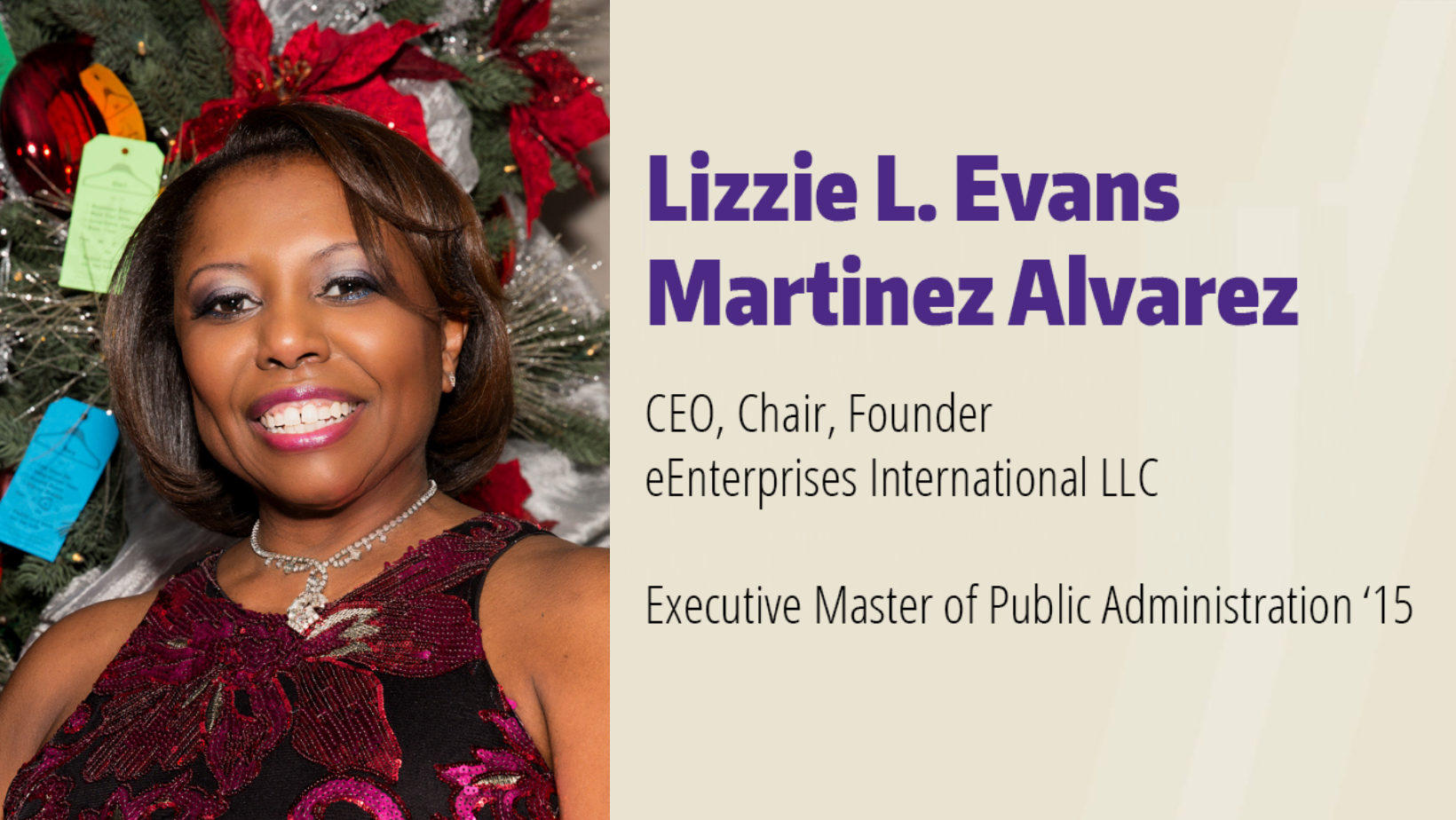
Promoting economic empowerment to communities of color: Lizzie L. Evans Martinez Alvarez, EMPA ’15

Lizzie L. Evans Martinez Alvarez

As a child, what did you want to be when you grew up? 

I started working when I was nine years of age picking peas on a sharecropper’s farm in East Texas. I was always playing banker with the younger siblings, trying to teach them how to save their monetary gifts and earnings. They trusted me because I always carried pocket change from working various odd jobs in the community. I was a natural born entrepreneur, always Enterprising for Profit$. Learn more about my passion for financial literacy.

How might that childhood Dream Job relate to what you do now? 

I created eEnterprises with the intent of leading a change within the community by sharing what I have been learning and discovering in my experiences in business, education, and life. My goal is to help students and young entrepreneurs discover their full potential in a manner that makes it more equitable for everyone. I now focus tirelessly on my volunteer work to empower youth in high schools by teaching financial literacy, entrepreneurship, and digital tools for businesses in the modern world. Serving as a Director-at-Large on the board of the Association of Federal Deposit Insurance Corporation Alumni, I continue to assist the Federal Deposit Insurance Corporation (FDIC) in expanding the Money Smart Financial Literacy program to the underserved youth and BIPOC communities.

What motivates you to get up in the morning and bring your absolute best to work every day and what is something you have been most proud of, professionally? 

“Nothing Beats a Failure but a Try,” an infamous quote of my late mother Dora Lee Evans, is the fuel to my flame. I received my commission as a bank examiner with the FDIC at age 36. Why bank examiner? Perhaps it was a rocky transition from childhood to adulting. For many adult years, I struggled with handling my personal finances. The financial illiterate “aha” moment did not come until I started volunteering with the Urban Financial Services Coalition – Los Angeles Chapter and teaching the importance of the FICO [credit] score at inner city high schools. One day while teaching credit awareness at Crenshaw High School in Los Angeles, CA, I realized the importance of assessing your needs versus your wants. It finally dawned on me that I did not have a budget, or a balance sheet, and I had 21 credit cards with balances. The experience from examining FDIC insured financial institutions prepared me to self-examine my own personal financial performance. In accordance with the Uniform Bank Performance Report, I received a “5” rating (the poorest) in the earnings, capital, and asset quality performances. I will not quit until I reach a FICO score of at least 750.

You’ve been a champion of Diversity, Equity and Inclusion throughout your career. Can you share how you are continuing to promote Diversity, Equity and Inclusion in your work and why?  

I received several distinguished awards of recognition for serving on the FDIC Chairman’s Diversity Committee throughout my 11-year stint. Since retirement from the FDIC in March 2009, I have volunteered tirelessly—providing professional development programs, supporting educational advancement, and promoting economic empowerment to communities of color at large. I earned an Executive MPA degree from the Evans School in 2015. In this program, I researched and wrote a policy paper titled “The Importance of Financial Literacy in Washington K-12 Public Schools.” The policy content is reflected in SSB5202 legislation signed by Governor Inslee on May 8, 2015 – which happens to be on my birthday.

Since May of 2015, I have been serving on the Financial Education Public Private Partnership Education Committee under the direct supervision of Dr. Pamela Whalley. I am taking my financial skills, abilities, and knowledge to deliver financial education to at-risk high school students and collegiate youth interns throughout Washington State and abroad in Ghana, West Africa. I serve as the Executive Director of the Financial Services Coalition, a 501(c)(3) co-founded in 2008 with intent to offer a public service to disadvantaged communities. The FSC-PS Charitable Foundation is now partnered as a professional affiliation of the UW Hubert H. Humphrey Fellows.

How does your Evans education impact how you approach your work today?

The Evans School’s education has positively impacted my personal values by forcing me to discover my core strengths. The invaluable work experience with cohorts from various sectors taught me how to collaborate and lead across boundaries. The nonprofit management knowledge expanded my bandwidth to research socioeconomic cures and ills using cost benefit analysis. The tools acquired during this accelerated 18-month study has help my organization to effectively deliver public services to BIPOC communities. Not only am I better suited to lead organizational change development in the 21st Century, but I now have an insatiable appetite for continuous improvement.

As you pursue your Doctorate degree in Higher Education Leadership at the University of Texas at Austin, what kind of research are you particularly interested in exploring? 

I am a first-generation learner (spanning from 400+ years of lineage) to obtain a higher education graduate degree with all rights, privileges, and honors pertaining thereto. While escalating from racial disparities and climbing to reach the pinnacle of corporate America, I realized the importance of Paying It Forward. I have overcome the barriers of systemic racism and workplace discrimination throughout my entire working career, ultimately peaking as a retired commissioned bank examiner at the FDIC.

In 2021, my servant leadership journey expands in bridging a pipeline for K-12 students to achieve higher education. STEM Pathways to Success is my doctorate mantra. I plan to research structural change in educational institutions through the lens of social justice, diversity, equity, and inclusion. Some of the key competencies that I will gain from studying Educational Leadership and Policy in the Ed.D. program at the University of Texas at Austin are listed below:

  • Social justice, inclusion, and equity foundations
  • Assessment, evaluation, and research
  • Law, policy, and governance
  • Organization and human resources
  • Leadership
  • Student success and learning
  • Technology in education

Dismantling racism in higher education is the key to unlocking the foundational freedoms that we all deserve and seek. It is time to heal the wounds from the past and enter the realm of equity, prosperity, and justice for all.

If you could give Evans School students one piece of advice, what would it be?

Take the “Road Less Traveled,” for it is not trodden and leads to boundless possibilities. If you want to make impact in 2021 and beyond, you must choose “The Road Not Taken” as quoted by poet Robert Frost. Discover your purpose and dare to do so something different from other people. Lead Change!

We’d love to learn more about you and your tremendous contributions to the public good, so we can share your story as we connect, learn and reflect. Share your story!

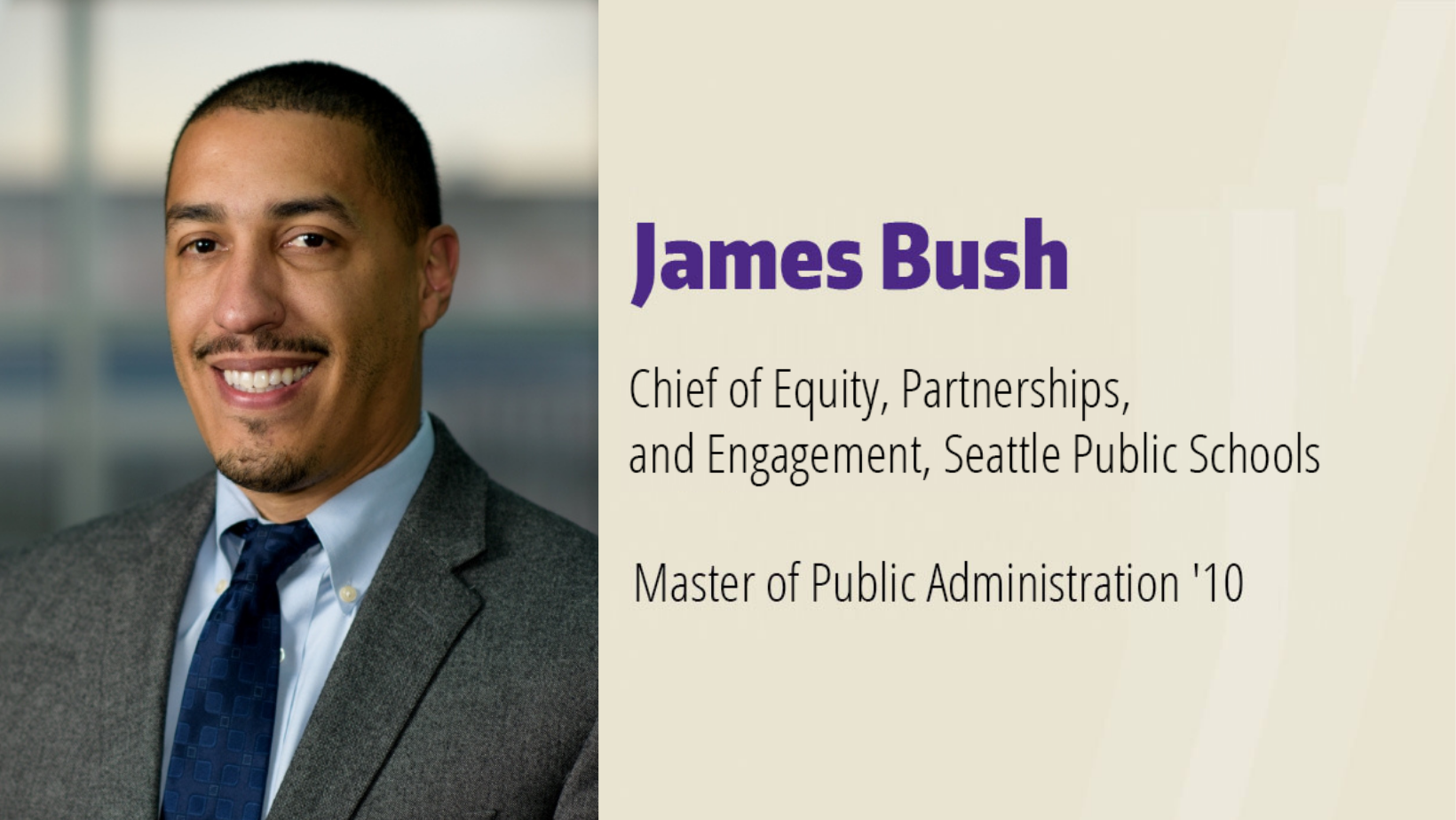
Increasing Teacher Diversity: James Bush, MPA ’10

James Bush alumni profile

As the district’s Chief of Equity, Partnerships, and Engagement of the Seattle Public Schools, what is one way you plan to ensure racial equity throughout the Seattle School District?

As the Chief of Equity, Partnerships, and Engagement my plan is to build from the existing work of Chief Dr. Keisha Scarlett and ensure that racial equity is embedded in all district processes, policies, and plans. At its core, our plan for educational equity will center on serving students furthest from educational justice. This includes supporting other district colleagues in using our racial equity analysis tool in the development and design of district programs such as our upcoming districtwide Black Studies classes.

What is something you have been most proud of, professionally?

Professionally, I am most proud of my appointment as Seattle Public Schools’ Chief of Equity, Partnership, and Engagement.

This appointment is the culmination and recognition of years of collaborative work with local government institutions and community partners. My original Seattle Public Schools role, as the Director of School & Community Partnerships, required that I use all my skills, experience and training to lift up a variety of complex and innovative projects. As the leader of an amazing team, we were able to push the system to better understand collective impact and the need to work directly with community partners, students, and families to ensure that students had access to programs and services to help them reach their goals.

What are the most critical problems faced by people who work in your field? How do you think these problems should be handled?

One of the most pressing issues in the field of education is the lack of diversity in our educational system. SPS has taken a variety of steps to increase the diversity of our teacher ranks with the creation of SPS’s Academy for Rising Educators. Additionally, our educational systems also need to develop new pipelines to recruit and retain public policy professionals who specialize in policy design, implementation, and evaluation.

What is your favorite memory from your time at the Evans School?

I have many fond memories of my time at Evans. Working with an amazing team on my degree project, serving as a mayor’s fellow, and building community with the Evan’s People of Color. As a lifelong Seattleite and Rainier Beach / Beacon Hill resident, having the opportunity to work on a degree project that directly serves my community was an experience that was aligned to my personal and professional goals.

Who has been your strongest influence in life? Why?

I am blessed to have grown up and be supported by a variety of community leaders. I have had a village that has guided me, lifted me, held me accountable, and pushed me to ensure that I achieve my personal and professional goals.

We’d love to learn more about you and your tremendous contributions to the public good, so we can share your story as we connect, learn and reflect. Share your story!

New Book and Lessons learned: Norman Rice, MPA ’74

“Gaining Public Trust: A Profile of Civic Engagement”

The Honorable Norman Rice, MPA ’74. was elected as the first African American mayor of Seattle in 1989 and served two terms earning him national acclaim. When Rice stepped into his role as mayor, the city was experiencing deep divisiveness and polarization. African Americans represented only 10% of the city’s population and the city was engrossed by the controversial issue of using school busing to achieve racial integration.

In his new book, Gaining Public Trust: A Profile of Civic Engagement, Rice shares his journey to leadership and public service, and what he’s learned about the critical importance of civic engagement through his notable successes in bringing Seattle’s divided city together.

As our communities navigate the COVID-19 response and recovery, and as our country continues to grapple with its long history of systemic racism and devastating inequities, the lessons Rice learned 30 years ago – during the city’s most contentious times – are still applicable today.

In his recently released book, he shares:

We need both civic and civil engagement. The skeptics among us might look around and say there is no chance for civic engagement that is civil these days because our politics have become so divisive. But I don’t believe that. I believe democracy survives only when we have meaningful engagement of the populace. It takes more than just voting or reading polling data. It is imperative to examine what it means to participate civilly in the political process and go back to the days when we actually solved problems by listening to each other and arriving at solutions together. It isn’t even so much a matter of bringing bipartisanship into the mix; it has more to do with people recognizing we all approach problems differently. Reaching agreement on the problem is just one step. We have to then find a way forward, despite our differences, to get to the solutions that work best.

With honest, thoughtful, and inclusive leadership, Rice successfully created ways to bring together government, businesses, community groups, and individuals to partner and improve the public school system, revitalize Seattle’s downtown, and strengthen neighborhoods.

Read more about the Honorable Norman Rice, his reflections on leadership, and his new book in the UW Magazine article, “Civic and Civil Engagement.